
Net-Zero Strategy

Thunder Bay Net-Zero Strategy

The Net-Zero Strategy (NZS) is a community-wide energy use and greenhouse gas emissions inventory and action plan for Thunder Bay to reach net-zero emissions by 2050. It provides a vision for the community and highlights the scale of changes needed to respond to the climate emergency declared by City Council in January 2020.

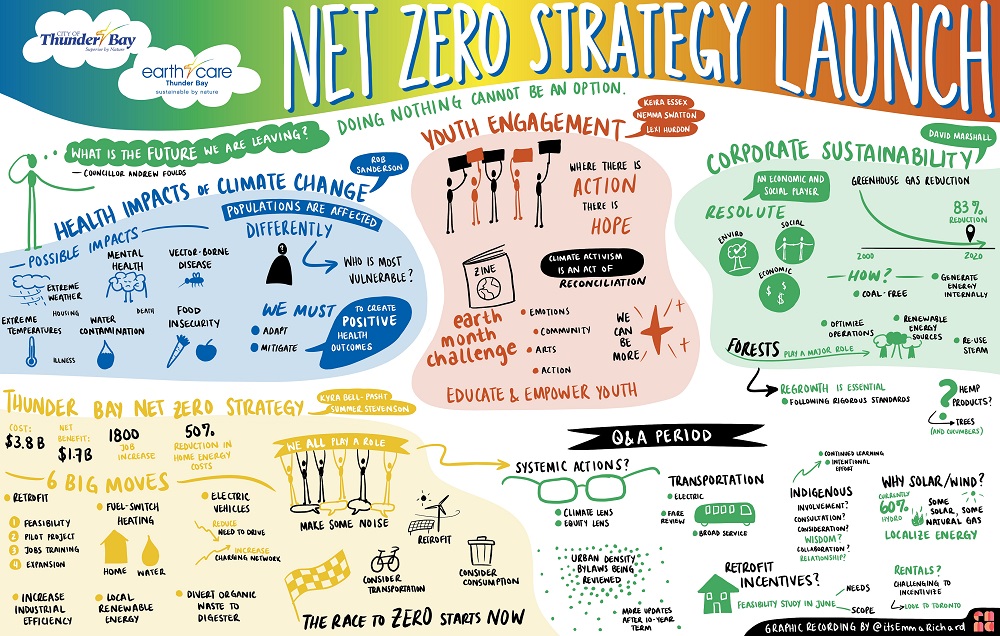
The following visual summary of the Virtual Launch Event was done by Emma Richard, Graphic Artist.

mind map with illustrations and words outlining the net-zero strategy

When we heat our homes or drive our cars using fossil fuels, carbon dioxide and other greenhouse gases (GHGs) are released into the atmosphere. These are often referred to as emissions. Some of these emissions are absorbed by carbon sinks. Carbon sinks are natural systems, like forests or wetlands, that suck up and store carbon from the atmosphere. Net-zero refers to the balance between the amount of emissions produced and the amount that can be absorbed by these carbon sinks.

To achieve net-zero, we need to reduce the amount of emissions that are released into the atmosphere so that it is equal to what can be absorbed by our natural environment. Think of it as a two-sided weighing scale!

About the project

In 2019, the City of Thunder Bay received funding from the Federation of Canadian Municipalities and the Province of Ontario’s Municipal Energy Plan Program for the creation of a Community Energy and Emissions Plan (now the Net-Zero Strategy). On January 13, 2020, Thunder Bay City Council declared a climate emergency emphasising the urgency of addressing climate change. The climate emergency reinforces the need for a plan to provide the community with the information and tools to make decisions that contribute to the decarbonisation of Thunder Bay.


Frequently asked questions

Nearly 8 out of 10 respondents surveyed said that they believe climate change should be a high priority for the community.

A community survey conducted by researchers at Lakehead University, the University of Northern British Columbia, and Simon Fraser University in 2020, found that 9 out of 10 Thunder Bay residents believe that our climate is changing and over 60% of community members in Thunder Bay believe that climate change should be a high or very high priority issue for the municipality.

In 2016, on average, each Thunder Bay resident emitted 11.3 tonnes of CO2e. This is lower than the national average (19.6 tCO2e/per capita, 2016) and on par with the provincial average (11.5 tCO2e/per capita, 2018). Source: Government of Canada Greenhouse Gas Emissions 1990-2018 webpage

Here’s how we compare to other cities in Northern Ontario:

Emissions per Capita: Thunder Bay and other Northern Ontario Cities
Municipality Year Emissions per Capita (tCO2e)
City of Thunder Bay 2016 11.3
City of Sault Ste. Marie 2017 20.5
City of Greater Sudbury 2016 7.4
City of Timmins 2017 6.7

In 2014, Thunder Bay City Council adopted the EarthCare Sustainability Plan (2014-2020) which included the following emissions target: By 2020, the community of Thunder Bay will reduce greenhouse gas emissions by 20% below 2009 levels. By the end of 2019, Corporate GHG emissions were 26% below 2009 baseline levels, exceeding the goal laid out in the Plan.

In 2019, Thunder Bay City Council approved the Corporate Energy Management Plan 2019-2024. The plan outlines strategic initiatives to manage Corporate energy consumption and create a culture of conservation to ensure the wise use of energy within all City of Thunder Bay operations.  

While the City has made significant progress with Corporate energy and emissions reductions, the community actually saw an increase in emissions from 2009-2016.

The creation of the NZS is funded by grants from the Federation of Canadian Municipalities and the Province of Ontario’s Municipal Energy Plan Program.

Financing the net-zero pathway will be a complex task that requires support from multiple different partners. Decisions still need to be made to determine the roles the City and key stakeholders will play and who pays for specific climate initiatives. The actions and strategies proposed in the draft 5-year implementation plan will be subject to the City’s democratic decision-making process. Due to the nature of this type of planning exercise, these decisions will be made on an ongoing basis throughout the implementation of the Strategy.

Contact Us

City Hall:
500 Donald Street E, P.O. Box 800
Thunder Bay, ON P7C 5K4
City Hall: (807) 625-2230
TTY: (807) 622-2225

Sign up to our News & Notices

Stay up to date on the City's activities, events, programs and operations by subscribing to our News & Notices