| Playground Patter |
| Playground Patter was a newsletter produced by the Ontario Ministry of Education to help playground supervisors run their programs. The issues shown here, all from the summer of 1953, include tips on planning, carrying out, and evaluating the Playgrounds programme. It's likely that many of these suggestions were incorporated into the Fort William and Port Arthur supervised playgrounds.
These are multi-panel brochures and are transcribed in the order in which they are meant to be read, rather than how they appear when reading left-to-right.
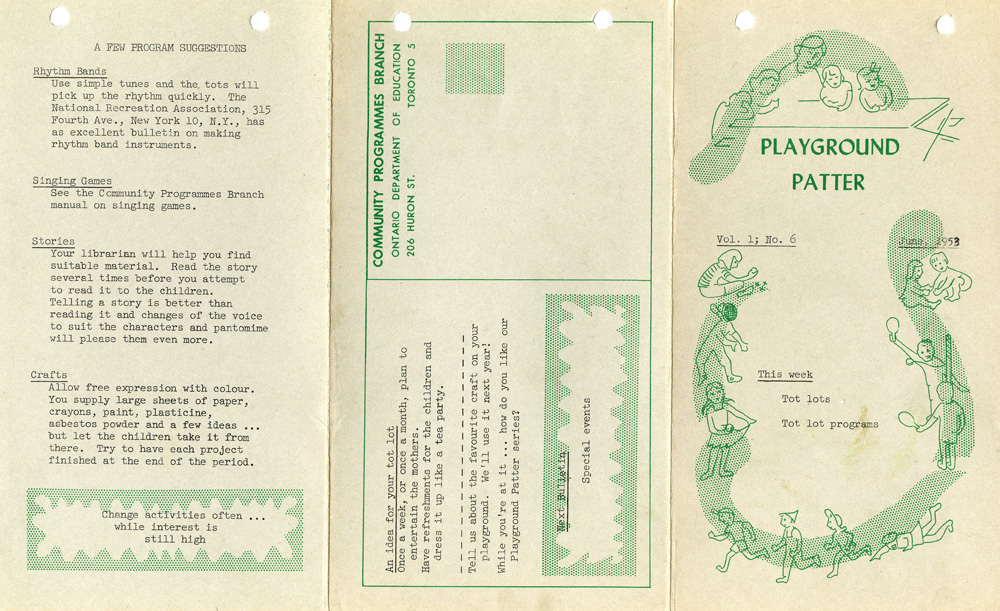
[Panel 1:]
Playground Patter
Volume 1; Number 6
June, 1953
This week:
Tot lots
Tot lot programs
[Panel 2:]
A Few Program Suggestions
Rhythm Bands: Use simple tunes and the tots will pick up the rhythm quickly. The National Recreation Association, 315 Fourth Ave, New York 10, NY, has an excellent bulletin on making rhythm band instruments.
Singing Games: See the Community Programmes Branch manual on singing games.
Stories: Your librarian will help you find suitable material. Read the story several times before you attempt to read it to the children. Telling a story is better than reading it and changes of the voice to suit the characters and pantomime will please them even more.
Crafts: Allow free expression with colour. You supply large sheets of paper, crayons, paint, plasticine, asbestos powder and a few ideas ... but let the children take it from there. Try to have each project finished at the end of the period.
Change activities often ... while interest is still high.
[Panel 3:]
An idea for our tot lot: Once a week, or once a month, plan to entertain the mothers. Have refreshments for the children and dress it up like a tea party.
Tell us about the favourite craft on your playground. We'll use it next year!
While you're at it ... how do you like our Playground Patter series?
Next Bulletin: Special events.
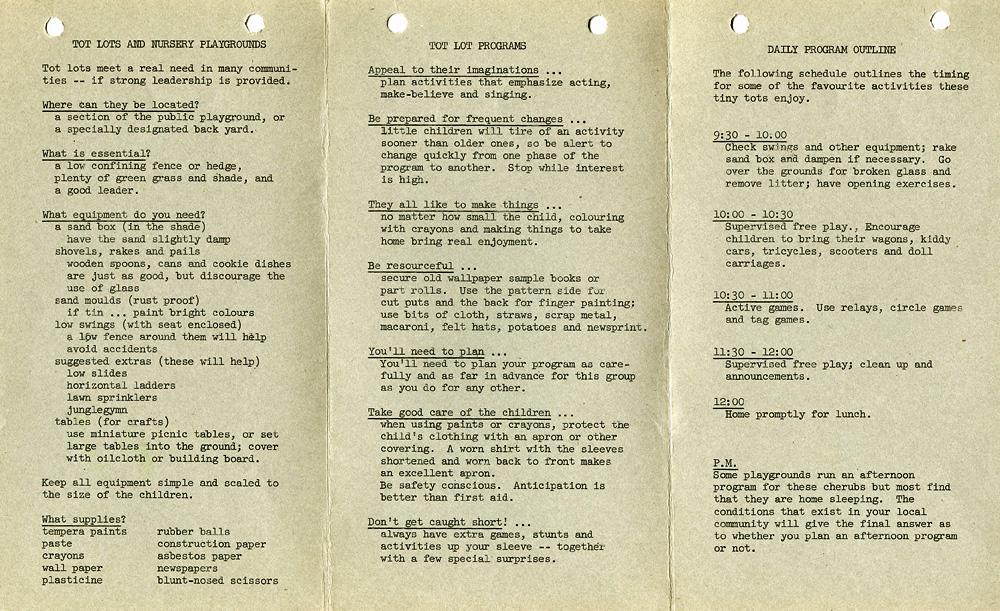
Tot Lots and Nursery Playgrounds
Tot lots meet a real need in many communities -- if strong leadership is provided.
Where can they be located?
- a section of the public playground, or a specially designated back yard.
What is essential?
- a low confining fence or hedge, plenty of green grass and shade, and a good leader.
What equipment do you need?
- a sand box (in the shade), have the sand slightly damp
- shovels, rakes and pails -- wooden spoons, cans and cookie dishes are just as good, but discourage the use of glass
- sand moulds (rust proof) -- if tin ... paint bright colours
- low swings (with seat enclosed) -- a low fence around them will help avoid accidents
- suggested extras (these will help) -- low slides, horizontal ladders, lawn sprinklers, jungle gym
- tables (for crafts) -- use miniature picnic tables, or set large tables into the ground; cover with oilcloth or building board
Keep all equipment simple and scaled to the size of the children.
What supplies?
- tempera paints
- paste
- crayons
- wall paper
- plasticine
- rubber balls
- construction paper
- asbestos paper
- newspapers
- blunt-nosed scissors
[Panel 2:]
Tot Lot Programs
Appeal to their imaginations ... plan activities that emphasize acting, make-believe and singing.
Be prepared for frequent changes .. little children will tire of an activity sooner than older ones, so be alert to change quickly from one phase of the program to another. Stop while interest is high.
They all like to make things ... no matter how small the child, colouring with crayons and making things to take home bring real enjoyment.
Be resourceful ... secure old wallpaper sample books or part rolls. Use the pattern side for cut puts and the back for finger painting; use bits of cloth, straws, scrap metal, macaroni, felt hats, potatoes and newsprint.
You'll need to plan ... You'll need to plan your program as carefully and as far in advance for this group as you do for any other.
Take good care of the children ... when using paints or crayons, protect the child's clothing with an apron or other covering. A worn shirt with the sleeves shortened and worn back to front makes an excellent apron. Be safety conscious. Anticipation is better than first aid.
Don't get caught short! ... always have extra games, stunts and activities up your sleeve -- together with a few special surprises.
[Panel 3:]
Daily Program Outline
The following schedule outlines the timing for some of the favourite activities these tiny tots enjoy.
- 9:30 - 10:00 Check swings and other equipment; rake sand box and dampen if necessary. Go over the grounds for broken glass and remove litter; have opening exercises.
- 10:00 - 10:30 Supervised free play. Encourage children to bring their wagons, kiddy cars, tricycles, scooters and doll carriages.
- 10:30 - 11:00 Active games. Use relays, circle games and tag games.
- 11:30 - 12:00 Supervised free play; clean up and announcements.
- 12:00 Home promptly for lunch.
P.M.
Some playgrounds run an afternoon program for these cherubs but most find that they are home sleeping. The conditions that exist in your local community will give the final answer as to whether you plan an afternoon program or not.
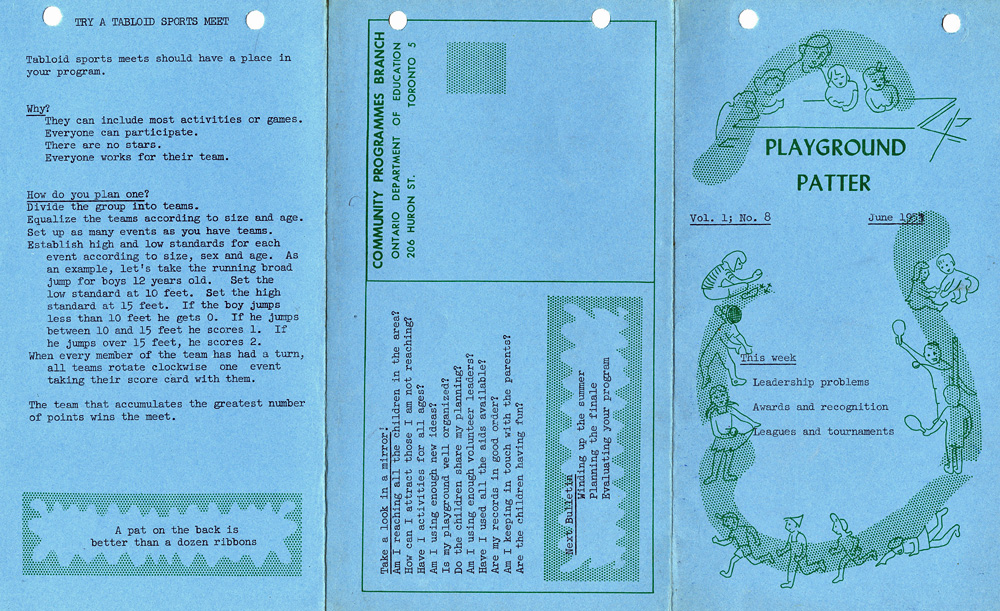
[Panel 1:]
Playground Patter
Volume 1; Number 8
June 1953
This week:
Leadership problems
Awards and recognition
Leagues and tournaments
[Panel 2:]
Try a Tabloid Sports Meet
Tabloid sports meets should have a place in your program.
Why?
- They can include most activities or games
- Everyone can participate.
- There are no stars.
- Everyone works for their team.
How do you plan one?
- Divide the group into teams.
- Equalize the teams according to size and age.
- Set up as many events as you have teams.
- Establish high and low standards for each event according to size, sex and age. As an example, let's take the running broad jump for boys 12 years old. Set the low standard at 10 feet. Set the high standard at 15 feet. If the boy jumps less than 10 feet he gets 0. If he jumps between 10 and 15 feet he scores 1. If he jumps over 15 feet, he scores 2.
- When every member of the team has had a turn, all teams rotate clockwise one event taking their score card with them.
The team that accumulates the greatest number of points wins the meet.
A pat on the back is better than a dozen ribbons.
[Panel 3:]
Take a look in a mirror!
- Am I reaching all the children in the area?
- How can I attract those I am not reaching?
- Have I activities for all ages?
- Am I using enough new ideas?
- Is my playground well organized?
- Do the children share my planning?
- Am I using enough volunteer leaders?
- Have I used all the aids available?
- Are my records in good order?
- Am I keeping in touch with the parents?
- Are the children having fun?
Next bulletin:
- Winding up the summer
- Planning the finale
- Evaluating your program
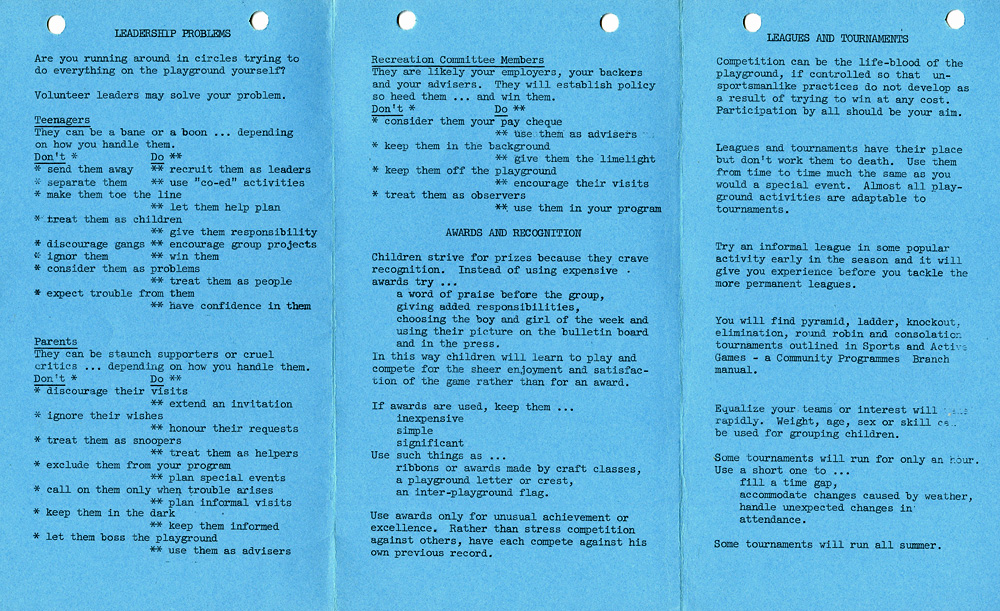
[Panel 1:]
Leadership Problems
Are you running around in circles trying to do everything on the playground yourself?
Volunteer leaders may solve your problem.
Teenagers: They can be a bane or a boon .. depending on how you handle them.
Don't:
- send them away
- separate them
- make them toe the line
- treat them as children
- discourage gangs
- ignore them
- consider them as problems
- expect trouble from them
Do:
- recruit them as leaders
- use "co-ed" activities
- let them help plan
- give them responsibility
- encourage group projects
- win them
- treat them as people
- have confidence in them
Parents: They can be staunch supporters or cruel critics ... depending on how you handle them.
Don't:
- discourage their visits
- ignore their wishes
- treat them as snoopers
- exclude them from your program
- call on them only when trouble arises
- keep them in the dark
- let them boss the playground
Do:
- extend an invitation
- honour their requests
- treat them as helpers
- plan special events
- plan informal visits
- keep them informed
- use them as advisors
[Panel 2:]
Recreation Committee Members: They are likely your employers, your backers, and your advisors. They will establish policy so heed them ... and win them.
Don't:
- consider them your pay cheque
- keep them in the background
- keep them off the playground
- treat them as observers
Do:
- use them as advisors
- give them the limelight
- encourage their visits
- use them in your program
Awards and Recognition
Children strive for prizes because they crave recognition. Instead of using expensive awards try...
- a word of praise before the group
- giving added responsibilities
- choosing the boy and girl of the week and using their picture on the bulletin board and in the press
In this way children will learn to play and compete for the sheer enjoyment and satisfaction of the game rather than for an award.
If awards are used, keep them...
- inexpensive
- simple
- significant
Use such things as ...
- ribbons or awards made by craft classes
- a playground letter or crest
- an inter-playground flag
Use awards only for unusual achievement or excellence. Rather than stress competition against others, have each compete against his own previous record.
[Panel 3:]
Leagues and Tournaments
Competition can be the life-blood of the playground, if controlled so that un-sportsmanlike practices do not develop as a result of trying to win at any cost. Participation by all should be your aim.
Leagues and tournaments have their place but don't work them to death. Use them from time to time much the same as you would a special event. Almost all playground activities are adaptable to tournaments.
Try an informal league in some popular activity early in the season and it will give you experience before you tackle the more permanent leagues.
You will find pyramid, ladder, knockout, elimination, round robin and consolation tournaments outlined in sports and Active Games - a Community Programmes Branch manual.
Equalize your teams or interest will wane rapidly. Weight, age, sex or skill can be used for grouping children.
Some tournaments will run for only an hour. Use a short time to ...
- fill a time gap
- accommodate changes caused by weather
- handle unexpected changes in attendance
Some tournaments will run all summer.
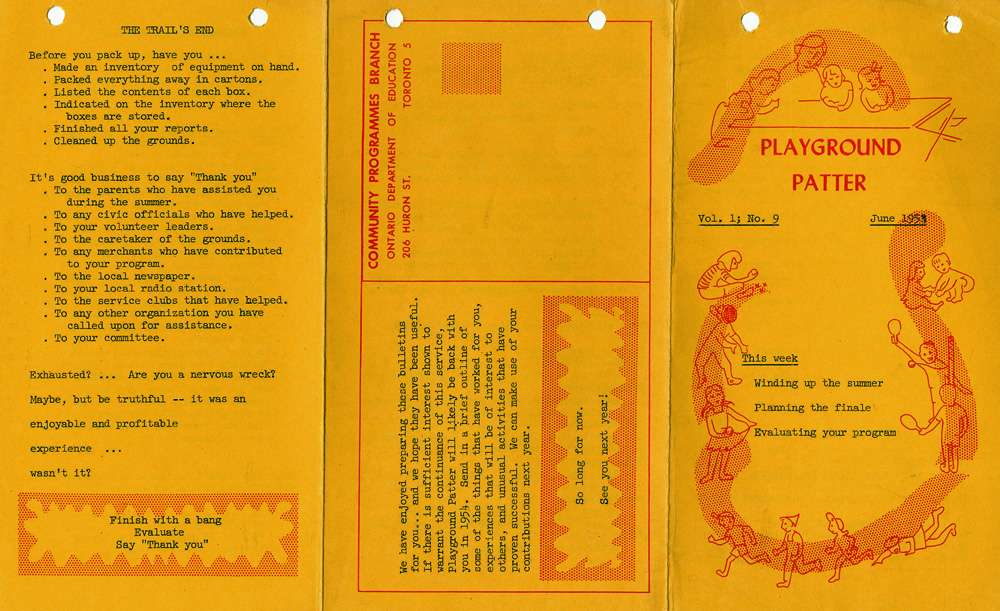
[Panel 1:]
Playground Patter
Volume 1; Number 9
June 1953
This week:
- Winding up the summer
- Planning the finale
- Evaluating your program
[Panel 2:]
The Trail's End
Before you pack up, have you ...
- Made an inventory of equipment on hand
- Packed everything away in cartons
- Listed the contents of each box
- Indicated on the inventory where the boxes are stored
- Finished all your reports
- Cleaned up the grounds
It's good business to say "Thank you" - To the parents who have assisted you during the summer
- To any civic officials who have helped
- To your volunteer leaders
- To the caretaker of the grounds
- To any merchants who have contributed to your program
- To the local newspaper
- To your local radio station
- To the service clubs that have helped
- To any other organization you have called upon for assistance
- To your committee
Exhausted? ... Are you a nervous wreck?
Maybe, but be truthful -- it was an enjoyable and profitable experience ... wasn't it?
Finish with a bang
Evaluate
Say "Thank You"
[Panel 3:]
We have enjoyed preparing these bulletins for you ... and we hope they have been useful. If there is sufficient interest shown to warrant the continuance of this service, Playground Patter will likely be back with you in 1954. Send in a brief outline of some of the things that have worked for you, experiences that will be of interest to others, and unusual activities that have proven successful. We can make use of your contributions next year.
So long for now.
See you next year!
[Panel 1:]
Winding Up the Summer
Will the season finish with a fizzle ... or are you going to end it with a bang?
Why not plan a whizz-bang closing program for the last day; or, better still, build up to a climax with a week chock full of special events?
There are definite advantages in showing the people what the children on your playground have been doing all summer.
- It gives the children a sense of achievement
- It's an opportunity for everyone to gain recognition
- It brings the neighbourhood together
- You can publically thank all who have helped
- It holds the children's interest to the very last
- The taxpayer sees how some of his money has been spent
- It makes it easier to get money for the next year
- It's good publicity and aids public relations
Planning the finale:
- Begin your plans well in advance
- Work all the details out on paper
- Arrange lots of publicity
- Line up plenty of volunteer helpers
- Be sure they know their job
- Have mimeographed programs with exact times and places
- Pick out your runners and whips
- Draft a master sheet for events and winners
- Check ... and double check all equipment
- Start on time ... and keep things moving
[Panel 2:]
Planning the Program
When?
- Try not to conflict with some other big event in the community.
Where?
- Someplace that is shady and where there are bleachers and suitable play areas.
What?
- Plan a variety of events that will include everyone and show most of the activities used during the summer.
How?
- Do not arrange a program of athletic events that glorify several stars while the rest sit and watch.
- Give points for entering.
- Arrange events so that everyone in an age group has a chance to enter.
- Have the competitors working for the good of the playground ... not the individual.
This will test your organizational ability!
Program Suggestions
- Passive displays: arts and crafts, sand box, playground zoo.
- Active displays: game demonstrations, dramatics, sing-songs, dancing, kite flying, rhythm band.
- Individual competitions: bicycle rodeo, tether ball, paddle tennis, quoits, bean-bag board.
- Team competitions: volleyball, croquet, tin-can cricket, tug-of-war.
- Novelty events: peanut scramble, widest grin contest, largest bubble-gum bubble, most freckles.
- Extra events: swimming meet, track meet.
[Panel 3:]
Evaluating Your Program
Are you all finished? Not quite!
While the picture is still fresh in your mind sit down and evaluate your program.
Here are some questions that may help.
- What would you do differently if you could repeat the summer?
- What activities were most popular?
- What activities were least popular?
- Have you suggestions for improving unpopular activities?
- What special events would you recommend for next year?
- Were your leaders satisfactory?
- How could your volunteer leaders be better trained?
- Did your safety patrols serve their intended purpose?
- Have you any recommendations to increase their effectiveness?
- Did the apparatus and equipment meet your needs?
- Did your inter-playground leagues detract from your over-all program?
- Can this interference be avoided?
- Have you any pictures that would be useful for next year?
- Can you add specific recommendations for your committee to pass along to your successor?
Make your report as complete as possible and your evaluation accurate.
It will help:
- future planning
- you, if you return next year
- your successor
Title: Volume 1, No.6; Vol.1, No. 8; Vol.1, No.9 of Playground Patter
Date: June 1953
Creator: Ontario Department of Education
Series: 121, Fort William Parks & Recreation Files
Location: TBA 4802-12
|
| Playgrounds Special Events Manual |
|
The Fort William Board of Parks and Recreation
Playground Special Events Manual
Introduction to Special Events
Special Events afford the opportunity for children to participate in something "special" besides the weekly programme. It may be a sand castle contest in the sandbox for pre-schoolers or a "tug-of-war" contest in the evening for young boys 10 to 14 years of age.
The important feature of special events is that the children will aid in suggestions for such days and will help organize the day. Volunteers can help greatly in this kind of activity keeping children in the group, judging and giving out prizes.
A well planned special event is always a success, but sometimes a spontaneous special event is just as successful.
Some Ideas in Planning a Special Event
- Decide with children, date, time, place, kind of event.
- Advertise on bulletin board, local stores, town criers, community news.
- Radio announcements, write-ups in paper, be handled through Head Supervisor.
- Decide with children what kind of prizes are necessary.
- Decide on judges 2 or 3 days prior to special event day.
- In case of cancellation due to rain or other causes have alternate date set and announced.
- If a promise has been made to the children, the directors should make very sure to carry through plans.
Opening Day Celebration
We are suggesting a full scale parade, picnic and races for your opening day. This is a publicity stunt to advertise your playground and to increase the interest in your programme.
Planning:
Organize committees.
- Use every possible method of publicity.
- Get your adults committees working.
- Children love to dress up, show off, decorate their tricycles, wagons, doll carriages. Use all these for your parade.
- Get placards, banners, flags.
- Use clowns, decorated pets, floats, tin can or wash tub band, decorated bicycles, noise makers. Make it a community event.
- Decide on parade route through residential district.
- Small children cannot walk far, so don't make the route too long.
- Advise office re: parade route and starting time. Keep the children off the road.
Programme:
- Judging: Costumes, decorations, etc.
- Parade: Parade marshall, followed by banners and placards, small children walking, small children's vehicles, clowns, decorated bicycles, older children walking, floats.
- Picnic: Basket picnic on playground. Children's games, stories. Older children's races, novelty races, games, sports.
- Evening: Teen and adults sports such as horseshoes, volleyball.

For the small fry:
- Building up the Event: Almost all children have heard of Huckleberry Finn and Tom Sawyer. Tell the children these favourite stories - describe Huckleberry. Have the children draw him. Make posters publicizing the event.
- Costumes: Yes. Each child becomes Huckleberry Finn for a day. Be certain each Huck is equipped with a fishing pole.
- Fish: All Varieties. A wading pool stocked with wooden fish that have been constructed by the older children. Place a bent nail in the back of each fish so that the children will be able to hook them.
Prizes might be awarded for:
- Best Huck Finn
- Best equipped fisherman
- Most fish caught
- Best tomboy
- Youngest boy or girl who didn't catch a fish
- First fish caught
Slices of watermelon would make an ideal treat for the occasion.
Other Events:
- How about adding a freckle and pigtail contest to the special day's attraction
- Insect collections might be displayed and ribbons awarded for the
- Largest collection
- Most unusual looking insect
- Prettiest insect
Doll Show
Planning and Preparation:
- This event can be held in connection with other events and give the little girls a part in the programme. The idea can be used a number of times during the season.
- Announce the event in the usual way, and plan a special feature for display, judging and presentation of prizes. Every little girl has a doll and loves to show it off and have it admired.
Programme:
Depending on the number and types of entries classification can be decided, such as best dressed, smallest, largest, most comical, etc. Have a parade of dolls past the judges and then display them for final selection and presentation of prize ribbons.
To add to the programme, have doll carriages and other vehicles in which dolls can ride decorated with crepe paper, flowers, etc. Another idea would be to have little girls in costume as mothers, nurses, teachers. Make a big feature of this event, take pictures of the winner. Give the programme as much prominence as your other special events. It may be the biggest event in some little girl's life.
- Doll Show can be combined with Pet Show.
- Penny Carnival
- A Penny Carnival will prove lots of fun to the children -- not only the actual carnival itself, but the planning and setting up of the various events will appeal to the children's imagination. Listed below are a few ideas that might prove successful.
- Funny House: Cover the jungle gym with newspaper or wrapping paper, and dream up surprises for whoever goes through it. There will be an entrance and an exit close to the ground.
- Refreshments: Have a few mothers provide lemonade, home made candy
- Ring Toss: Can have scaler rings and stakes in the ground.
- Nine Pins: Using a ball and plastic bottles.
- Throws: Throwing softballs for distance.
- Fish Pond
- Weight Guessing Booth.
What to Make:
- Make 25 to 30 fish out of wood. This can be done during craft session. Make a large hole (size of twenty-five cent piece) for the mouth. Paint fish any colour and shellac.
- Fishing poles any length of sticks (length of old broom handles will do).
- Use.
What to Do:
- Arrange the date and age group who can participate.
- Advertise by circulars, radio and press, and yourself.
- Arrange for prizes.
- Write up rules and regulations and explain such to everyone.
- The one who catches the most fish in 15 minutes wins something special.
Variety
Paint fish different colours
- Blue 5 points
- Red 4 points
- Yellow 3 points
- White 2 points etc.
Someone who can add keeps score - "Recreation is not alone for the children, but for the aged also, because the aged know enough to learn."
- Pet Show
- Planning: Appoint committees, advertise it, talk about it, plan classifications, entry forms, judges. Decide on a date and time. Arouse interest. Talk it up. All animals should be on a leash.
- Publicity: Posters, sandwich boards, announcements. Tell dog stories.
- Entry Forms: Should include type of pet, breed, owner's name, address and telephone number.
- Award Prizes: Appearance, decorations, largest, smallest, most tricks, behaviour, etc.
- Programme: Have judging committee, have a parade of pets. Have them perform tricks -- present prizes.
Hat Show:
Suggest that Everyone on the Playground Wear a Fancy Hat
- Planning: Publicize the event in advance - use colourful signs. Use as a craft project during the week. Have children make their own hat on the playground or at home. Use crepe paper, flowers, leaves, bark, feathers, newspapers, crafts of felt or printed cotton and a dozen other waste material items. Cover old straw hat or felt hats with fancy trimmings. Select judges in advance and post their names on the bulletin board.
- Programme: Have all children parade before the judges, and stop where all can see, in a line or circle. Have various classifications - best looking hat, most comical hat, most original, youngest entry, most colourful etc. Present prize ribbons and take snapshot of the group.
Art Fair:
- Supply the children with a minimum supply of materials.
- Include a good deal of art work in your craft programme preceding the special event.
Sections:
- Crayon - Free hand drawings design
- Water Paints
- Chalk
- Spatter Paints
- Finger Paintings
- Free hand cutting and painting
- Potato Prints
- Soap Carving
Birthday Party
Planning and Preparation:
- Everyone can't have a birthday during the summer months, but they can have a party to celebrate the birthdays of the other children. Plan a monthly birthday party for those children having birthdays during the month and invite all the children to participate.
- Any party requires careful planning. Appoint committees for publicity, decorations, invitations, refreshments. A meeting of all the committees can decide the details of the programme, date, time, etc.
Publicity & Invitations:
- Vary the method each time to add interest in the event. Personal invitations, posters, letters, or verbal invitations could be used. Invite the parents too.
- Decorations and Refreshments:
- Flowers, coloured paper streamers, cake with candles or individual iced cupcakes are a few suggestions. Others would be dixie cups, revels, candies, pink lemonade. Five or ten cents might be collected from those attending to cover minimum costs.
Programme:
- Start the party when first guests arrive. Use party games, identification games and stunts or sing-song. Have a diversified programme of quiet games, musical or singing games, amateur entertainment.
- Finish with refreshments -- close with "Happy Birthday".
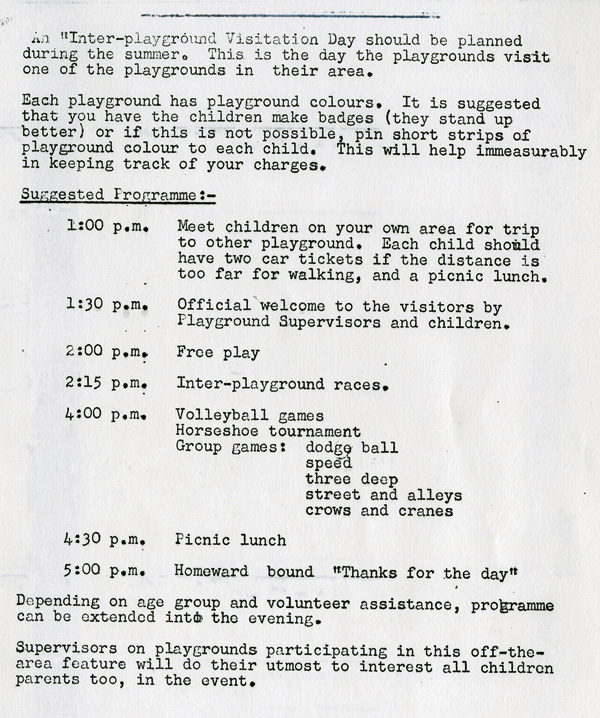
An Inter-playground Visitation Day should be planned during the summer. This is the day the playgrounds visit one of the playgrounds in their area.
Each playground has playground colours. It is suggested that you have the children make badges (they stand up better) or if this is not possible, pin short strips of playground colour to each child. This will help immeasurably in keeping track of your charges.
Suggested Programme:
- 1:00 pm Meet children on your own area for trip to other playground. Each child should have two car tickets if the distance is too far for walking, and a picnic lunch.
- 1:30 pm Official welcome to the visitors by Playground Supervisors and children.
- 2:00 pm Free Play
- 2:15 pm Inter-playground races
- 4:00 pm Volleyball games; Horseshoe tournament; Group games: dodge ball, speed, three deep, street and alleys, crows and cranes
- 4:30 pm Picnic lunch
- 5:00 pm Homeward bound "Thanks for the day"
Depending on age group and volunteer assistance, programme can be extended into the evening.
Supervisors on playgrounds participating in this off-the-area features will do their utmost to interest all children, parents too, in the event.
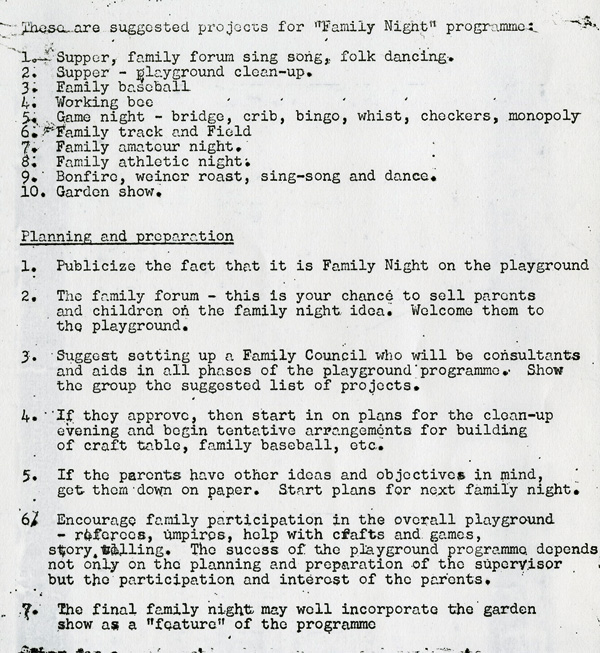
These are suggested projects for "Family Night" programme:
- Supper, family forum sing song, folk dancing.
- Supper - playground clean-up.
- Family baseball
- Working bee
- Game night - bridge, crib, bingo, whist, checkers, monopoly
- Family track and field
- Family amateur night.
- Family athletic night.
- Bonfire, wiener roast, sing-song and dance.
- Garden show.
Planning and preparation:
- Publicize the fact that it is Family Night on the playground
- The family forum -- this is your chance to sell parents and children on the family night idea. Welcome them to the playground.
- Suggest setting up a Family Council who will be consultants and aids in all phases of the playground programme. Show the group the suggested list of projects.
- If they approve, then start in on plans for the clean-up evening and begin tentative arrangements for building of craft table, family baseball, etc.
- If the parents have other ideas and objectives in mind, get them down on paper. Start plans for next family night.
- Encourage family participation in the overall playground - referees, umpires, help with crafts and games, story telling. The success of the playground programme depends not only on the planning and preparation of the supervisor but the participation and interest of the parents.
- The final family night may well incorporate the garden show as a "feature" of the programme.
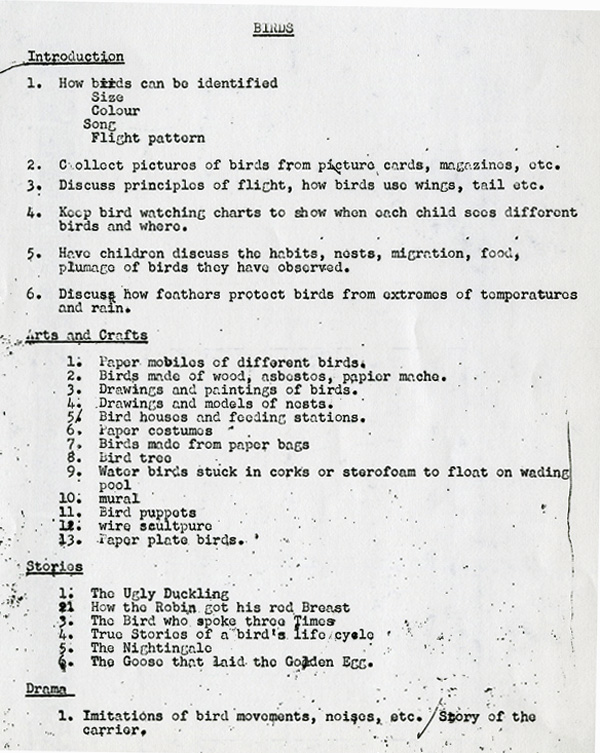
Birds
Introduction:
- How birds can be identified: Size, colour, song, flight pattern
- Collect pictures of birds from picture cards, magazines, etc.
- Discuss principles of flight, how birds use wings, tail, etc.
- Keep bird watching charts to show when each child sees different birds and where.
- Have children discuss the habits, nests, migration, food, plumage of birds they have observed.
- Discuss how feathers protect birds from extremes of temperatures and rain.
Arts and Crafts:
- Paper mobiles of different birds.
- Birds made of wood, asbestos, papier mache.
- Drawings and paintings of birds.
- Drawings and models of nests.
- Bird houses and feeding stations.
- Paper costumes.
- Birds made from paper bags.
- Bird tree
- Water birds stuck in corks or styrofoam to float on wading pool
- Mural
- Bird puppets
- Wire sculpture
- Paper plate birds
Stories:
- The Ugly Duckling
- How the Robin got his Red Breast
- The Bird who Spoke Three Times
- True stories of a bird's life cycle
- The Nightingale
- The Goose that Laid the Golden Egg
Drama:
- Imitations of bird movements, noises, etc. Story of the carrier.
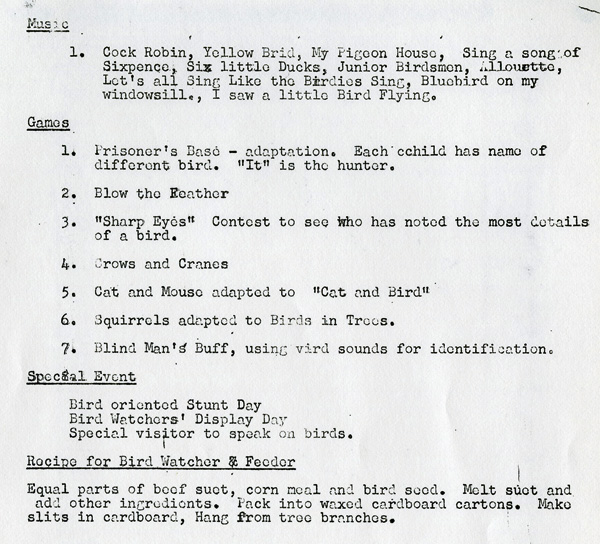
Music:
Cock Robin, Yellow Bird, My Pigeon House, Sing a song of sixpence, Six Little Ducks, Junior Birdsmen, Alouette, Let's All Sing Like the Birdies Sing, Bluebird on my Windowsill, I Saw a Little Bird Flying
Games:
- Prisoner's Base - adaptation. Each child has name of different bird. "It" is the hunter.
- Blow the Feather
- "Sharp Eyes" contest to see who has noted the most details of a bird.
- Crows and Cranes
- Cat and Mouse adapted to "Cat and Bird"
- Squirrels adapted to Birds in Trees
- Blind Man's Bluff, using bird sounds for identification.
Special Event:
- Bird oriented Stunt Day
- Bird Watchers' Display Day
- Special visitor to speak on birds
Recipe for Bird Watcher & Feeder
- Equal parts of beef suet, corn meal and bird seed. Melt suet and add other ingredients. Pack into waxed cardboard cartons. Make slits in cardboard. Hang from tree branches.
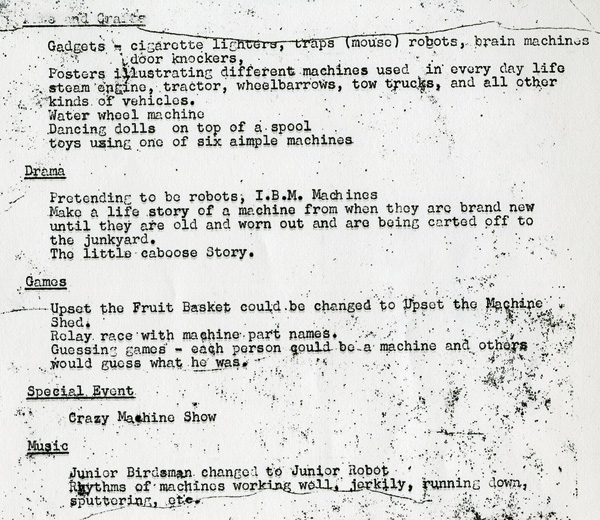
Arts and Crafts:
- Gadgets - cigarette lighters, traps (mouse), robots, brain machines, door knockers
- Posters illustrating different machines used in every day life: steam engine, tractor, wheelbarrows, tow trucks, and all other kinds of vehicles
- Water wheel machine
- Dancing dolls on top of a spool
- Toys using one of six simple machines
Drama:
- Pretending to be robots, IBM Machines
- Make a life story of a machine from when they are brand new until they are old and worn out and are being carted off to the junkyard
- The little caboose story
Games:
- Upset the Fruit Basket could be changed to Upset the Machine Shed
- Relay race with machine part names
- Guessing games - each person could be a machine and others would guess what he was
Special Event:
Music:
- Junior Birdsman changed to Junior Robot
- Rhythms of machines working well, jerkily, running down, sputtering, etc
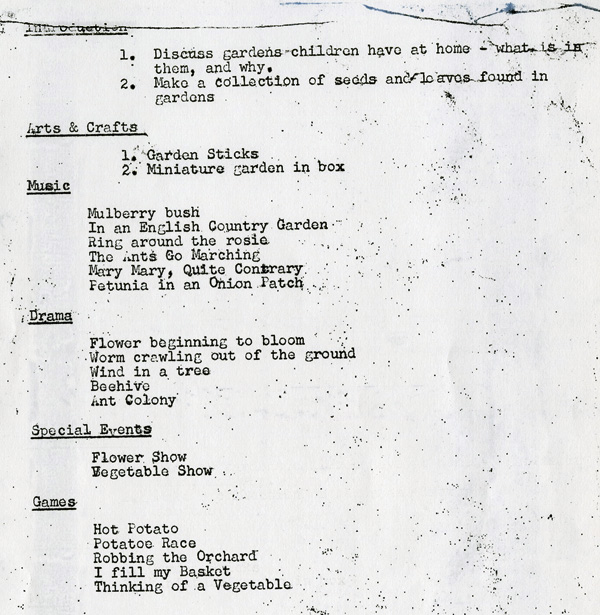
Introduction:
- Discuss gardens children have at home - what is in them, and why.
- Make a collection of seeds and leaves found in gardens.
Arts & Crafts:
- Garden Sticks
- Miniature garden in box
Music:
- Mulberry bush
- In an English Country Garden
- Ring around the Rosie
- The Ants Go Marching
- Mary Mary, Quite Contrary
- Petunia in an Onion Patch
Drama:
- Flower beginning to bloom
- Worm crawling out of the ground
- Wind in a tree
- Beehive
- Ant Colony
Special Events
- Flower Show
- Vegetable Show
Games;
- Hot Potato
- Potato Race
- Robbing the Orchard
- I Fill My Basket
- Thinking of a Vegetable
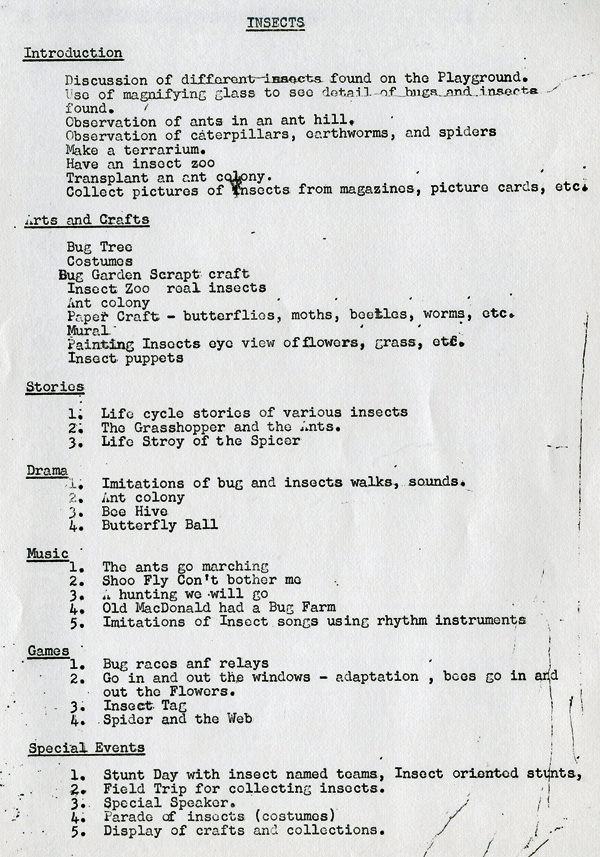
Insects
Introduction:
- Discussion of different insects found on the Playground.
- Use of magnifying glass to see detail of bugs and insects found.
- Observation of ants in an ant hill.
- Observation of caterpillars, earthworms, and spiders
- Make a terrarium
- Have an insect zoo
- Transplant an ant colony
- Collect pictures of insects from magazines, picture cards, etc.
Arts and Crafts:
- Bug tree
- Costumes
- Bug garden - Scrap craft
- Insect zoo - real insects
- Ant colony
- Paper Craft - butterflies, moths, beetles, worms, etc
- Mural
- Painting insects' eye view of flowers, grass, etc
- Insect puppets
Stories:
- Life cycle stories of various insects
- The Grasshopper and the Ants
- Life Story of the Spider
Drama:
- Imitations of bug and insect walks, sounds
- Ant colony
- Bee hive
- Butterfly Ball
Music:
- The ants go marching
- Shoo Fly can't bother me
- A hunting we will go
- Old MacDonald had a Bug Farm
- Imitations of Insect songs using rhythm instruments
Games:
- Bug races and relays
- Go in and out of the windows: adaptation, bees go in and out of the flowers
- Insect tag
- Spider and the Web
Special Events:
- Stunt Day with insect named teams, insect oriented stunts
- Field trip for collecting insects
- Special speaker
- Parade of insects (costumes)
- Display of crafts and collections.
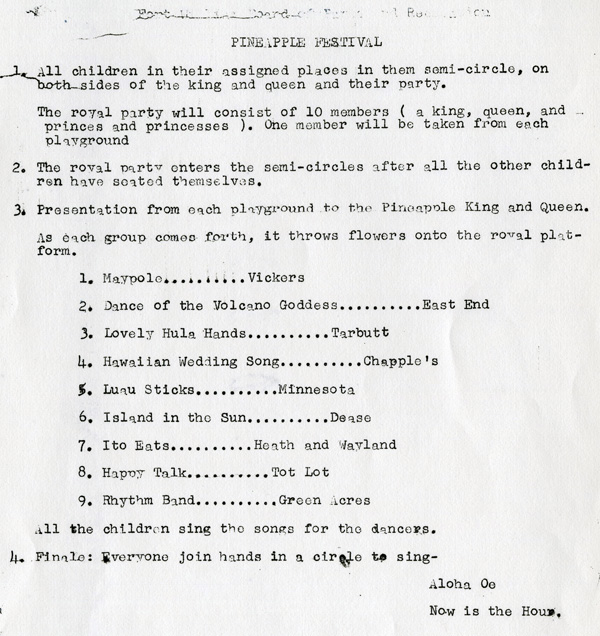
Pineapple Festival:
- All children in their assigned places in them semi-circle, on both sides of the king and queen and their party.
- The royal party will consist of 10 members (a king, queen, and princes and princesses). One member will be taken from each playground.
- The royal party enters the semi-circles after all the other children have seated themselves.
- Presentation from each playground to the Pineapple King and Queen.
As each group comes forth, it throws flowers on to the royal platform.
- Maypole -- Vickers
- Dance of the Volcano Goddess -- East End
- Lovely Hula Hands -- Tarbutt
- Hawaiian Wedding Song -- Chapples
- Luau Sticks -- Minnesota
- Island in the Sun -- Dease
- Ito Eats -- Heath and Wayland
- Happy Talk -- Tot Lot
- Rhythm Band -- Green Acres
All the children sing the songs for the dancers.
Finale: Everyone join hands in a circle to sing: Aloha Oe, Now is the Hour.
Title: Playgrounds Special Events Manual
Date: ca. 1955
Creator: The Fort William Board of Parks and Recreation
Series: 121, Fort William Parks & Recreation Files
Location: TBA 4802-11
|
| General Instructions to Playground Supervisors |
|
This manual, provided to Playground Supervisors in 1967, provides general instructions on running the playground, a sample weekly programme to be used as a reference, and a summary of safety procedures. Unlike in some other years, the supervisors are warned against allowing children to leave the playground site, or providing treats and prizes for competitions.
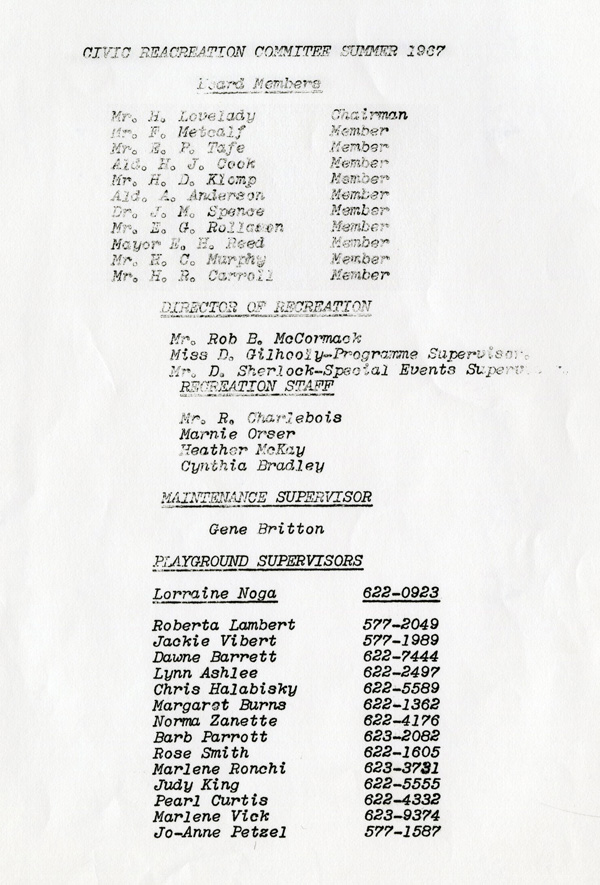
Civic Recreation Committee Summer 1967
Board members:
- Mr H. Lovelady, Chairman
- Mr F. Metcalf, Member
- Mr R.P. Tafe, Member
- Ald. H.J. Cook, Member
- Mr H.D. Klomp, Member
- Ald. A. Anderson, Member
- Dr. J.M. Spence, Member
- Mr. E.G. Rollason, Member
- Mayor E.H. Reed, Member
- Mr H.C. Murphy, Member
- Mr. H.R. Carroll, Member
Director of Recreation:
- Mr Rob B. McCormack
- Miss D. Gilhooly - Programme Supervisor
- Mr. D. Sherlock - Special Events Supervisor
Recreation Staff:
- Mr R. Charlebois
- Marnie Orser
- Heather McKay
- Cynthia Bradley
Maintenance Supervisor:
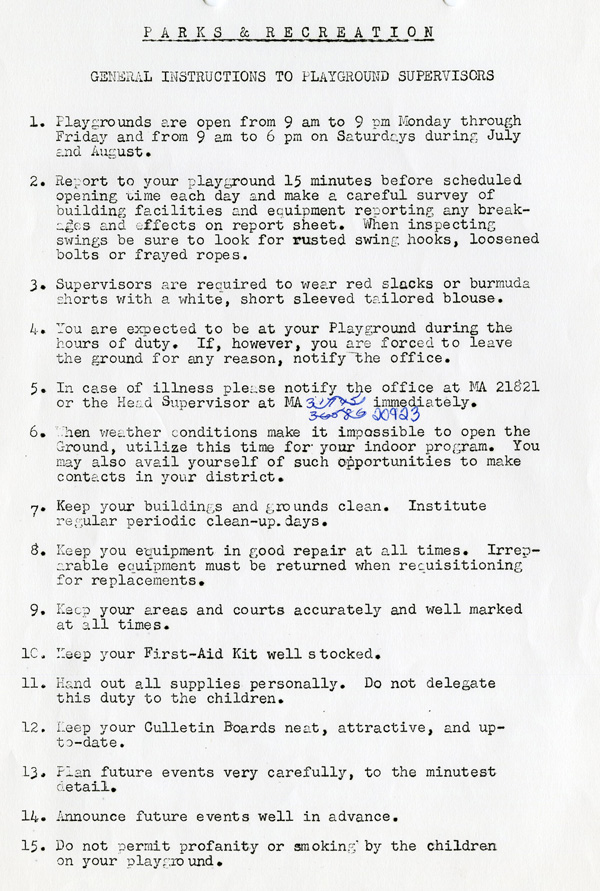
Parks & Recreation
General Instructions to Playground Supervisors
- Playgrounds are open from 9 am to 9 pm Monday through Friday and from 9 am to 6 pm on Saturdays during July and August.
- Report to your playground 15 minutes before scheduled opening time each day and make a careful survey of building facilities and equipment reporting any breakages and effects on report sheet. When inspecting swings be sure to look for rusted swing hooks, loosened bolts, or frayed ropes.
- Supervisors are required to wear red slacks or bermuda shorts with a white, short sleeved tailored blouse.
- You are expected to be at your Playground during the hours of duty. If, however, you are forced to leave the ground for any reason, notify the office.
- In case of illness please notify the office at MA 21821 or the Head Supervisor at MA [several numbers hand-written] immediately.
- When weather conditions make it impossible to open the Ground, utilize this time for your indoor program. You may also avail yourself of such opportunities to make contacts in your district.
- Keep your building and grounds clean. Institute regular periodic clean-up days.
- Keep your equipment in good repair at all times. Irreparable equipment must be returned when requisitioning for replacements.
- Keep your areas and courts accurately and well marked at all times.
- Keep your First-Aid Kit well stocked.
- Hand out all supplies personally. Do not delegate this duty to the children.
- Keep your Bulletin Boards neat, attractive, and up-to-date.
- Plan future events very carefully, to the minutest detail.
- Announce future events well in advance.
- Do not permit profanity or smoking by the children on your playground.
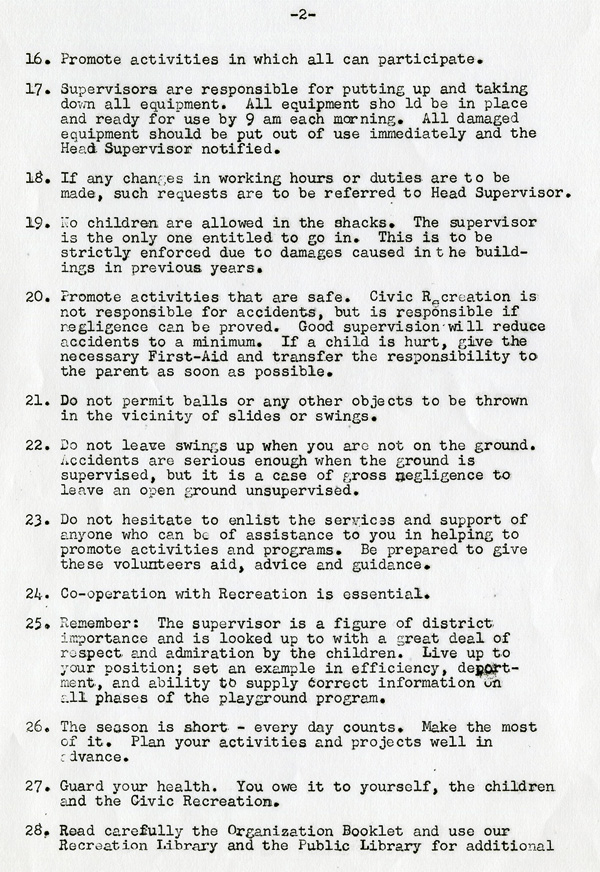
16. Promote activities in which all can participate.
17. Supervisors are responsible for putting up and taking down all equipment. All equipment should be in place and ready for use by 9 am each morning. All damaged equipment should be put out of use immediately and the Head Supervisor notified.
18. If any changes in working hours or duties are to be made, such requests are to be referred to Head Supervisor.
19. No children are allowed in the shacks. The supervisor is the only one entitled to go in. This is to be strictly enforced due to damages caused in the buildings in previous years.
20. Promote activities that are safe. Civic Recreation is not responsible for accidents, but is responsible if negligence can be proved. Good supervision will reduce accidents to a minimum. If a child is hurt, give the necessary First-Aid and transfer the responsibility to the parent as soon as possible.
21. Do not permit balls or any other objects to be thrown in the vicinity of slides or swings.
22. Do not leave swings up when you are not on the ground. Accidents are serious enough when the ground is supervised, but it is a case of gross negligence to leave an open ground unsupervised.
23. Do not hesitate to enlist the services and support of anyone who can be of assistance to you in helping to promote activities and programs. Be prepared to give these volunteers aid, advice and guidance.
24. Co-operation with Recreation is essential.
25. Remember: the supervisor is a figure of district importance and is looked up to with a great deal of respect and admiration by the children. Live up to your position; set an example in efficiency, deportment, and ability to supply correct information on all phases of the playground program.
26. The season is short - every day counts. Make the most of it. Plan your activities and projects well in advance.
27. Guard your health. You owe it to yourself, the children, and the Civic Recreation.
28. Read carefully the Organization Booklet and use our Recreation Library and the Public Library for additional [cont'd]
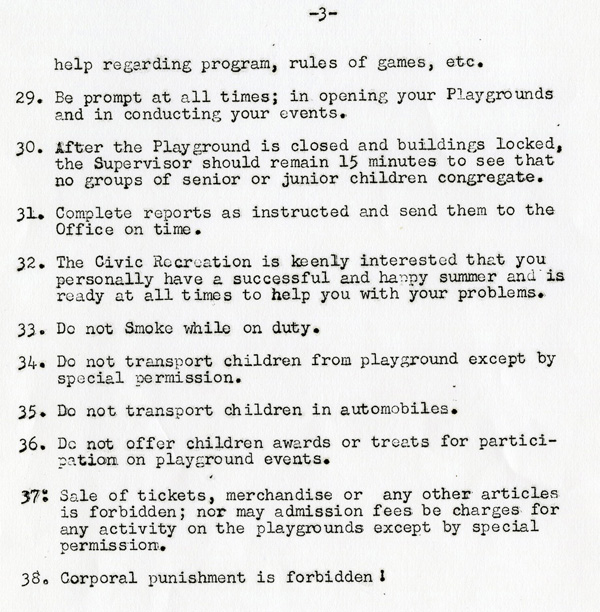
[cont'd from previous]
help regarding program, rules of games, etc.
29. Be prompt at all times; in opening your Playgrounds and in conducting your events.
30. After the Playground is closed and buildings locked, the Supervisor should remain 15 minutes to see that no groups of senior or junior children congregate.
31. Complete reports as instructed and send them to the Office on time.
32. The Civic Recreation is keenly interested that you personally have a successful and happy summer and is ready at all times to help you with your problems.
33. Do not Smoke while on duty.
34. Do not transport children from playground except by special permission.
35. Do not transport children in automobiles.
36. Do not offer children awards or treats for participation on playground events.
37. Sale of tickets, merchandise or any other articles is forbidden; nor may admission fees be charged for any activity on the playgrounds except by special permission.
38. Corporal punishment is forbidden!
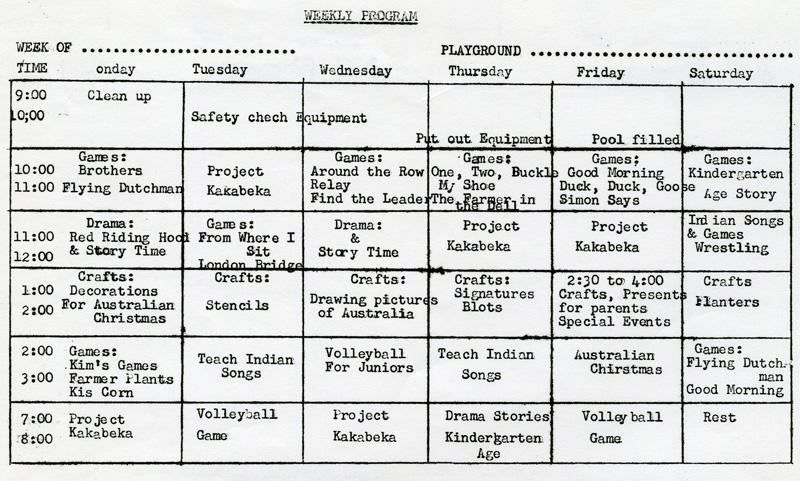
Weekly Program [sample]
Monday:
- 9:00-10:00 - Clean up
- 10:00-11:00 - Games: Brothers, Flying Dutchman
- 11:00-12:00 - Drama: Red Riding Hood & Story Time
- 1:00-2:00 - Crafts: Decorations for Australian Christmas
- 2:00-3:00 - Games: Kim's Games, Farmer Plants His Corn
- 7:00-8:00 Project Kakabeka
Tuesday:
- 9:00-10:00 Safety Check Equipment
- 10:00-11:00 Project Kakabeka
- 11:00-12:00 - Games: From Where I Sit, London Bridge
- 1:00-2:00: Crafts: Stencils
- 2:00-3:00 - Teach Indian Songs
- 7:00-8:00 - Volleyball Game
Wednesday:
- 9:00-10:00 Safety Check Equipment 10:00-11:00 Games: Around the Row, Relay, Find the Leader
- 11:00-12:00 - Drama & Story Time
- 1:00-2:00: Crafts: Drawing pictures of Australia
- 2:00-3:00 - Volleyball for Juniors
- 7:00-8:00 - Project Kakabeka
Thursday:
- 9:00-10:00 Put Out Equipment
- 10:00-11:00 Games: One, Two, Buckle My Shoe, the Farmer in the Dell
- 11:00-12:00 - Project Kakabeka
- 1:00-2:00: Crafts: Signatures, Blots
- 2:00-3:00 - Teach Indian Songs
- 7:00-8:00 - Drama Stories, Kindergarten Age
Friday:
- 9:00-10:00 Pool Filled
- 10:00-11:00 Games: Good Morning, Duck Duck Goose, Simon Says
- 11:00-12:00 - Project Kakabeka
- 1:00-2:00: Crafts, Presents for parents, Special Events
- 2:00-3:00 - Australian Christmas
- 7:00-8:00 - Volleyball Game
Saturday:
- 9:00-10:00
- 10:00-11:00 Games: Kindergarten Age Story
- 11:00-12:00 Indian Songs & Games, Wrestling
- 1:00-2:00: Crafts: Planters
- 2:00-3:00 - Games: Flying Dutchman, Good Morning
- 7:00-8:00 - Rest
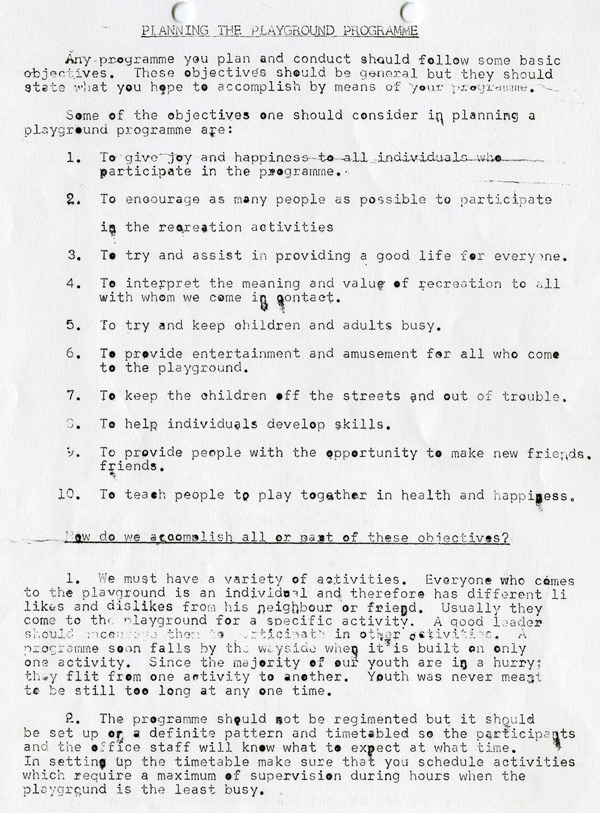
Planning the Playground Programme
Any programme you plan and conduct should follow some basic objectives. These objectives should be general but they should state what you hope to accomplish by means of your programme.
Some of the objectives one should consider in planning a playground programme are:
1. To give joy and happiness to all individuals who participate in the programme.
2. To encourage as many people as possible to participate in the recreation activities.
3. To try and assist in providing a good life for everyone.
4. To interpret the meaning and value of recreation to all with whom we come in contact.
5. To try and keep children and adults busy.
6. To provide entertainment and amusement for all who come to the playground.
7. To keep the children off the streets and out of trouble.
8. To help individuals develop skills.
9. To provide people with the opportunity to make new friends.
10. To teach people to play together in health and happiness.
How do we accomplish all or most of these objectives?
1. We must have a variety of activities. Everyone who comes to the playground is an individual and therefore has different likes and dislikes from his neighbour or friend. Usually they come to the playground for a specific activity. A good leader should encourage them to participate in other activities. A programme soon falls by the wayside when it is built on only one activity. Since the majority of our youth are in a hurry: they flit from one activity to another. Youth was never meant to be still too long at any one time.
2. The programme should not be regimented but it should be set up or a definite pattern and timetabled so the participants and the office staff will know what to expect at what time. In setting up the timetable make sure that you schedule activities which require a maximum of supervision during hours when the playground is the least busy.
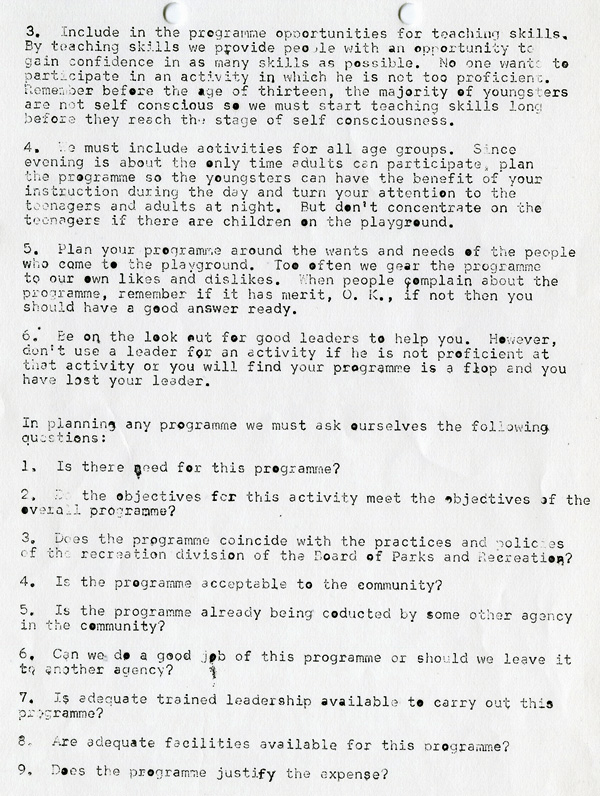
3. Include in the programme opportunities for teaching skills. By teaching skills we provide people with an opportunity to gain confidence in as many skills as possible. No one wants to participate in an activity in which he is not too proficient. Remember before the age of thirteen, the majority of youngsters are not self conscious so we must start teaching skills long before they reach the stage of self consciousness.
4. We must include activities for all age groups. Since evening is about the only time adults can participate, plan the programme so the youngsters can have the benefit of your instruction during the day and turn your attention to the teenagers and adults at night. But don't concentrate on the teenagers if there are children on the playground.
5. Plan your programme around the wants and needs of the people who come to the playground. Too often we gear the programme to our own likes and dislikes. When people complain about the programme, remember if it has merit, O.K., if not then you should have a good answer ready.
6. Be on the look out for good leaders to help you. However, don't use a leader for an activity if he is not proficient at that activity or you will find your programme is a flop and you have lost your leader.
In planning any programme we must ask ourselves the following questions:
1. Is there need for this programme?
2. Do the objectives for this activity meet the objectives of the overall programme?
3. Does the programme coincide with the practices and policies of the recreation division of the Board of Parks and Recreation?
4. Is the programme acceptable to the community?
5. Is the programme already being conducted by some other agency in the community?
6. Can we do a good job of this programme or should we leave it to another agency?
7. Is adequate trained leadership available to carry out this programme?
8. Are adequate facilities available for this programme?
9. Does the programme justify the expense?
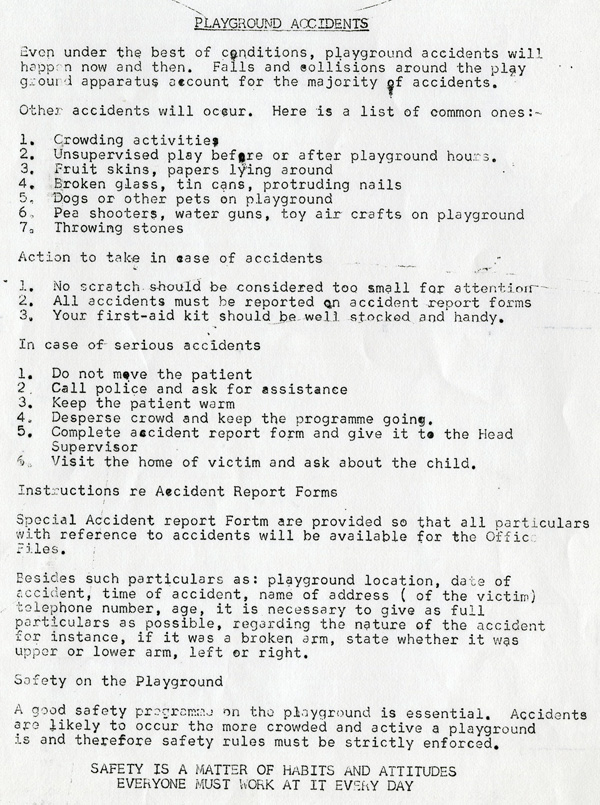
Playground Accidents
Even under the best of conditions, playground accidents will happen now and then. Falls and collisions around the playground apparatus account for the majority of accidents.
Other accidents will occur. Here is a list of common ones:
1. Crowding activities.
2. Unsupervised play before or after playground hours.
3. Fruit skins, papers lying around.
4. Broken glass, tin cans, protruding nails
5. Dogs or other pets on playground
6. Pea shooters, water guns, toy air crafts on playground
7. Throwing stones.
Action to take in case of accidents:
1. No scratch should be considered too small for attention
2. All accidents must be reported on accident report forms
3. Your first-aid kit should be well stocked and handy.
In case of serious accidents:
1. Do not move the patient
2. Call police and ask for assistance
3. Keep the patient warm
4. Disperse crowd and keep the programme going
5. Complete accident report form and give it to the Head Supervisor
6. Visit the home of victim and ask about the child.
Instructions re Accident Report Forms
Special Accident Report Forms are provided so that all particulars with reference to accidents will be available for the Office Files.
Besides such particulars as: playground location, date of accident, time of accident, name of address (of the victim), telephone number, age, it is necessary to give as full particulars as possible, regarding the nature of the accident for instance, if it was a broken arm, state whether it was upper or lower arm, left or right.
Safety on the Playground
A good safety programme on the playground is essential. Accidents are likely to occur the more crowded and active a playground is and therefore safety rules must be strictly enforced.
Safety is a matter of habits and attitudes. Everyone must work at it every day.
Title: General Instructions to Playground Supervisors
Date: 1967
Creator: Fort William Parks and Recreation Department
Series: 121, Fort William Parks & Recreation Files
Location: TBA 4802-11
|
| Organization Manual |
|
This Port Arthur Parks & Recreation manual covers instructions and equipment lists for various games, sports, and crafts. It also includes tips on how to be a good leader, how to run the Playtown Council, and what to do in case of an accident.
The Playtown Council is an interesting look into how children were involved in decision-making on the playgrounds. Elections were run formally and publicly recognized, and the elected Councillors then had a role in planning the activities for the summer.
Only selected pages from the manual are presented in this exhibit.
Port Arthur Parks & Recreation
[illustration]
Organization Manual
1969
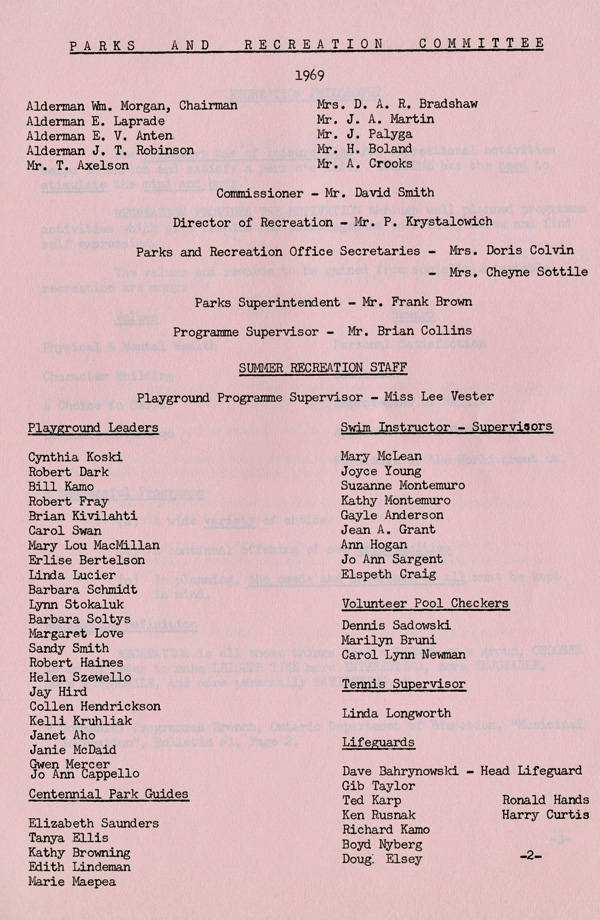
Parks and Recreation Committee: 1969
- Alderman Wm. Morgan, Chairman
- Mrs D.A.R. Bradshaw
- Alderman E. Laprade
- Mr J.A. Martin
- Alderman E.V. Anten
- Mr J. Palyga
- Alderman J.T. Robinson
- Mr H. Boland
- Mr T. Axelson
- Mr. A. Crooks
Commissioner: Mr. David Smith
Director of Recreation: Mr. P. Krystalowich
Parks and Recreation Office Secretaries: Mrs. Doris Colvin, Mrs. Cheyne Sottile
Parks Superintendent: Mr. Frank Brown
Programme Supervisor: Mr. Brian Collins
Summer Recreation Staff:
Playground Programme Supervisor -- Miss Lee Vester
Playground Leaders:
- Cynthia Koski
- Robert Dark
- Bill Kamo
- Robert Fray
- Brian Kivilahti
- Carol Swan
- Mary Lou MacMillan
- Erlise Bertelson
- Linda Lucier
- Barbara Schmidt
- Lynn Stokaluk
- Barbara Soltys
- Margaret Love
- Sandy Smith
- Robert Haines
- Helen Szewello
- Jay Hird
- Collen Hendrickson
- Kelli Kruhliak
- Janet Aho
- Janie McDaid
- Gwen Mercer
- Jo Ann Cappello
Centennial Park Guides:
- Elizabeth Saunders
- Tanya Ellis
- Kathy Browning
- Edith Lindeman
- Marie Maepea
Swim Instructor - Supervisors
- Mary McLean
- Joyce Young
- Suzanne Montemuro
- Kathy Montemuro
- Gayle Anderson
- Jean A. Grant
- Ann Hogan
- Jo Ann Sargent
- Elspeth Craig
Volunteer Pool Checkers
- Dennis Sadowski
- Marilyn Bruni
- Carol Lynn Newman
Tennis Supervisor:
Lifeguards:
- Dave Bahrynowski - Head Lifeguard
- Gib Taylor
- Ted Karp
- Ken Rusnak
- Richard Kamo
- Boyd Nyberg
- Doug Elsey
- Ronald Hands
- Harry Curtis
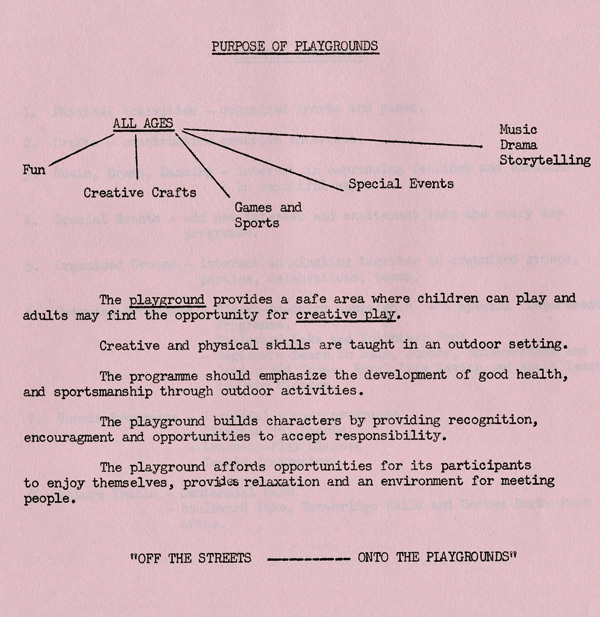
Purpose of Playgrounds
[diagram]
All Ages:
- Fun
- Creative Crafts
- Games and Sports
- Special Events
- Music, Drama, Storytelling
The playground provides a safe area where children can play and adults may find the opportunity for creative play.
Creative and physical skills are taught in an outdoor setting.
The programme should emphasize the development of good health, and sportsmanship through outdoor activities.
The playground builds characters by providing recognition, encouragement and opportunities to accept responsibility.
The playground affords opportunities for its participants to enjoy themselves, provides relaxation and an environment for meeting people.
"Off the streets - Onto the playgrounds"
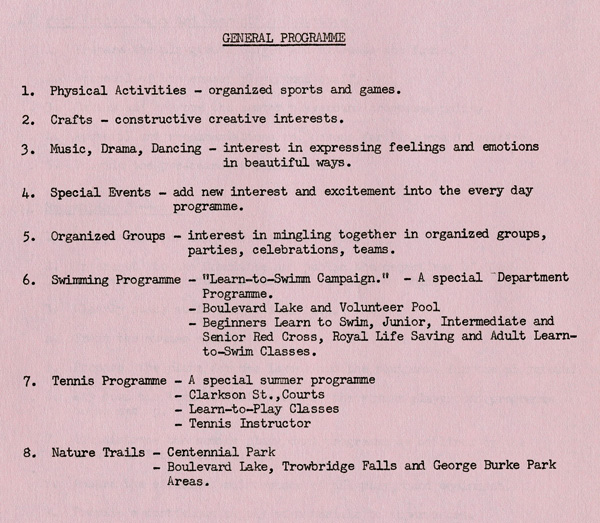
General Programme
1. Physical Activities - organized sports and games.
2. Crafts - constructive creative interests.
3. Music, Drama, Dancing - interest in expressing feelings and emotions in beautiful ways.
4. Special Events - add new interest and excitement into the every day programme.
5. Organized Groups - interest in mingling together in organized groups, parties, celebrations, teams.
6. Swimming Programme - "Learn-to-Swim Campaign" - a special Department Programme - Boulevard Lake and Volunteer Pool - Beginners Learn to Swim, Junior, Intermediate and Senior Red Cross, Royal Life Saving and Adult Learn-to-Swim Classes.
7. Tennis Programme - A special summer programme - Clarkson St. Courts - Learn-to-Play Classes - Tennis Instructor
8. Nature Trails - Centennial Park - Boulevard Lake, Trowbridge Falls and George Burke Park Areas.
You!! The Leader
To be a successful playground leader you must have a firm conviction of the importance of your job, a desire and capacity for work and a willingness to put your whole self into your work. Unless you are ready to maintain a high standard of personal conduct and good tastes, you should seek some other occupation.
Who are the children waiting for on the playground this summer? You!!
Without you the playground is just a place. With you it is a programme; you make things happen; you make things fun.
You will be the authority on games, stories, arts and crafts, and special events. Your interests and attitudes will be reflected in the children; therefore your dress, speech and actions will exert a wide influence over them and in the neighbourhood.
As a leader - know what is expected of you.
You Should Know:
- Parks and Recreation Policies
- Rules and Regulations
- Your Duties and Responsibilities
- Emergency Procedure and Phone Numbers
- Who will supervise you
- Who looks after Equipment Maintenance
- Who removes the garbage
- Where craft supplies and games equipment come from
Sports: Coaching Hints
- Simplicity is the keynote of success. Teach the fundamentals systematically and constantly.
- Teach only a few things at each practice.
- Use lead-up games for variety
- Do not concentrate too long on one phase of the game
- Let your players learn by playing
- Tell them once and have them do it a million times
- Encourage players to talk about the game
- Encourage players to ask when they do not understand
- Always keep your eye on the ball
- Always remember the playing of the game is more important than winning. You, their coach, are moulding the citizens of tomorrow.
- Know your game rules
Discipline:
Discipline involves your method of handling:
- Yourself on the job
- Unpleasant situations as they are created by children
- The misuse of grounds and equipment
The complete lack can destroy the benefits of your total programme
How to Avoid Problems: The most sure-fire way of avoiding problems of discipline is to plan an interesting programme and to carry it out with enthusiasm and sincerity.
Activity Keeps Away Trouble:
- keep things humming and avoid idle moments
- Include something for everyone
- avoid awards and costly prizes
- use a playground council - elected representatives for specified periods - to help plan programmes (and junior leaders)
- do not cater to the whims of a few - even if they make more noise with their requests than all the rest together.
Types of Children
Regardless of your efforts to plan so things will run smoothly, you will still find certain types of children on the playground who create special problems. Be prepared for these:
1. Big Bully:
- his actions are often caused by a feeling of insecurity
- he could be a leader
- try guiding his energy into useful channels
- give him some responsibility and a taste of success
2. Shy Violet
- discover something the child can do well and encourage him to demonstrate this skill
- by doing so you will make him feel more at ease in the group
- make him feel important by giving him chores and letting him run your errands
3. "I don't wanna" Sulker
- encourage the child to do things he likes to do and does well
- give him praise when praise is due
- draw him slowly into other activities
Playtown Government
The Playtown set-up is an attempt to give the playground children an opportunity to live through the experience of self-government. In a small way, it attempts to give them an opportunity to practise and experience their responsibilities as citizens.
They soon learn, through guidance, trial and error, the good practices in this problem of self-government.
Procedure Outline to be followed:
1. Explain to the children the whole process of electing their own governing body and their responsibility as citizens. Outline the duties of the various officials and stress the importance of choosing the right people for specific jobs.
2. Set a date for election giving the children about a week to prepare.
3. Have them present written nominations for Mayor. These nomination papers should be signed by ten Playtown Citizens.
4. The candidates running should present their platforms. Their campaign should include speeches, posters, etc.
5. Returning officers representing each candidate are appointed. A Polling Booth is set up and hours of voting designated. Only registered Playtown children (over seven years of age) are allowed to vote.
6. When the election is over, scrutineers are appointed to count the ballots. The winner is announced and a special ceremony arranged. A prominent citizen should present the Mayor with his badge of office in the playground.
7. The playground leader, acting in an advisory capacity, the Mayor, and the defeated candidates plus one or two supporters of each candidate hold a meeting and set up the Playtown Council. They appoint suitable people, either from among themselves or at large to act as councillors, chiefs and members of the various departments (see chart)
8. After the Playtown elections, the mayor and his three councillors, along with their playground leader, join the other city playgrounds in a special ceremony with the Mayor of the City and his Councillors. This is a special Inaugural Meeting. At this time, the Playtown Councils are presented with their badges.
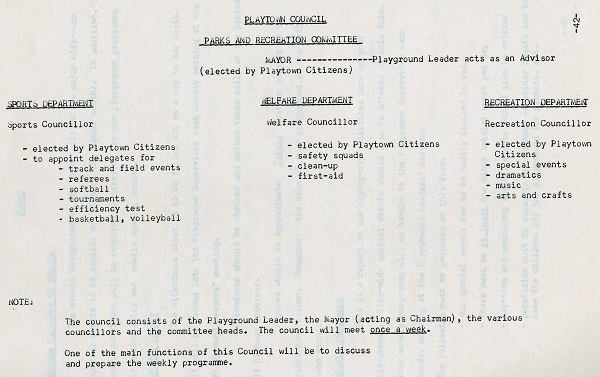
Playtown Council
Parks and Recreation Committee
Mayor -- Playground Leader acts as an Advisor
(elected by Playtown Citizens)
Sports Department:
Sports Councillor
- elected by Playtown Citizens
- to appoint delegates for: track and field events, referees, softball, tournaments, efficiency test, basketball, volleyball
Welfare Department:
Welfare Councillor:
- elected by Playtown Citizens
- safety squads
- clean-up
- first aid
Recreation Department:
Recreation Councillor
- elected by Playtown Citizens
- special events
- dramatics
- music
- arts and crafts
Note: The council consists of the Playground Leader, the Mayor (acting as Chairman), the various councillors and the committee heads. The council will meet once a week. One of the main functions of this Council will be to discuss and prepare the weekly programme.
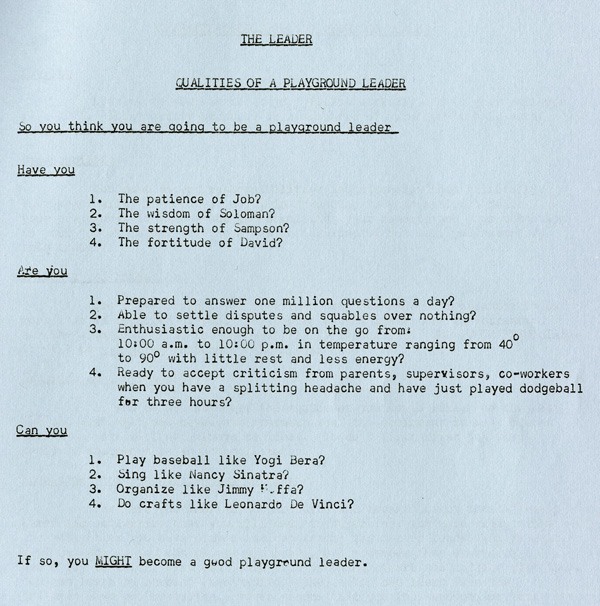
The Leader
Qualities of a Playground Leader
So you think you are going to be a playground leader.
Have you:
1. The patience of Job?
2. The wisdom of Solomon?
3. The strength of Samson?
4. The fortitude of David?
Are you:
1. Prepared to answer one million questions a day?
2. Able to settle disputes and squabbles over nothing?
3. Enthusiastic enough to be on the go from 10:00 a.m. to 10:00 p.m. in temperature ranging from 40o to 90o with little rest and less energy?
4. Ready to accept criticism from parents, supervisors, co-workers when you have a splitting headache and have just played dodgeball for three hours?
Can you:
1. Play baseball like Yogi Bera?
2. Sing like Nancy Sinatra?
3. Organize like Jimmy Hoffa?
4. Do crafts like Leonardo Da Vinci?
If so, you might become a good playground leader.
Title: Organization Manual 1969
Date: 1969
Creator: Port Arthur Parks and Recreation
Series: 28, Port Arthur Parks & Recreation Files
Location: TBA 4750-33
|
| Neighbourhood Playgrounds Manual |
|
This 1972 manual for playgrounds leaders focuses on teaching appropriate leader conduct, tips on leadership styles, and managing children of all age groups. It also includes suggestions for arts and crafts, sports and athletics, drama and pantomime, and games and activities.
This exhibit includes sample pages and does not present the entire manual.
Neighbourhood Playgrounds Manual
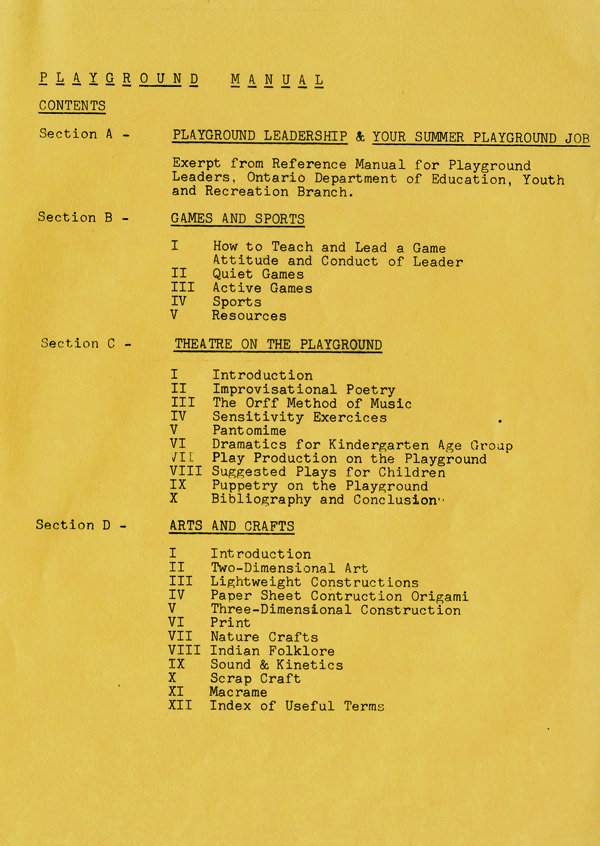
Playground Manual
Contents:
Section A: Playground Leadership & Your Summer Playground Job
Excerpt from Reference Manual for Playground Leaders, Ontario Department of Education, Youth and Recreation Branch.
Section B: Games and Sports
1. How to Teach and Lead a Game
Attitude and Conduct of Leader
2. Quiet Games
3. Active Games
4. Sports
5. Resources
Section C: Theatre on the Playground
1. Introduction
2. Improvisational Poetry
3. The Orff Method of Music
4. Sensitivity Exercises
5. Pantomime
6. Dramatics for Kindergarten Age Group
7. Play Production on the Playground
8. Suggested Plays for Children
9. Puppetry on the Playground
10. Bibliography and Conclusion
Section D: Arts and Crafts
1. Introduction
2. Two-Dimensional Art
3. Lightweight Constructions
4. Paper Sheet Construction Origami
5. Three-Dimensional Construction
6. Print
7. Nature Crafts
8. Indian Folklore
9. Sound & Kinetics
10. Scrap Craft
11. Macrame
12. Index of Useful Terms
"Playgrounds -- Where Things Happen!"
Philosophy: It is our belief that playgrounds have a vital role to play in any community. In order to enrich the summer programme, it is essential for the playground leader to utilize community resources. Playgrounds afford an opportunity for today's youth to find:
- purposeful release of energy through creative play
- an atmosphere conducive to socialization
- opportunities for responsibilities and good sportsmanship
- mental and emotional security
- an awareness of their neighbourhood and community
- skills that may be used in the future
- satisfaction and a feeling of accomplishment in everyday tasks
- confidence and pride in themselves and the playground as a whole
in a relaxed, supervised, outdoor environment. Playgrounds allow for the natural growth and development of every child through free play. Playgrounds are an integral part of a child's developing years.
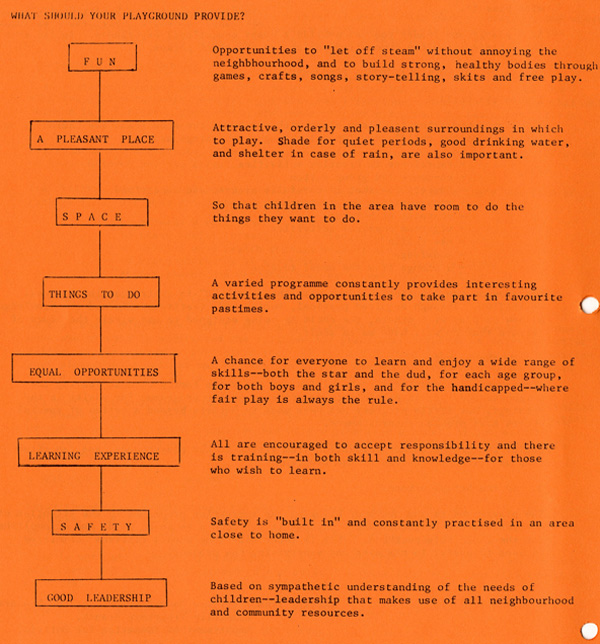
What Should Your Playground Provide:
Fun: Opportunities to "let off steam" without annoying the neighbourhood, and to build strong, healthy bodies through games, crafts, songs, story-telling, skits and free play.
A Pleasant Place: Attractive, orderly and pleasant surroundings in which to play. Shade for quiet periods, good drinking water, and shelter in case of rain, are also important.
Space: So that children in the area have room to do the things they want to do.
Things To Do: A varied programme constantly provides interesting activities and opportunities to take part in favourite pastimes.
Equal Opportunities: A chance for everyone to learn and enjoy a wide range of skills -- both the star and the dud, for each age group, for both boys and girls, and for the handicapped -- where fair play is always the rule.
Learning Experience: All are encouraged to accept responsibility and there is training -- in both skill and knowledge -- for those who wish to learn.
Safety: Safety is "built in" and constantly practised in an area close to home.
Good Leadership: Based on sympathetic understanding of the needs of children -- leadership that makes use of all neighbourhood and community resources.
Drama:
July 7, 1972 : Lyn Wenzell
Imagination is an instinct. It appears spontaneously. The young bird learns to fly and the six week old antelope learns to leap just as the child learns to create.
- First, consider that the purpose of childhood is to provide a period of play. Play, which trains the higher animals and man for serious living, play takes place in a long period of immaturity in order for it to have its full effect. The higher the attainment required, the longer the time of preparation.
- Next, play is directly related to the development of intelligence. Play arises in youth at a time when certain instincts are of serious need to the individual. in this way, play is necessary for the higher development of intelligence. imitation is also related to this development.
Impromptu Shows:
- A game with a new twist! Musical Chairs (without the chairs).
- Stand in a circle and give everyone a hat. Then give one player an extra hat. When the music starts, each player lifts the hat off his own head and puts it on the head of the person to his left. The trick is for the person holding the extra hat to slap it on his own head before his neighbour can put a hat on him. When the music stops, anyone caught with 2 hats is out.
- Pantomime, the oldest of dramatic arts, is a way of expressing feelings and ideas with facial expressions, gestures, and movement instead of words.
Here are a few pantomime games!
- What am I? Act out the part of animal or thing -- a kitten or a snake, a vacuum cleaner or a window shade.
- Who am I? Take the part of some person -- an old man putting on his shoes, a baby making mud pies, Napoleon at Waterloo. You might make a game of acting out a nursery rhyme character.
Charades:
- The players divide into 2 teams. One team chooses a word or series of words to act out -- perhaps the title of a book or movie, a famous saying, a line from a poem, or an advertising slogan. The other team must guess the words from the actions.
Pantomime:
Pantomime more than any other form of theatre offers children the opportunity to explore a new and unique means of communication since they use their faces, and bodies as vehicles for expression rather than words. Mime in the strict sense of its meaning is "the acting out of something without words or sound effects"; it can take the form of charades where children act out words or characters for others to guess or it can follow a story line or be representative of a familiar activity. With the addition of sounds and music, basic pantomime can become an even more interesting and creative activity.
When dealing with pantomime (or all children's theatre) it is often wise to introduce the initial concept as a game, or as a dramatization of a familiar story which the leader is reading, or perhaps the actions to a familiar song or record. The game concept is most often the wisest choice as it is the most practical for the playground situation, as well as being highly important as children's games are often the basis for children's drama. Suggested games for introducing the children in your playground theatre programme are as follows:
1. In the Manner of the Adverb
- One of the participants is chosen "it" and leaves the area, while the others agree on an adverb. When "it" returns to the area he tries to guess the adverb by asking one player after another to act it out in pantomime. For instance, he may say "eat in the manner of the adverb". Thus, if the adverb is slowly, the player addressed eats slowly. To the next player "it" may say "run in the manner of the adverb". "It" is entitled to one performance from each player. If he fails to guess it by that time, he has to give up. If he guesses it correctly, the person whose action gave it away becomes "it". Some excellent adverbs are: jerkily, lovingly, industriously, conceitedly.
2. The Passing Game
- The leader suggests an imaginary object to be passed around in a circle. This object to be passed can be a pea, a huge balloon or a sack of potatoes, for example. The object is passed around from person to person and the idea is to try to keep it from falling, and to indicate its size and weight by the action. This game can be more interesting when played out of sequence with the object being passed at random to a surprise receiver.
3. The Magic Game
- Abracadabra do, do, do
- Turn into (leader suggests) one two, one two
The leader may create an imaginary wand and put a spell on her children. Recite the rhyme. They could turn into:
a) spinning tops
b) jumping jacks
c) vooming[?] eagles
d) bunny rabbits
e) hissing snakes
f) thunder rolling
g) fairies
h) ghosts
i) lightning
j) a dancing fire
k) dancing puppets
l) rag dolls
How to Select a Game
When selecting an activity, it is well to choose games that insure maximum participation for the children. Try to avoid having just one or two players active while others look on.
When selecting your games, consider the following points:
a) age, sex, and number of players
b) amount of time available and facilities available
c) equipment necessary
d) the ease with which the game can be taught
e) the value of the game: enjoyment possible, interest, activity, exercise, educational value
f) skills required
g) relationship to the rest of your programme
h) allow time for playing "requested" games
How to Teach and Lead a Game
1. Get the children into game formation at the place where the activity will be done.
2. Secure their attention before explaining the game.
3. State the name, make explanations clear, concise. Be brief and to the point.
4. Demonstrate the game at the time of explanation.
5. Plan details in advance -- know your activity well and have any required equipment ready.
6. Know how to play the game yourself and enjoy playing it.
7. Teach children to obey, enforce all rules.
8. Be firm and just when making decisions.
9. See that all participants have an equal chance. Let the children do things!
10. Keep things moving; use variation. Stop activity at its peak.
11. Don't scold, embarrass, confuse, or shout.
12. Maintain discipline by keeping interest high.
13. Be aware of the safety factors involved.
14. Try to match teams evenly.
15. Be enthusiastic -- the vitality, sparkle, shown by the children will be in direct proportion to the enthusiasm you have for the activity.
16. If the activity is not going properly, stop the game and begin again.
17. Emphasize that the sport of the game lies in playing and that winning is secondary.
Attitude and Conduct of Leader
1. Remember that the boys and girls of your team will reflect your attitude and conduct towards their opponents. Meet as leaders not as opponents.
2. Encourage and permit your captains to act as leaders.
3. Study the rules of all the games in which your children are participating -- they look to you for final decisions.
4. Require standards of decency for both conduct and language of your players and spectators.
5. See that your team, win or lose, parts on friendly terms with its opponents.
6. If your team is visiting, see that it is on time. If the game is played on your playground see that the equipment is on hand; have your players ready on time. Sportsmanship first, winning the game or event is second.
- Your enthusiasm is contagious
- Your programme is reflective
- Its success is your success
Quiet Games:
- In daily playground programmes, it is recommended that 50% of the time be allotted to quiet activities. Such activities are especially suited to hot weather and periods of limited attendance, which prohibit active sports and games. Quiet activities include storytelling, playground dramatics, singing, listening to records, nature recreation and crafts.
1. Charades
- The children are divided into two or more groups. Each group is informed that it must choose a word of two or three syllables and prepare to dramatize each syllable and the entire word without speaking, while the others try to discover what word has been chosen. This can be varied by acting out song titles, nursery rhymes, book titles and the like.
2. I Spy
- One player is "it" and chooses an object within sight. "It" says "I spy with my little eye, something that begins with "B" (or whatever letter the object begins with). The players in turn try to guess what "it" sees. The player who guesses correctly then becomes "it". This may be varied using colours.
3. Geography
- The first player begins by naming a city, town, village, river or other geographic location within a certain area. If he says Toronto, the second player must name another location beginning with the last letter, ie "O". The game continues in this manner. If a small group is playing, set the boundary lines for a small area. For a large group increase the area.
4. A B C
- This game is a novelty relay in which, at a signal, the first player recites the alphabet as quickly as he can. The second player does likewise. This procedure continues until all have recited. The team finishing first scores.
Collage:
- a type of abstraction made with fragments of many types of materials pasted or fastened together into an artistic composition
- good use of scrap crafts
- first projects result in spontaneous motivation excited by the materials
- with older children, incorporate ideas for design if need arises
- choose mood inspirations, or provide problems in "opposite" textures, colour, size, shapes, light, dark
Boxes for Building:
- abundant resources for building anything the child desires
- first tell a story, then let them build the setting, create the character or let them tell their own story after they build
- or with huge boxes make an entire group effort to make child-like size trains or villages
- a bit of paint and imagination can create an entire environment of fun
Stuffed Paper Animals (inspired by talk about animals, trip, etc)
- double thickness of mill paper or brown paper where child draws or paints his fantastical animal bird or fish (simple designs are most successful) have the children make huge bodies with "fat" appendages that can easily be stuffed
- pin the paper together so it doesn't slip
- cut around the figure
- rise wads of crumpled newspaper for stuffing
- either glue ends or sew with yarn and a large needle -- all around to the beginning (while stuffing)
- this exercise satisfies the need to work large and free
- paint or use crayon work to finish
- scrap felt or cloth ones can also be made on a smaller scale
Kites:
- pine or bass sticks -- pliable (from lumber yards, scrap boxes)
- use heavy weight paper or plastic garbage bags
Applique
- pieces of scrap fabrics are applied, or laid on, sewed or pasted onto one another (burlap backing and cardboard)
- the design may be previously conceived on coloured paper, then used as a pattern for materials, but is not necessary other than the change may suggest new ideas
- stitchery over top can add to the design using bright wool
- applique techniques can be applied to the making of mittens, slippers, head bands, glass cases and purses.
Introduction
- Special events either make your playground fun or a drag. They are activities which are arranged to add variety to the routine of the playground. The nature of the activities can be elaborate or simple, depending on the children involved, and the physical setting of the playground.
- Special events can also appeal to teenagers or adults who are brought to the playground as visitors. They are valuable in publicizing the playground programme to the general public, as well as in attracting children who are not interested in the regular programme.
- Special events, then, can provide an incentive to regular programmes by giving an aim and direction to various projects. In assisting the development of initiative, patience, and imagination, they also provide an extra challenge for the playground supervisor.
There are four types of Special Events, according to the length of time required:
1. Short Term Special Events: These events only take a few minutes and are used as a break from the regular programme to add new interest and stimulate increased enthusiasm.
2. One-Period Special Events: This type of event requires a morning, afternoon or evening, and can be used alone or grouped together to make a larger programme.
3. Day-Long Special Events: This type of event occupies the entire day.
4. Week-Long Special Events: These events are carried out over a period of a week and require more planning. They should be planned around a theme and relate to all parts of the programme, from crafts to active games. The "Build-up" and planning provides new interest and opportunity for the children and leaders.
Check These Points in Planning a Special Event:
1. Planning: Plan far enough ahead to allow ample time for proper programming. Set date, time, and place as soon as possible. Allow children and parents to help with planning. Remember: elaborate events take more preparation.
2. Authorization: Make sure that all plans have been cleared and approved by the various authorities (i.e. playground co-ordinators). Special Events away from the playground require parents' permission and transportation facilities. A trip through a local industry involves planning with the Public Relations office of the company.
3. Publicity: The bigger the event, the more publicity should go out on it. Use craft projects, posters in stores, pamphlets, etc., for children to pass out and take home. Do not forget that "What, Where, When, and Why". The best way to advertise is by word of mouth; therefore, ask the children to pass the news around the neighbourhood
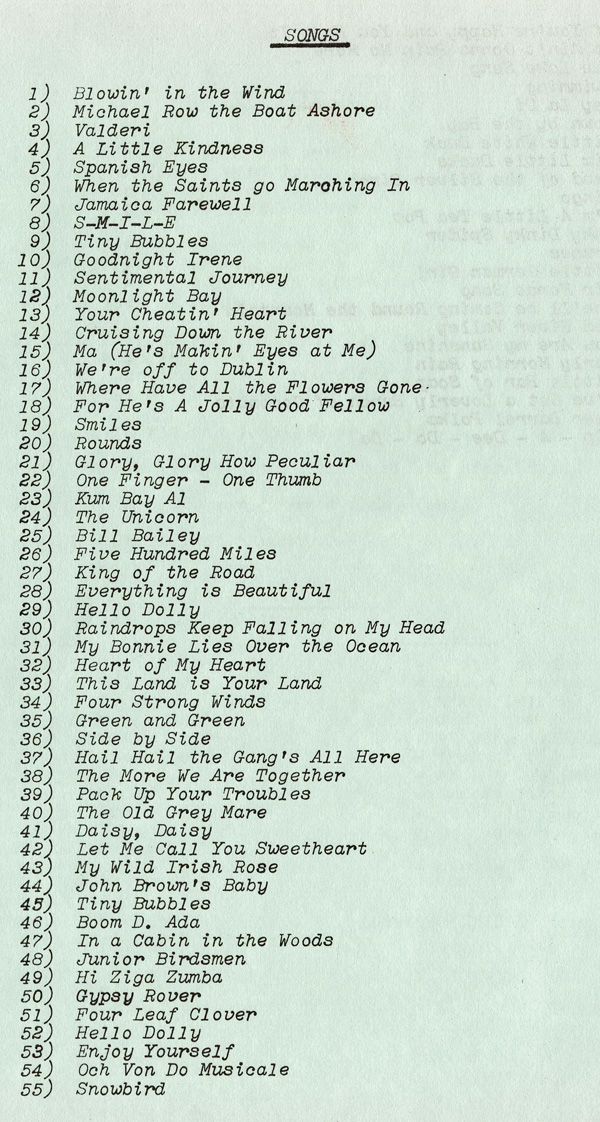
Songs:
1) Blowin' in the Wind
2) Michael Row the Boat Ashore
3) Valderi
4) A Little Kindness
5) Spanish Eyes
6) When the Saints go Marching In
7) Jamaica Farewell
8) S-M-I-L-E
9) Tiny Bubbles
10) Goodnight Irene
11) Sentimental Journey
12) Moonlight Bay
13) Your Cheatin' Heart
14) Cruising Down the River
15) Ma (He's Makin' Eyes at Me)
16) We're off to Dublin
17) Where Have All the Flowers Gone
18) For He's a Jolly Good Fellow
19) Smiles
20) Rounds
21) Glory, Glory How Peculiar
22) One Finger - One Thumb
23) Kum Bay Al
24) The Unicorn
25) Bill Bailey
26) Five Hundred Miles
27) King of the Road
28) Everything is Beautiful
29) Hello Dolly
30) Raindrops Keep Falling on My Head
31) My Bonnie Lies Over the Ocean
32) Heart of my Heart
33) This Land is Your Land
34) Four Strong Winds
35) Green and Green
36) Side by Side
37) Hail Hail the Gang's All Here
38) The More We Are Together
39) Pack Up Your Troubles
40) The Old Grey Mare
41) Daisy, Daisy
42) Let Me Call You Sweetheart
43) My Wild Irish Rose
44) John Brown's Baby
45) Tiny Bubbles
46) Boom D Ada
47) In a Cabin in the Woods
48) Junior Birdsmen
49) Hi Ziga Zumba
50) Gypsy Rover
51) Four Leaf Clover
52) Hello Dolly
53) Enjoy Yourself
54) Och Von Do Musicale
55) Snowbird
Title: Neighbourhood Playgrounds Manual
Date: 1972
Creator: Thunder Bay Parks and Recreation Department
Series: 156, Thunder Bay Central Files (Administration, Parks, Community Recreation)
Location: TBA 5249-19
|






 Connect