




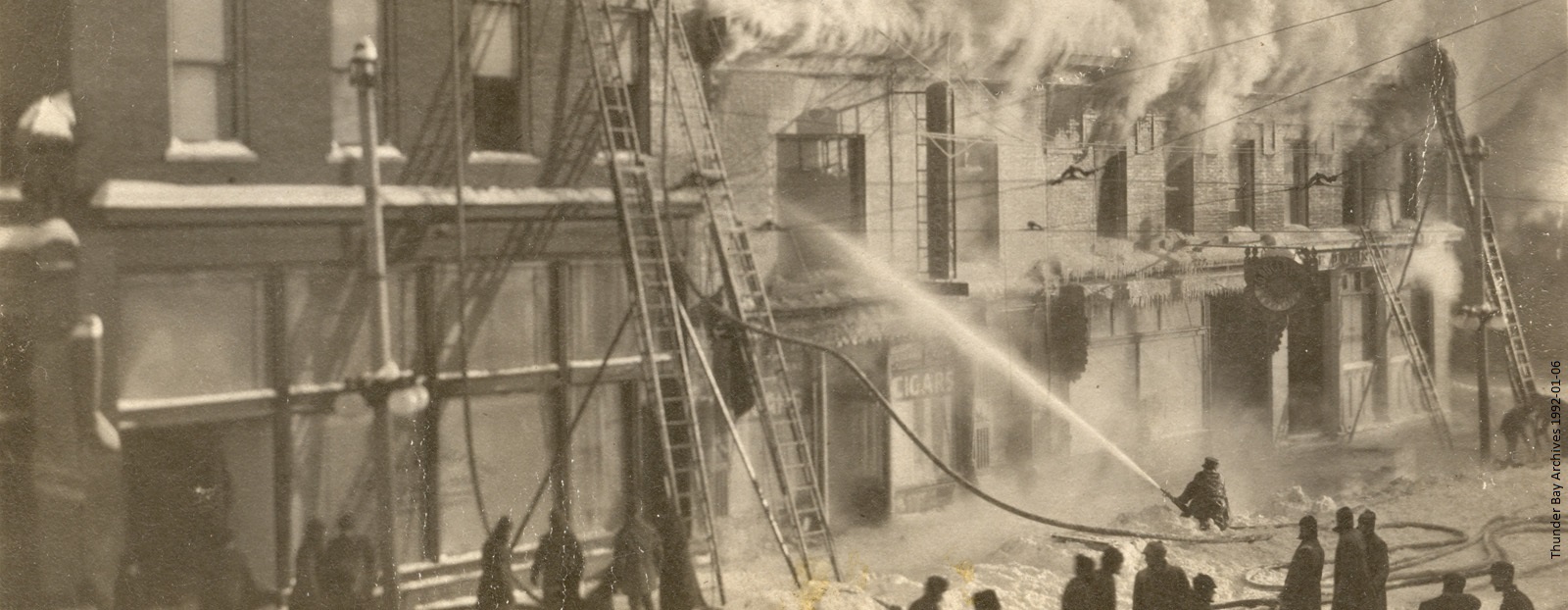


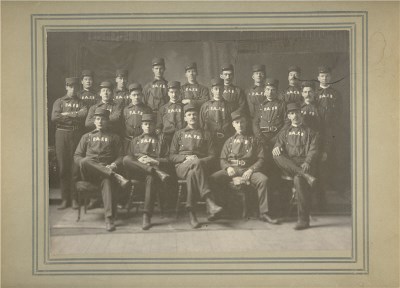
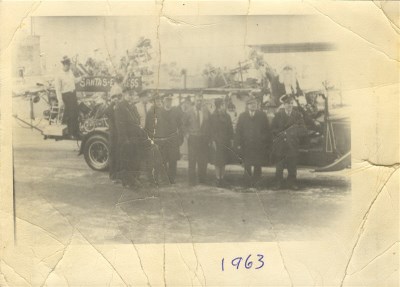
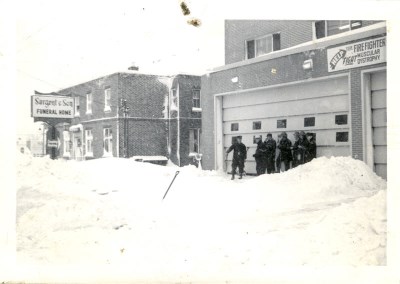
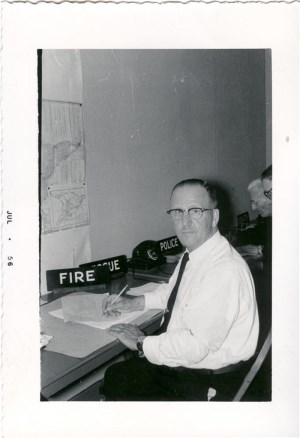
This exhibit details the histories of the Fire Departments of Fort William and Port Arthur, and encourages an appreciation for this vital service which continues to be provided to the City of Thunder Bay. For more information on fire services in the City today please contact, or visit Thunder Bay Fire Rescue.
| The Early Days: 1900s to 1920s: A look at the long-forgotten practices of a young community service | ||||||||||||||||||||||||||||||||||||||||||||||||||||||||||||||||||||||
| The Early Days | ||||||||||||||||||||||||||||||||||||||||||||||||||||||||||||||||||||||
| Firefighters: Qualifications, training, and working conditions | ||||||||||||||||||||||||||||||||||||||||||||||||||||||||||||||||||||||
The firefighters themselves are the most important resource of any fire department. But there are many aspects to the job and challenges that firefighters face that are unseen by the public. This page contains information on hiring, training, and working conditions.
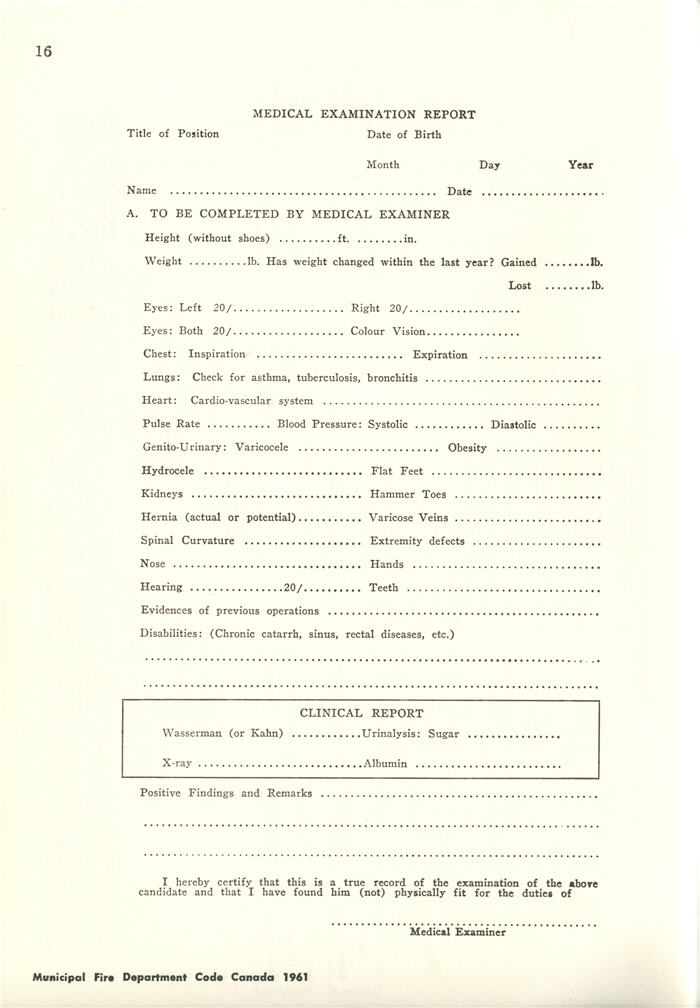
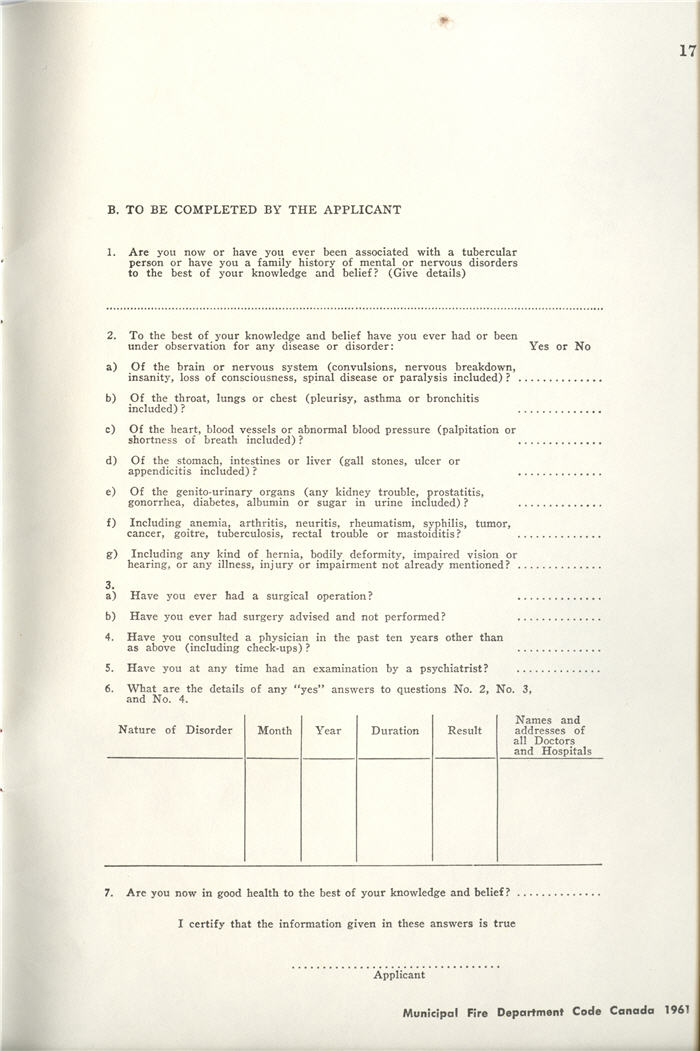
The Hiring ProcessIn order to become firefighters, the men of Fort William and Port Arthur had to meet a number of requirements. In 1962, newly hired Port Arthur firemen had to have completed Grade 10, and had to pass a one-year probation period (Fort William required three months of probation). If the fireman received a promotion at any point in his career, he also had to pass a year’s probation for that particular position. New hires for the Port Arthur Fire Department were to be between 21 and 30 years old, with exceptions made for men who had served in the military. If an applicant had served in the military and was over 30, his years of service were to be deducted from his age, and if the result was under 30, he could still be considered for employment. Furthermore, firemen who enlisted in the military would not compromise their seniority by doing so, and could return to their previous position upon return from service. Applicants had to be at least 5’8”, a minimum of 150 pounds, physically fit, able to pass a medical exam, and were required to be a resident of Port Arthur. If any employee was found not to be medically fit, lighter duties around the Department would be given to him. Medical ExamThis is a sample medical exam report from the Municipal Fire Department Code of Canada handbook (1961). Each firefighter had to pass a medical in order to be hired or promoted within the Department. Questions to be answered covered topics such as family history of mental or nervous disorders, contact with a person with tuberculosis, and details of surgical history.
"MEDICAL EXAMINATION REPORT Title of position Date of Birth Month Day Year Name Date A. TO BE COMPLETED BY THE MEDICAL EXAMINER
CLINICAL REPORT
I hereby certify that this is a true record of the examination of the above candidate and that I have found him (not) physically fit for the duties of [Signature of] Medical Examiner Municipal Fire Department Code Canada 1961"
B. TO BE COMPLETED BY THE APPLICANT 1. Are you now or have you ever been associated with a tubercular person or have you a family history of mental or nervous disorders to the best of your knowledge and belief? (Give details) 2. To the best of your knowledge and belief have you ever had or been under observation for any disease or disorder: 3. 4. Have you consulted a physician in the past ten years other than as above (including check-ups)? 5. Have you at any time had an examination by a psychiatrist? 6. What are the details of any “yes” answers to questions No. 2, No. 3, and No. 4. 7. Are you in good health to the best of your knowledge and belief? I certify that the information given in these answers is true [Signature of] Applicant" Municipal Fire Department Code Canada 1961 City of Thunder Bay Archives Series Number: 29 TBA: 2556-07
Firefighters' TrainingTraining for the members of the two Fire Departments was of the highest importance, and sessions were held regularly and practiced with extreme vigilance. Both Port Arthur and Fort William frequently reported Fire Department members passing firefighting courses with honours. Both Departments sent students away to the Ontario Fire College in Gravenhurst, Ontario, In 1961, the training program for the Port Arthur Fire Department was reformed. Firefighters were to receive more instruction to ensure that newcomers were well trained, and so the experienced firefighters could learn about new equipment, techniques, and strategies. Members were also trained in first aid, an important skill to have when dealing with threats to life every day. In 1962, the Port Arthur Fire Department began using the Abitibi Power and Paper Company’s land as a training ground for firefighters. The same year, the training manual underwent a major revision. The original basic manual had outlined simple firefighting principles and concepts. The new version included information on the use of equipment, and helped the firefighters learn how to put out fires in tandem, allowing them to work more quickly. Also during the same year, the two departments announced their interest in developing a shared training facility. In 1966, the Fort William training program for firefighters was also revitalized. The Department updated its training manual and training schedule, with two-hour sessions running Monday to Friday. All firefighters would learn the same procedures and techniques, to improve efficiency and teamwork. The daily training routine included hose evolutions, ladder practice, and the examination and mending of hose. Working ConditionsThe firefighters in Port Arthur were unionized under the International Association of Firefighters, Local 496. Benefits were provided under a health plan. If a firefighter was injured on the job, the City would pay the difference after the contribution of the Workmen’s Compensation Board to make up wages for a maximum of six months.
In 1945, firemen asked to have shifts reduced to 8 hours, from the existing 10-hour day or 14-hour night shift. A 48-hour workweek was soon passed by the Port Arthur Trades and Labour Council, and became effective June 1, 1946. Twelve years later, a shorter 40-hour work week was granted, resulting in a need for more employees. Nine extra positions were created. In Fort William, 1960 saw a change to a 44-hour work week from a 48-hour work week, run on a two week cycle. Standards set by the National Fire Protection Association required the Port Arthur Fire Department to have at least 120 firefighters listed as employees. When the recommendation was made in 1960, the Department only had 69 firefighters. Being short-staffed seemed to be a common state of affairs for both cities. In Fort William in 1920, for instance, there were 16 men on an average shift. In 1956, the numbers had decreased to 8 men per shift, which Chief Harold Lockwood was adamant about improving. For more information on this subject, or any other subject of interest, please visit or contact the City of Thunder Bay Archives. |
||||||||||||||||||||||||||||||||||||||||||||||||||||||||||||||||||||||
| Duties and Life at the Fire Stations: The working lives of everyday heroes | ||||||||||||||||||||||||||||||||||||||||||||||||||||||||||||||||||||||
|
Firefighters were also involved in rescue missions. A 1962 agreement for the Port Arthur Fire Department recommended that there be two trained skin divers on duty at all times in the event of a rescue or dragging mission, an idea that came about because of a drowning at Boulevard Lake. Interested firemen would volunteer for this training. The Port Arthur Fire Department, as a result of rescue training, was able to help out with the scaffolding collapse of the S.S. Shahristan on September 27, 1965. Five workmen were involved in this accident, as they fell through to the hold of the ship. Using Fire Department equipment, the firefighters raised the men out of the ship and onto the dock to be attended to by the Ambulance and Rescue Truck. Over time, fires occurred less frequently, as the Departments engaged in public education and developed more efficient responses. The Fort William Fire Department Annual Reports, from the 1940s on, show a yearly decrease in losses due to fire and an increasing commitment to prevention and education. Beginning in the mid-1940s, and increasing in importance as the years went on, firefighters were responsible for door-to-door home and business inspections. These inspections, according to Fire Chief E.H. Dean, were the reason that Fort William was ahead of most of North America when it came to preventing loss of life and property. Fort William, in fact, had a consistently good record in terms of destruction caused by fire. In 1959, the losses as calculated per capita ($0.68) were the lowest on record and possibly the lowest in Canada compared to other cities of the same size. The 1940s and 1950s saw an increased devotion to community service by the two Fire Departments, as they participated in Fire Prevention Week, extensive training and courses, inspections, and blood drives.
Being a firefighter also tended to impose on off-duty time. In the case of large fires, off-duty firemen would be called in to assist. This happened in 1963, when Acklands Limited on Violet Street in Fort William required all on- and off-duty firefighters, as well as all the equipment from the fire stations, to bring the fire under control. Extinguishing this fire took more than three hours of work. There were a variety of additions to the Port Arthur Fire Department staff during the 1950s. Previously, on-duty firefighters had been responsible for clerical and typist work. This situation soon became insufficient, and the Chief and Deputy Chief expressed frustration for years about firefighters being held down by clerical work when they had many other duties to perform in the Department. A regular typist was hired in 1960. A full-time fire inspector, Arthur Parry, was appointed in 1957 in order that there would be at least one person devoted to fire inspections, instead of relying on other busy members of the Department. The role of the Fire Inspector became more significant throughout the 1960s, and a request was made by the Fire Inspector to hire extra inspectors at the Port Arthur Fire Department.
Comfort was important to the members of the Fire Department, as the job and duties were undoubtedly taxing. It was important for the firemen to get adequate rest and be able to relax while at the station. This sparked a debate about working conditions in Port Arthur in the late 1950s, specifically regarding beds in the fire station. Outside opinion was solicited: the Fire Chief of Kitchener advised the Port Arthur Fire Department that it was better to have rested firemen on the night shift rather than forcing them to be awake, of course with the condition that the beds would not be abused by lazy men. Given the strain and physical endurance required for the job, it was thought that the firefighters should get the rest necessary to function well. Considering that the night shift could be called in early for a big fire, and then have to continue working, it would be unfair to expect them to remain awake for longer than a full shift. It is also important to consider that firefighters had a high incidence of heart disease due to smoke inhalation and the strenuous nature of their work.
By the time that this report was written in 1958, beds had long been removed from the stations, leaving sleeping firefighters to seek rest on chairs, tables, the floor, and even on piles of hoses. During the twelve years they were forbidden, beds were smuggled in, but were removed from sight during the day. There was no delay in response time to a fire alarm between firefighters who had been in bed and those who had been occupied elsewhere in the fire hall. Thus, a case had been made for beds in the fire stations.This same predicament was not an issue in Fort William: beds in the fire stations had always been acceptable, as was noted in the 1954 union agreement. Members of the Port Arthur Fire Department were not allowed to participate actively in politics. This included a restriction on the ability to strike and to strike in support of other unions, as the Fire Department was declared an essential service in 1946. The men were also restricted from gambling (particularly card games) while on duty, but other recreational equipment in the hall was allowed, such as televisions. This equipment was to be purchased by the men themselves, rather than coming out of the Fire Department's budget. Members of Council had voted against providing TVs in the Department in 1954, claiming that the quality of work would suffer if there was too much leisure in the fire stations.
The Port Arthur Fire Department, along with other Fire Departments across North America, supported fundraising for the Muscular Dystrophy Association of Canada. The annual campaign included door-to-door canvassing. Generous donations were collected, as demonstrated by the $3,000 raised for the Association in March, 1956. The Department also teamed with Fort William’s Fire Department to raise money for the Twin Haven school, which exclusively taught children with developmental disabilities, raising almost $12,000. The Fire Departments also collected Christmas toys for children each year, beginning in the mid-1950s. For more information on this subject, or any other subject of interest, please visit or contact the City of Thunder Bay Archives. |
||||||||||||||||||||||||||||||||||||||||||||||||||||||||||||||||||||||
| Fire Chiefs: The leaders of the Fire Departments over the years | ||||||||||||||||||||||||||||||||||||||||||||||||||||||||||||||||||||||
|
The Fire Chief has the most authority in the district Department and has important duties as a result. He has custody of all equipment and vehicles, determines the cause of fires, has the power to fairly punish wrongdoers, and keeps administrative and complaint records. He is given a vehicle for the job, known as the “Chief’s Car”, which is provided by the City. This had not always been the case, however: before 1925, the Fire Chief of Port Arthur had to use his own personal vehicle while on Department business. Fire Chiefs of the Fort William Fire Department
Fire Chiefs of the Port Arthur Fire Department
|
||||||||||||||||||||||||||||||||||||||||||||||||||||||||||||||||||||||
| Fire Stations: A history of places that have served as base of operations for the Fire Departments | ||||||||||||||||||||||||||||||||||||||||||||||||||||||||||||||||||||||
|
Fire stations are located throughout the City to provide service to different areas. Fort William maintained three primary fire stations for most of its history, working from the same locations until amalgamation. Port Arthur, on the other hand, operated stations in a less permanent manner, opening and closing throughout the City’s history. Port Arthur's only permanent fire station was Central Station, built in 1907. A History of the Fort William Fire Stations
Fort William’s Central Station was located at 120 Brodie Street South, on the east side between Victoria and Donald, and was built in 1903, after the first Fire Hall vanished in flames along with the Town Hall. It became the main station for Fort William, and was termed Fire Station No. 1. In the early 1900s this was the most well-equipped of the fire stations, as it housed the Fire Hall itself, bedrooms where all firefighters could sleep, stables, and a furnace room. (The Brown Street Station contained only the Fire Hall, and only the captain of the Brown Street Station was allowed to sleep at the station.) As time progressed, the station was gradually modernized and improved through renovations. In fact, the 1946 insertion of new Roll-Tite doors at the Central Station helped to make it “one of the most modern in Ontario.” (TBA0210-054 - 1946 Fire Department Annual Report, page 2) This station closed in 1963 and was demolished, and the firemen who had been stationed there were dispersed between the Brown Street Station and the Pacific Avenue Station until completion of the new Central Station on Vickers Street.
|
||||||||||||||||||||||||||||||||||||||||||||||||||||||||||||||||||||||
| Firefighting Equipment: The technologies and tools needed for service | ||||||||||||||||||||||||||||||||||||||||||||||||||||||||||||||||||||||
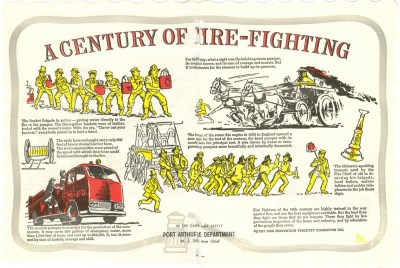
Vehicles and Firefighting EquipmentA variety of types of firefighting equipment has been used by the Fort William and Port Arthur Fire Departments. Over the years, this has included various hoses, chemical hoses, hand chemicals, hand pumps, foamite tanks, and fire hydrants. Hoses appeared to constantly need replacing: requests were put in nearly every year for additional hose. In Fort William, equipment was frequently moved around between the stations, depending on the age of the equipment and The picture above was published by the Joint Fire Prevention Publicity Committee Inc. in the early 1960s, this poster shows fire fighting over the years. It begins with the “Bucket Brigades” and the technologies of the early 1800s, and moves towards the modern era. Some equipment is displayed, such as the hose reels, the steam fire engine, and the Fire Chief’s “speaking trumpet”, which was later replaced by radio technology. The bottom left corner depicts a pumper truck, one of the basic necessities of any Fire Department. By 1961, Port Arthur and Fort William each had two pumper trucks. Port Arthur’s pumper trucks were capable of pumping 625 gallons of water per minute and 500 gallons per minute. Fort William’s pumper trucks were capable of pumping 625 gallons of water per minute and 600 gallons per minute. Five years later, Fort William made a request for a new fire pumper, which would By 1961, the Fort William Fire Department had in its inventory two pumpers, two hose trucks, one aerial truck, a portable pump, one ladder truck, a salvage and rescue vehicle, and the Chief’s car. The Central Station also maintained a civil defense truck, to which a snow plow was attached in 1967 so that the truck could be used for clearing snow at Fort William’s three fire stations. This was comparable to the Port Arthur Fire Department’s equipment during the same time period. In 1961, the department was equipped with two pumpers, a hose truck, a portable pump, a rescue truck, a ladder truck, an aerial truck, and the Chief’s car. The Department later purchased an auxiliary truck and an ambulance in 1966. When the Chief's car was replaced in 1960, the Department had bought a station wagon, that could also in an emergency serve as an ambulance. Fort William’s Fire Department was able to apply for a new pumper The proper upkeep of vehicles and equipment was of great importance. The condition of equipment and vehicles was always monitored in Fire Department Annual Reports, and the City would fund any necessary replacements. Vehicles had to pass an annual test to ensure safety and efficiency. Testing and maintenance was the job of the Department mechanic. The importance of upkeep and modern equipment was made painfully clear in 1932, when a ladder truck from Fort William’s Central Station was unable to make it to a fire at St. Paul’s church, where ladders were desperately needed. The situation was relieved only when firefighters and other vehicles were recruited to The Port Arthur Fire Department was often urged to expand its resources when it came to equipment. Given the size of Port Arthur, there were significant concerns about not having enough equipment on hand in the event of multiple or large fires. It was suggested, in accordance with the Canadian Underwriter’s Association and the National Fire Protection Association, that the Fire Department maintain six pumper trucks and two ladder trucks, with a crew of five or six firemen for each. Port Arthur had not been conforming to In order for the Fire Department to house all the new equipment, a new, larger fire station would be necessary. This fire station would have to be in central Port Arthur, but also take into consideration the traffic flow and other local concerns. The proposed new location was in the west end, so the station would protect the areas west of High St. (in the Oliver Road area), and the west end areas of Brent Park and Shuniah Road (around Junot and River St.). The new station would relieve the other stations, especially Central station, of some of the territory they had been responsible for protecting. This hypothetical new station was anticipated for years, as seen in the Annual Reports of the Fire Department, but never materialized. The two Fire Departments had managed, over the years, to acquire some impressive equipment. In 1948, the Port Arthur Fire Department purchased a 100-foot aerial ladder, which was publicly tested by reaching to the top windows of the Public Utilities Commission building, and to the top of the Prince Arthur Hotel. In fact, the Port Arthur Fire Department, in the late 1950s and early 1960s, was believed to be one of the top Fire Departments in Ontario in terms of equipment.
Radio and CommunicationsIn 1952, the Fort William Fire Department acquired a new radio phone system, to make communications during alarms and emergencies more efficient. Shortly after it was installed, the Fire Department was able to help after the Pool 4A Elevator Explosion and be called back to fight two other fires simultaneously. In Port Arthur, a request was made the same year for a new two-way radio system, and this was installed in Central Station the following year. Requirements for the system included being able to connect to the ambulance radio system, and to the Fort William Fire Department system. Being able to synchronize responses to alarms, and redirect calls, was worth the extra cost. In 1965, a phone message recording system was added, to prevent confusion and loss if a wrong address was pursued. Street fire alarm boxes had been available to the public and used in the earlier days of the Fire Departments, so that members of the public could warn of a fire. By 1960, the last fire alarm box was taken down in Port Arthur, and Fort William expressed interest in revoking their street alarm boxes--with good reason. The use of these alarms was considered outdated (due to modern telephone equipment and other alarm technology), and they were frequently the source of false alarms. The alarm boxes were dismantled in Fort William the following year. Protective Equipment
Of course, firefighting equipment also includes the protective gear that firefighters are required to wear. The City of Fort William provided formal uniforms to the firemen, which consisted of a coat, a vest, and matching pants and firefighting equipment consisting of a helmet, woolen mittens, shirts, fatigue pants, duty pants, rubber boots, and winter and summer caps. The Port Arthur firemen were provided with similar gear. They had two uniforms: a formal uniform and one designed for actual firefighting. Clothing included peacoats, tunics, vests, trousers, shirts, and neckties for formal attire and overalls, rubber boots, and waterproof coats for fighting fires. The uniforms varied in style depending on whether the wearer was an officer or a fireman. Requests for uniform tenders were placed in the newspaper. Potential vendors were required to submit a sample of fabric, information as to whether the garments would be made locally, and the price at which the item could be purchased. Among the regular clothing providers were Eatons and the local McNulty’s Ltd. In 1952, a request was made for the Fort William Department to purchase gas masks, as there had been three incidences that year where firefighters were unable to enter buildings due to poor ventilation and an abundance of smoke. In Port Arthur, in 1955, improved air masks were received as well as a Stephenson Resuscitator to improve life-saving capabilities and the ability to fight fires. For more information on this subject, or any other subject of interest, please visit or contact the City of Thunder Bay Archives. |
||||||||||||||||||||||||||||||||||||||||||||||||||||||||||||||||||||||
| Fire Prevention Activities: The cities' dedication to stopping fires before they start | ||||||||||||||||||||||||||||||||||||||||||||||||||||||||||||||||||||||
|
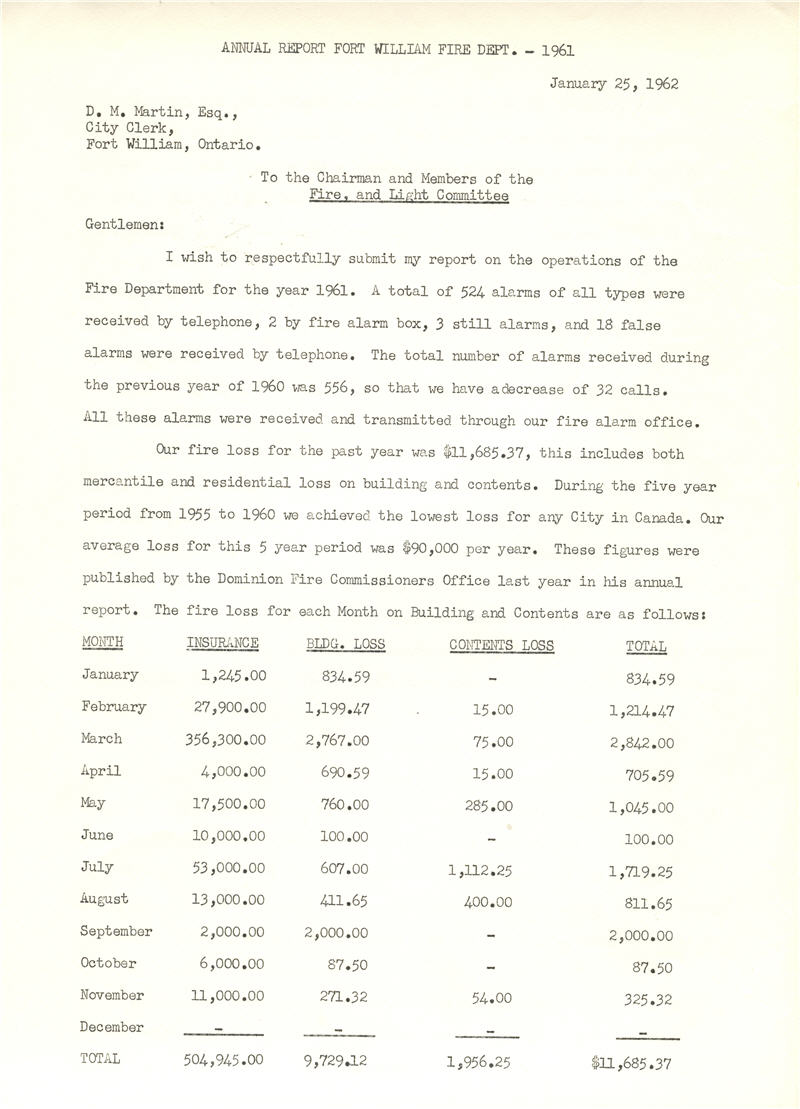
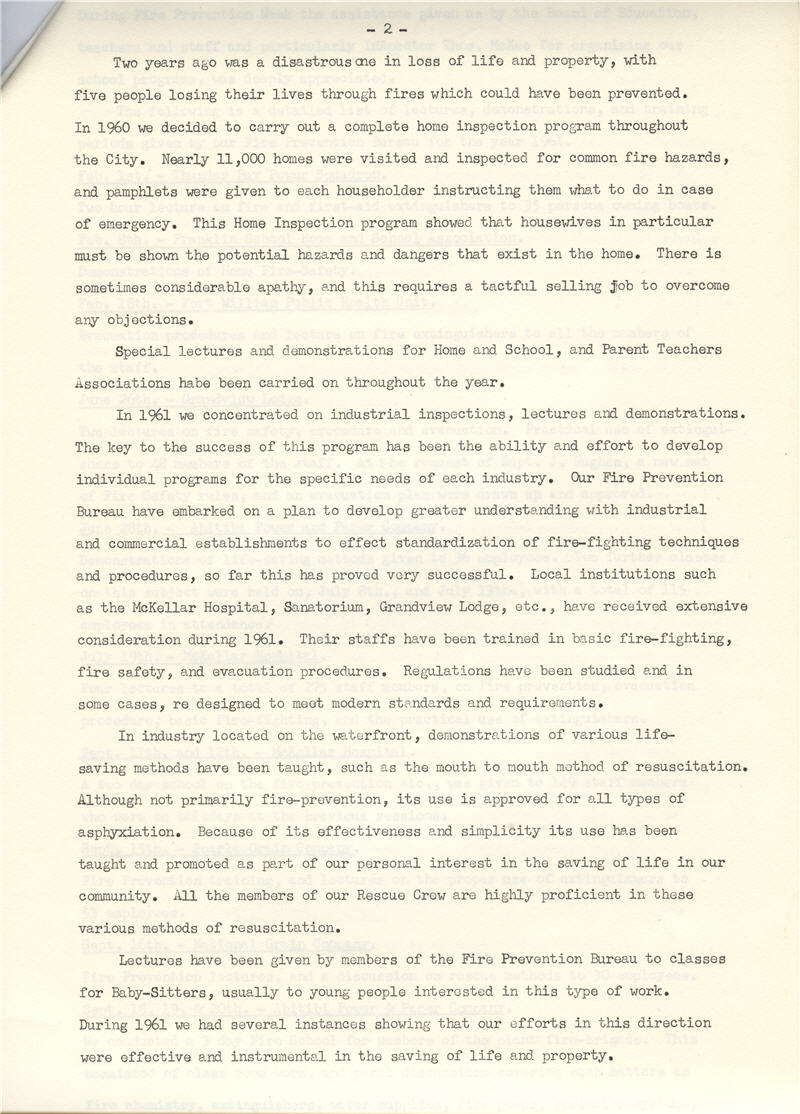
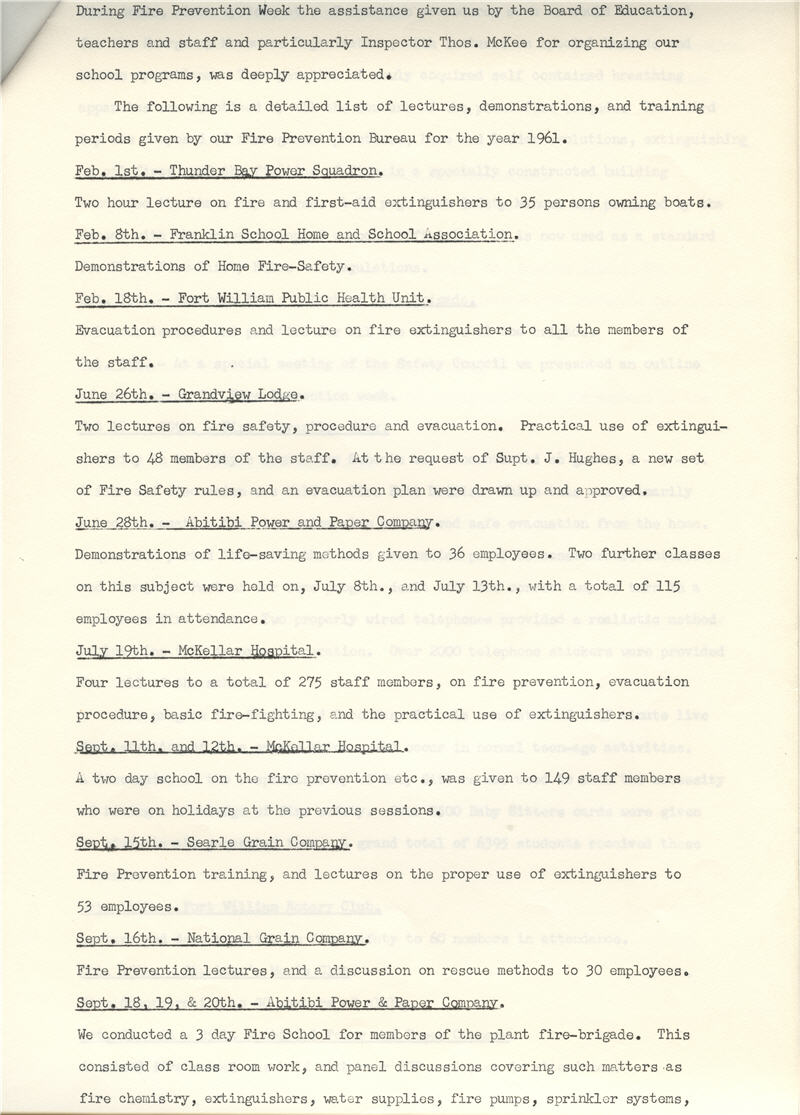
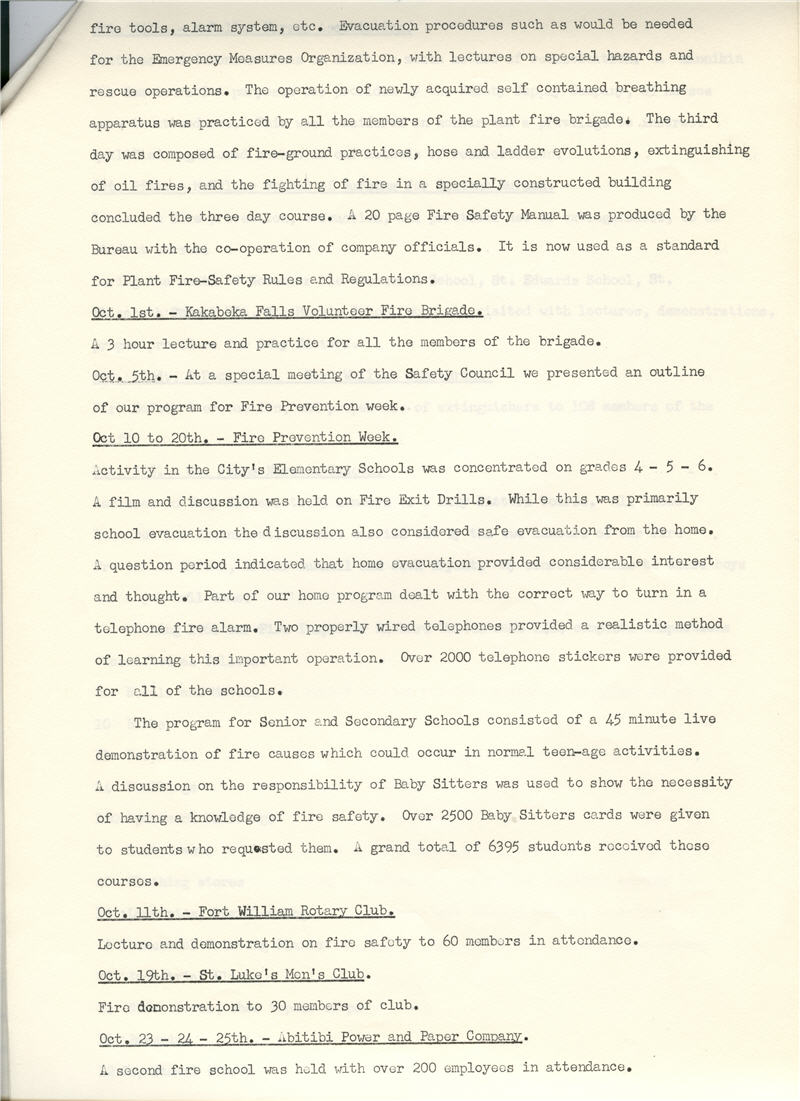
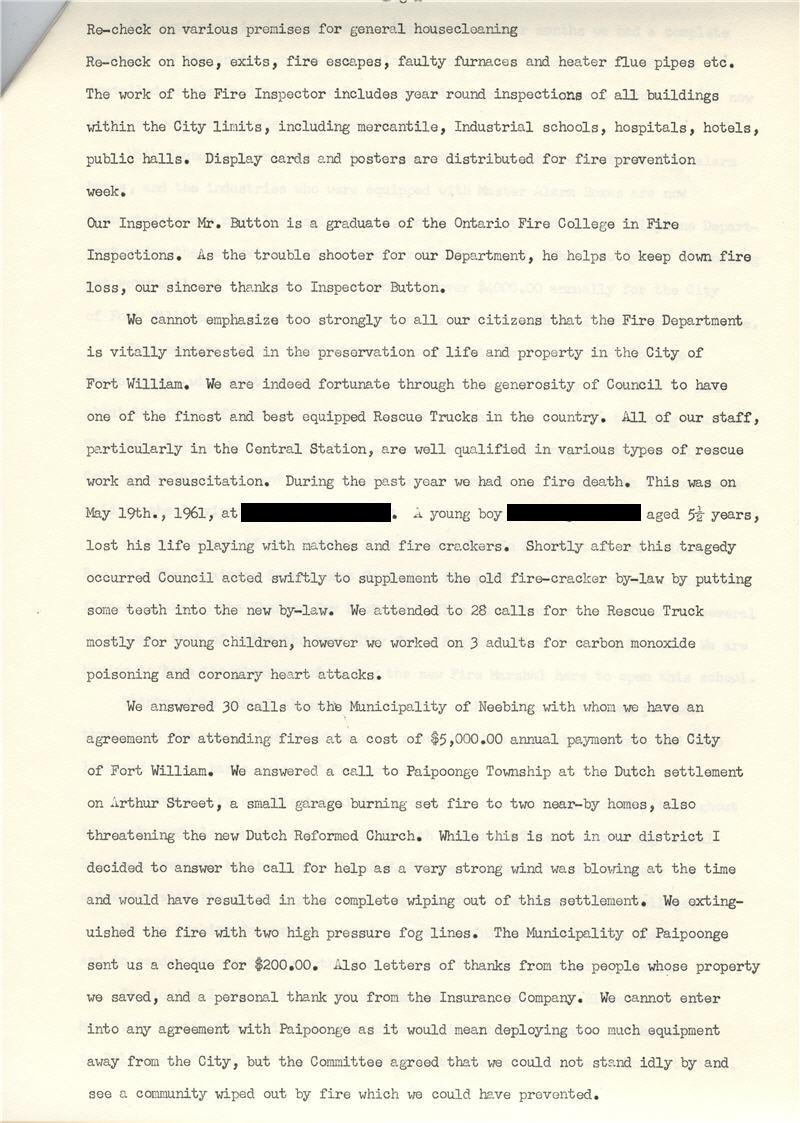
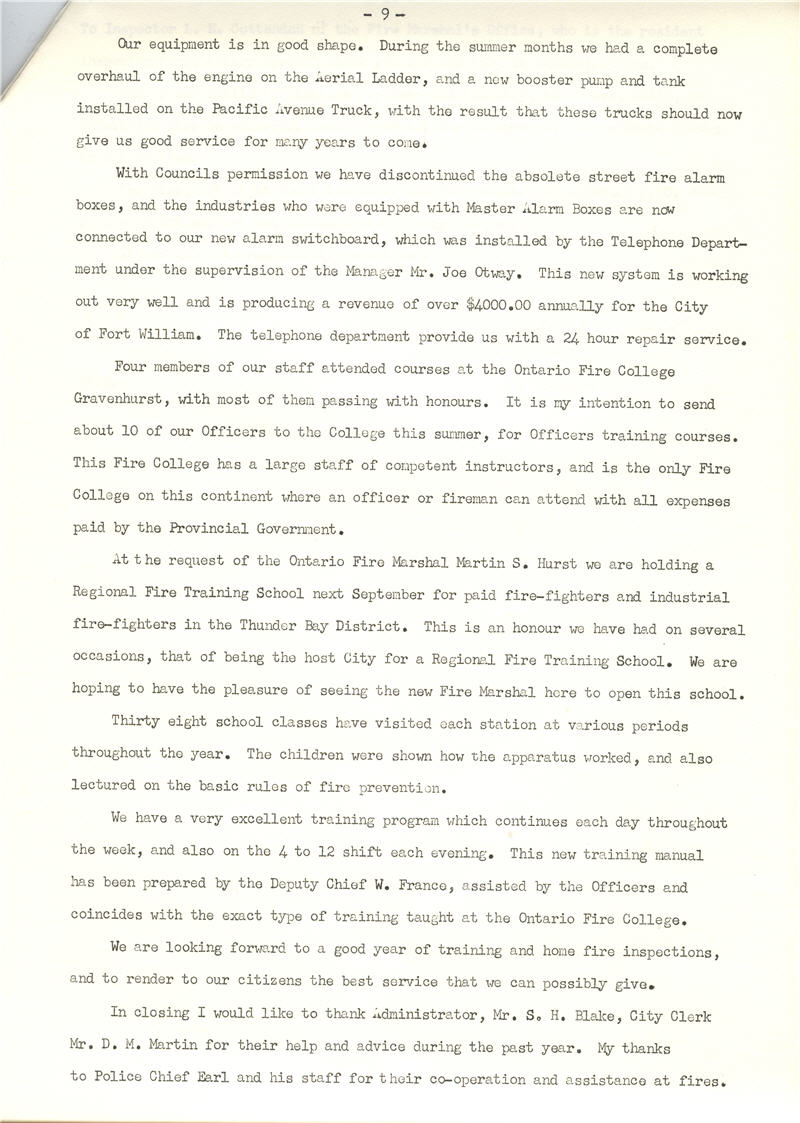
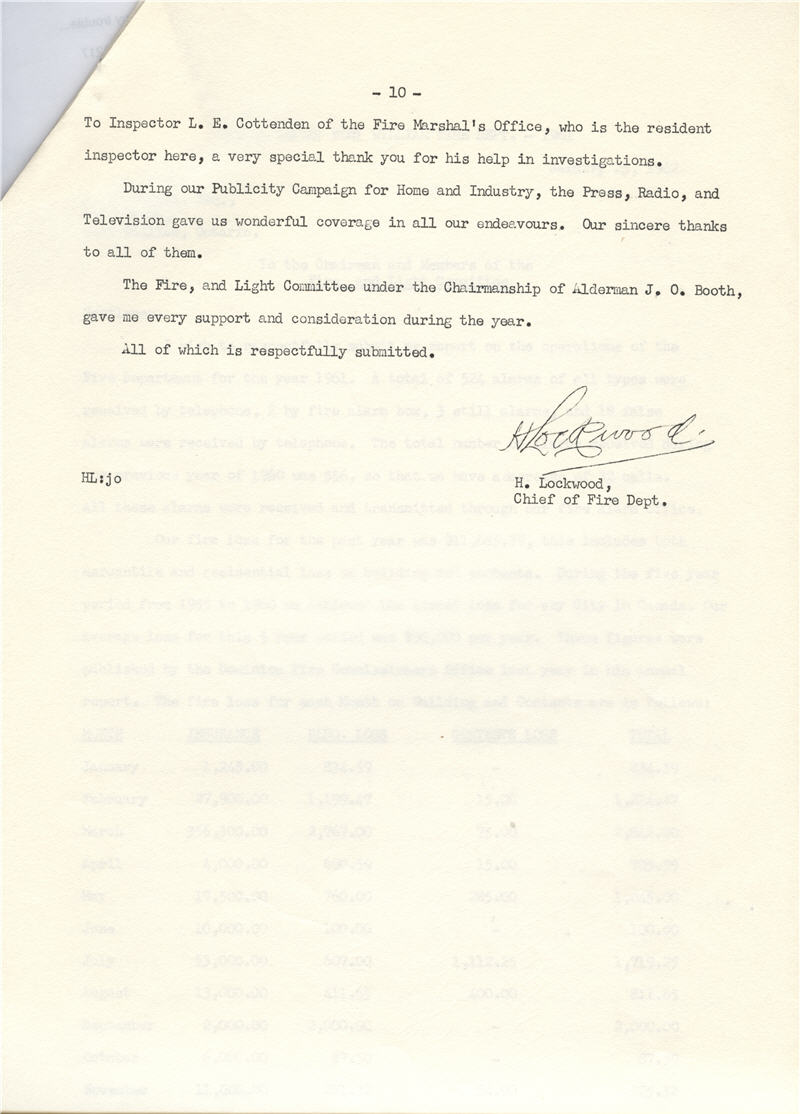
Fire Prevention Week was an important annual event for both the Fort William and Port Arthur Fire Departments. This event became a regular practice across North America in 1922, after an increase in devastating losses over the previous years. Fire Prevention Week was often focused on the particular problems that the cities were having in terms of fire safety. It improved the Fire Departments’ service by ensuring that major risks were not looming, and allowed them to make changes for safety where necessary. This, of course, meant involving the public in prevention education and activities. Fort WilliamThe firefighters were responsible for carrying out activities during Fire Prevention Week, which usually took place in the first half of October. Events included presentations to schoolchildren, radio announcements, and lectures to inform the public about what to do in the event of a fire. In some years, safety and information films from the National Film Board and the Fire Marshall’s Office were screened. Fire Prevention booklets were distributed as well. The Fire Department worked alongside the Junior Chamber of Commerce, CKPR, and the Daily-Times Journal to make the week a success, and even held a Fire Prevention Booth at the Canadian Lakehead Exhibition during the festivities. Fire Department Annual Report, 1961The Fire Chiefs were responsible for producing an annual report each year. This example dates from 1961. Throughout the years, the annual reports differed in content, but the most consistent elements were the record of losses due to fire and a report on the condition of the stations and equipment. As can be seen in this example, there is much detail given regarding inspections, training, community service, and Fire Prevention Week activities. The reports become more detailed and lengthy over time, and this report is a good example of the sort of extra detail provided. Included in this report is a discussion of service to Paipoonge despite the fact that the Department was not bound by agreement to be there. Also, the report notes the discontinuance of street alarm boxes, due to the mischief that the alarms tended to attract, which made for many false alarms over the years.
The transcription of this report is as follows: "Annual Report Fort William Fire Department.- 1961 To the Chairman and Members of the Fire, and Light Committee Gentlemen: I wish to respectfully submit my report on the operations of the Fire Department for the year 1961. A total of 524 alarms of all types were received by telephone, 2 by fire alarm box, 3 still alarms, and 18 false alarms were received by telephone. The total number of alarms received during the previous year of 1960 was 556, so that we have a decrease of 32 calls. All these alarms were received and transmitted through our fire alarm office. Our fire loss for the past year was $11,685.37, this includes both mercantile and residential loss on building and contents. During the five year period from 1955 to 1960 we achieved the lowest loss for any City in Canada. Our average loss for this 5 year period was $90,000 per year. These figures were published by the Dominion Fire Commissioners Office last year in his annual report. The fire loss for each Month on Building and Contents are as follows:
"Two years ago was a disastrous one in loss of life and property, with five people losing their lives through fires which could have been prevented. In 1960 we decided to carry out a complete home inspection program throughout the City. Nearly 11,000 homes were visited and inspected for common fire hazards, and pamphlets were given to each householder instructing them what to do in case of emergency. This Home Inspection program showed that housewives in particular must be shown the potential hazards and dangers that exist in the home. There is sometimes considerable apathy, and this requires a tactful selling job to overcome any objections. Special lectures and demonstrations for Home and School, and Parent Teachers Associations have [sic] been carried on throughout the year. In 1961 we concentrated on industrial inspections, lectures and demonstrations. The key to the success of this program has been the ability and effort to develop individual programs for the specific needs of each industry. Our Fire Prevention Bureau have embarked on a plan to develop greater understanding with industrial and commercial establishments to effect standardization of fire-fighting techniques and procedures, so far this has proved very successful. Local institutions such as the McKellar Hospital, Sanatorium, Grandview Lodge, etc., have received extensive consideration during 1961. Their staffs have been trained in basic fire-fighting, fire safety, and evacuation procedures. Regulations have been studied and in some cases, re designed to meet modern standards and requirements. In industry located on the waterfront, demonstrations of various life-saving methods have been taught, such as the mouth to mouth method of resuscitation. Although not primarily fire-prevention, its use is approved for all types of asphyxiation. Because of its effectiveness and simplicity its use has been taught and promoted as part of our personal interest in the saving of life in our community. All the members of our Rescue Crew are highly proficient in these various methods of resuscitation. Lectures have been given by members of the Fire Prevention Bureau to classes for Baby-Sitters, usually to young people interested in this type of work. During 1961 we had several instances showing that our efforts in this direction were effective and instrumental in the saving of life and property."
"During Fire Prevention Week the assistance given us by the Board of Education, teachers and staff and particularly Inspector Thos. McKee for organizing our school programs, was deeply appreciated. The following is a detailed list of lectures, demonstrations, and training periods given by our Fire Prevention Bureau for the year 1961.
"Sept. 18, 19, & 20th - Abitibi Power and Paper Company. We conducted a 3 day Fire School for members of the plant fire-brigade. This consisted of class room work, and panel discussions covering such matters as fire chemistry, extinguishers, water supplies, fire pumps, sprinkler systems, [Page 4] fire tools, alarm system, etc. Evacuation procedures such as would be needed for the Emergency Measures Organization, with lectures on special hazards and rescue operations. The operation of newly acquired self contained breathing apparatus was practiced by all the members of the plant fire brigade. The third day was composed of fire-ground practices, hose and ladder evolutions, extinguishing of oil fires, and the fighting of fire in a specially constructed building concluded the three day course. A 20 page Fire Safety Manual was produced by the Bureau with the co-operation of company officials. It is now used as a standard for Plant Fire-Safety Rules and Regulations.
The program for Senior and Secondary Schools consisted of a 45 minute live demonstration of fire causes which could occur in normal teenage activities. A discussion on the responsibility of Baby Sitters was used to show the necessity of having a knowledge of fire safety. Over 2500 Baby Sitters cards were given to students who requested them. A grand total of 6395 students received those courses.
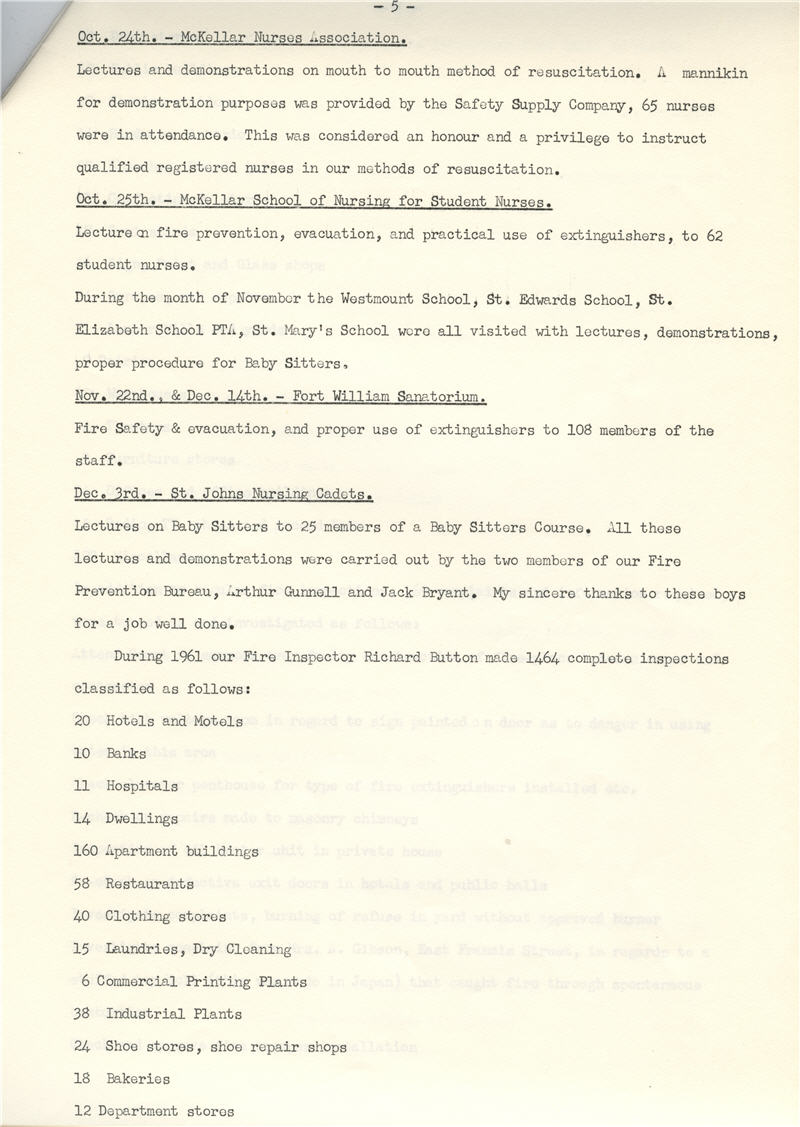
During 1961 our Fire Inspector Richard Button made 1464 complete inspections classified as follows:"
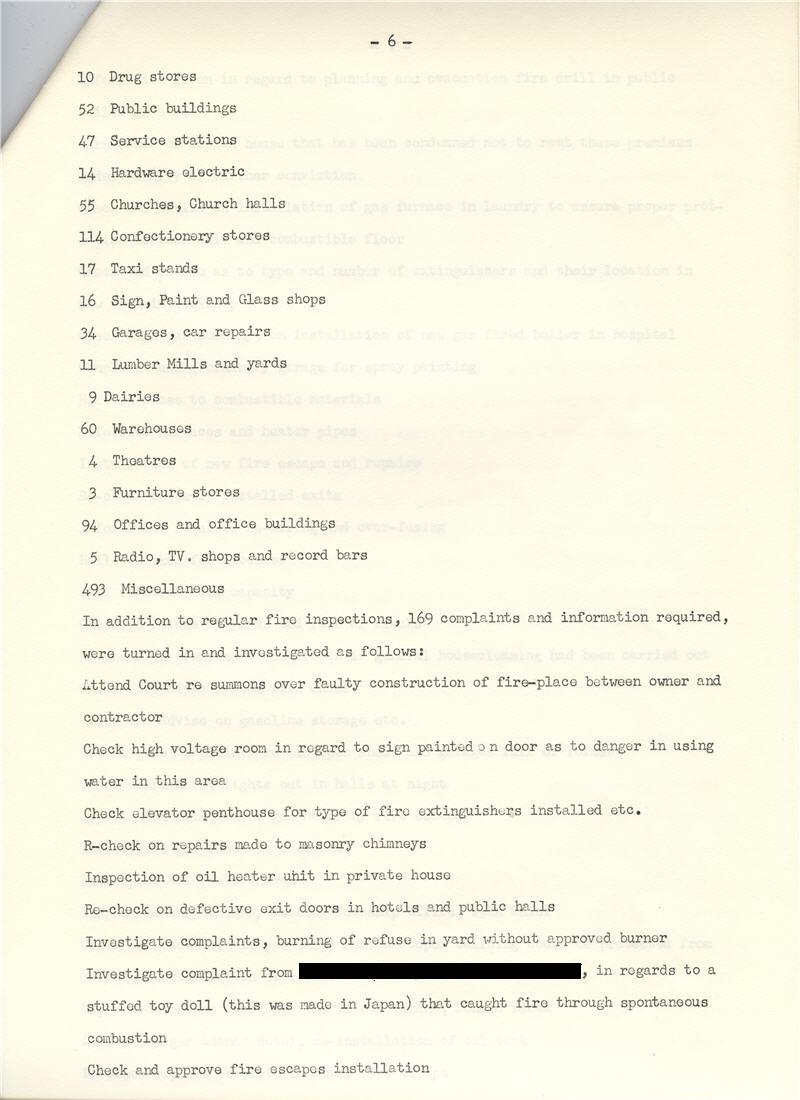
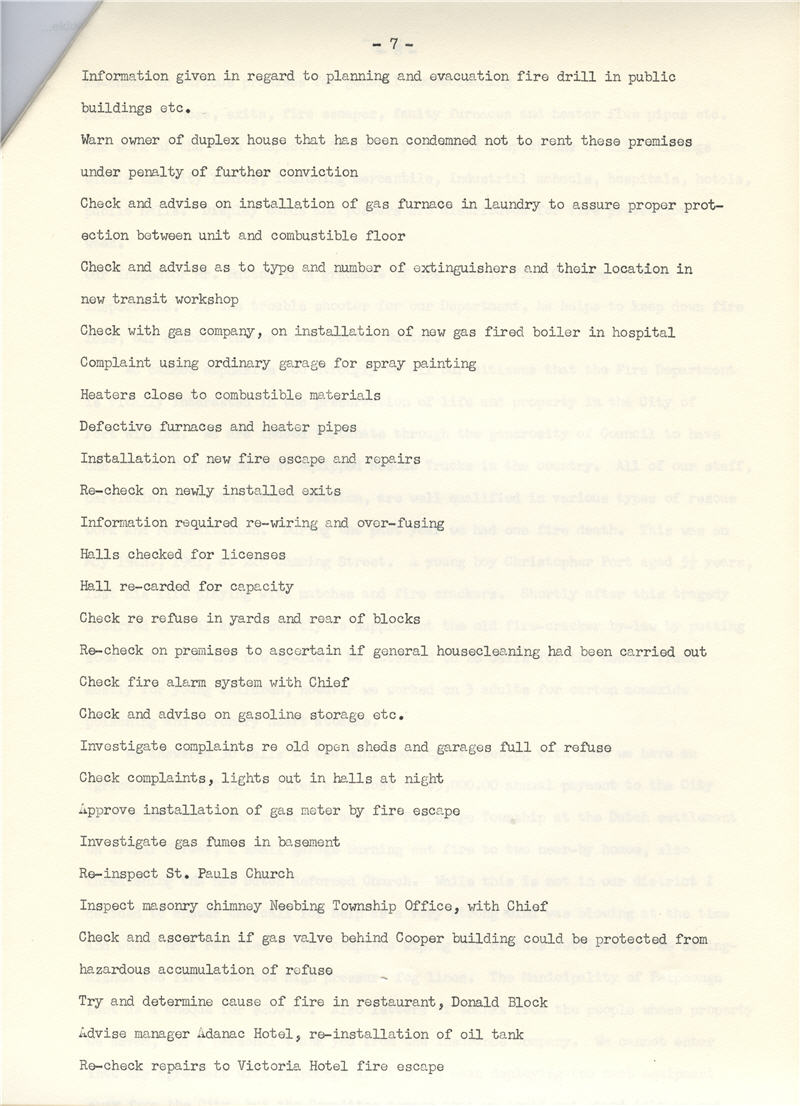
"20 Hotels and Motels, 10 Banks, 11 Hospitals, 14 Dwellings, 160 Apartment buildings, 58 Restaurants, 40 clothing stores, 15 Laundries, Dry Cleaning, 6 Commercial Printing Plants, 38 Industrial Plants, 24 Shoe stores, shoe repair shops, 18 Bakeries, 12 Department stores, [Page 6] 10 Drug stores, 52 Public buildings, 47 Service stations, 14 Hardware electric, 55 Churches, Church halls, 114 Confectionery stores, 17 Taxi stands, 16 Sign, Paint and Glass shops, 34 Garages, car repairs, 11 Lumber Mills and yards, 9 Dairies, 60 Warehouses, 4 Theatres, 3 Furniture stores, 94 Offices and office buildings, 5 Radio, TV. shops and record bars, 493 Miscellaneous. In addition to regular fire inspections, 169 complaints and information required, were turned in and investigated as follows:
The work of the Fire Inspector includes year round inspections of all buildings within the City limits, including mercantile, Industrial schools, hospitals, hotels, public halls. Display cards and posters are distributed for fire prevention week. Our Inspector Mr. Button is a graduate of the Ontario Fire College in Fire Inspections. As the trouble shooter for our Department, he helps to keep down fire loss, our sincere thanks to Inspector Button. We cannot emphasize too strongly to all our citizens that the Fire Department is vitally interested in the preservation of life and property in the City of Fort William. We are indeed fortunate though the generosity of Council to have one of the finest and best equipped Rescue Trucks in the country. All of our staff, particularly in the Central Station, are well qualified in various types of rescue work and resuscitation. During the past year we had one fire death. This was on May 19th, 1961 at [redacted]. A young boy [redacted], aged 5 ½ years, lost his life playing with matches and fire crackers. Shortly after this tragedy occurred Council acted swiftly to supplement the old fire-cracker by-law by putting some teeth into the new by-law. We attended to 28 calls for the Rescue Truck mostly for young children, however we worked on 3 adults for carbon monoxide poisoning and coronary heart attacks. We answered 30 calls to the Municipality of Neebing with whom we have an agreement for attending fires at a cost of $5,000.00 annual payment to the City of Fort William. We answered a call to Paipoonge Township at the Dutch settlement on Arthur Street, a small garage burning set fire to two near-by homes, also threatening the new Dutch Reformed Church. While this is not in our district I decided to answer the call for help as a very strong wind was blowing at the time and would have resulted in the complete wiping out of this settlement. We extinguished the fire with two high pressure fog lines. The Municipality of Paipoonge sent us a cheque for $200.00. Also letters of thanks from the people whose property we saved, and a personal thank you from the Insurance Company. We cannot enter into any agreement with Paipoonge as it would mean deploying too much equipment away from the City, but the Committee agreed that we could not stand idly by and see a community wiped out by fire which we could have prevented."
"Our equipment is in good shape. During the summer months we had a complete overhaul of the engine on the Aerial Ladder, and a new booster pump and tank installed on the Pacific Avenue Truck, with the result that these trucks should now give us good service for many years to come. With Councils permission we have discontinued the obsolete [sic] street fire alarm boxes, and the industries who were equipped with Master Alarm Boxes are now connected to our new alarm switchboard, which was installed by the Telephone Department under the supervision of the Manager Mr. Joe Otway. This new system is working out very well and is producing a revenue of over $4000.00 annually for the City of Fort William. The telephone department provide us with a 24 hour repair service. Four members of our staff attended courses at the Ontario Fire College Gravenhurst, with most of them passing with honours. It is my intention to send about 10 of our Officers to the College this summer, for Officers training courses. This Fire College has a large staff of competent instructors, and is the only Fire College on this continent where an officer or fireman can attend with all expenses paid by the Provincial Government. At the request of the Ontario Fire Marshal Martin S. Hurst we are holding a Regional Fire Training School next September for paid fire-fighters and industrial fire-fighters in the Thunder Bay District. This is an honour we have had on several occasions, that of being the host City for the Regional Fire Training School. We are hoping to have the pleasure of seeing the new Fire Marshal here to open this school. Thirty eight school classes have visited each station at various periods throughout the year. The children were shown how the apparatus worked, and also lectured on the basic rules of fire prevention. We have a very excellent training program which continues each day throughout the week, and also on the 4 to 12 shift each evening. This new training manual has been prepared by the Deputy Chief W. France, assisted by the Officers and coincides with the exact type of training taught at the Ontario Fire College. We are looking forward to a good year of training and home fire inspections, and to render to our citizens the best service that we can possibly give."
"In closing I would like to thank Administrator, Mr. S.H. Blake, City Clerk Mr. D.M. Martin for their help and advice during the past year. My thanks to Police Chief Earl and his staff for their cooperation and assistance at fires. [Page 10] To Inspector L.E. Cottenden of the Fire Marshal’s Office, who is the resident inspector here, a very special thank you for his help in investigations. During our Publicity Campaign for Home and Industry, the Press, Radio, and Television gave us wonderful coverage in all our endeavours. Our sincere thanks to all of them. The Fire, and Light Committee under the Chairmanship of Alderman J.O. Booth, gave me every support and consideration during the year. All of which is respectfully submitted. [Signed] H. Lockwood Chief of Fire Dept." City of Thunder Bay Archives Series Number: 16 TBA: 5225-59
Firemen also held fire drill evacuation competitions for schoolchildren, and some of the winning schools over the years included St. Martin’s School, Isabella Street School, and Ogden Street School. Fort William regularly placed well in Fire Prevention Week national ratings. In 1948, Fort William achieved tenth place in Canada, an impressive feat given the number of other cities involved and the enthusiasm of the competition. The Fire Department’s Annual Reports consistently mention the activities and events of Fire Prevention Week every year, and there was always positive feedback. Luckily, fire fatalities were generally rare in the Lakehead. In 1960, however, the beginning of the year saw five tragic deaths due to preventable fire, with most of the casualties being children. As a result, the Fire Department took up door-to-door inspections with more fervour, deciding that one-on-one contact with homeowners might prevent such tragedies. The campaign was a success, as firefighters were an excellent source of advice on fire prevention, the causes of fire, and changes that could be made to improve safety. The Fire Department devoted much time to fire prevention measures, as these activities kept safety and awareness in the minds of citizens and business owners. The devotion of individual firefighters is also evident, as many of these community education efforts were performed while off-duty. Port ArthurAs in Fort William, the Port Arthur Fire Department participated in Fire Prevention Week, and often ran similar activities. First advertised as “Safety Week” in 1920, with a focus on the theme of "Fire and Accident Prevention", Port Arthur continued the tradition annually as Fire Prevention Week. The firefighters were responsible for holding fire drill contests in schools, even blocking off doors to simulate the difficulty of escaping fires. They were also responsible for home inspections during the Week, which were successful in decreasing the number of household fires. The Port Arthur Fire Department took Fire Prevention Week seriously, and in 1942 had placed second in the national rankings for Educational Activities. The year before this, Port Arthur placed ninth in Canada and second in Ontario for Fire Prevention Week, showing that the Fire Department both cared about fighting fires and had a commitment to prevention and inspection. For more information on this subject, or any other subject of interest, please visit or contact the City of Thunder Bay Archives. |
||||||||||||||||||||||||||||||||||||||||||||||||||||||||||||||||||||||
| Cooperation Between the Cities: A united Lakehead before amalgamation | ||||||||||||||||||||||||||||||||||||||||||||||||||||||||||||||||||||||
Despite the long-standing and oft-noted rivalry between Fort William and Port Arthur, the two cities have always been willing to provide firefighting assistance to each other and to surrounding municipalities. This cooperation foreshadowed the creation of Thunder Bay and the cohesiveness of the Lakehead today.
Relationship between the Port Arthur and Fort William Fire DepartmentsThe Port Arthur and Fort William Fire Departments were at each other’s service in the event of an emergency or difficult-to-control fire. In the histories of the two cities, each required the assistance of the other on several occasions. Policies and purchasing decisions provide evidence of the importance of this cooperation. Two-way radios acquired by the Port Arthur Fire Department were designed to be able to connect with those used in Fort William. In fact, the Department had been considering a less expensive system, but decided on the more expensive model entirely because it would be compatible with Fort William's. Though the two cities remained mostly autonomous in fire affairs, it was comforting to each to know that there was a neighbour who could provide help if needed. Fire Services to other districts and municipalities
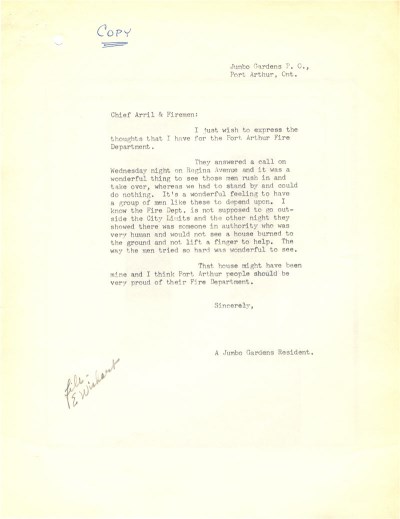
The Fort William Fire Department was often called to serve outside of the boundaries of the City, even before the Thunder Bay District Mutual Fire Aid Agreement was formed. There are reports of service to Neebing in 1955, when a fire endangered the municipal building. Although the Fire Department had made no official agreement to help, a fire in Paipoonge in 1961 summoned Fort William firefighters. Such an act of compassion shows that the Department was able to look beyond agreements and instead focus on the needs of communities in distress. The letter to the right was written by a resident of Jumbo Gardens, praising the Port Arthur Fire Department for a job well done outside of the boundaries the Department was required to work. Praise for the Department was deserved and common, often finding its way into the newspapers. This letter to the Department is one example of the gratitude that the City of Port Arthur, and those outside of it, had for their Fire Department. Documents suggest that the fire chiefs used their discretion in answering calls to other municipalities, as Fort William covered more than enough land to concern the Department. Fire service to Neebing ended on the first day of 1968, when a volunteer brigade assumed responsibility. This was also the case in Kakabeka Falls, as Chief Harold Lockwood had assisted in the creation of the Kakabeka Falls Fire Brigade ten years before in 1958, leaving the community more autonomous in its fire services and able to contribute to the Thunder Bay District Mutual Aid Plan in 1965. The Port Arthur Firefighters Agreement of 1959 asserted that firefighting service was strictly for Port Arthur, with possible aid to Fort William if needed. It was left to the Chief's discretion whether to fight fires starting elsewhere that had the potential to affect Port Arthur. Clear guidelines were necessary because Port Arthur had limited resources for outside assistance with only a few fire stations. This policy was changed after joining the Thunder Bay District Mutual Fire Aid Plan. Thunder Bay District Mutual Fire Aid PlanIn 1965, Fort William and Port Arthur joined the Thunder Bay District Mutual Fire Aid Plan, which organized service sharing between neighbouring municipalities. It was created in accordance with the Municipal Act, which stated that different municipalities would be able to form agreements regarding the use of fire equipment.
This policy of mutual assistance was ratified under By-Law 5312. If a fire was too large to be brought under control by one Fire Department, others would be contacted for help. Each Fire Chief had the authority to determine whether his Department would answer a call to a fire outside city limits. There would be no charges to municipalities for requiring assistance from another. The municipalities included in the agreement were:
Assistance to any of these locations would come from the two or three closest municipalities. For more information on this subject, or any other subject of interest, please visit or contact the City of Thunder Bay Archives. |
||||||||||||||||||||||||||||||||||||||||||||||||||||||||||||||||||||||
| Significant Fires: A sample of the losses witnessed by the Fire Department | ||||||||||||||||||||||||||||||||||||||||||||||||||||||||||||||||||||||
| Significant Fires | ||||||||||||||||||||||||||||||||||||||||||||||||||||||||||||||||||||||
| Firefighters Lost on Duty: Remembering those who gave their lives for a safer community | ||||||||||||||||||||||||||||||||||||||||||||||||||||||||||||||||||||||
|
The plaque on the right was created by the Port Arthur Fire Department to honour the members of the Department who had passed away, both on the job and after retirement. The plaque was located in the Central Fire Hall, and was placed there in September of 1959, with additional names added later. The plaque was created the same year that three members tragically died in an airplane crash. For Fort William, the firemen lost in the line of duty are as follows:
For Port Arthur, the firemen lost in the line of duty are as follows:
These lists extend only until 1970, and may not be complete. For more information on this subject, or any other subject of interest, please visit or contact the City of Thunder Bay Archives. |
 where the men would improve their skills in the craft of firefighting. In 1962, the Regional Fire School, a mobile training course that the Ontario Fire College held in different districts in Ontario, came to Fort William. Firemen from both Fort William and Port Arthur attended.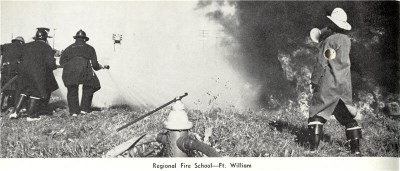
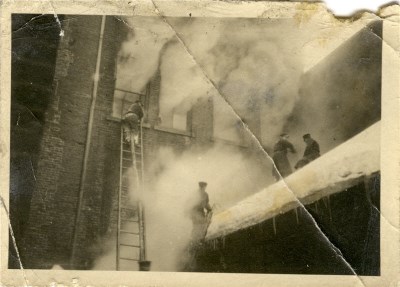
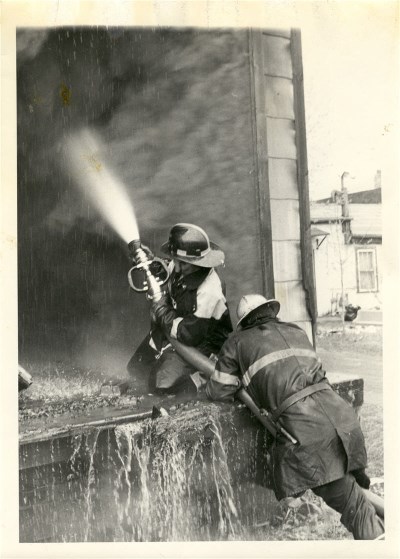 There is more to being a firefighter than extinguishing fires. Members of both Fire Departments were expected to participate in other activities to ensure the safety of the community. For instance, during the 1950s, the Fire Departments were involved in civil defense exercises, due to international tensions during the Cold War.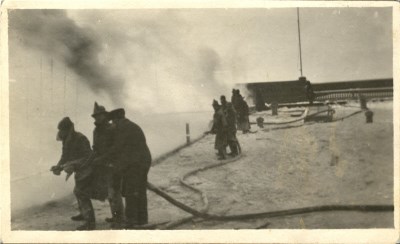

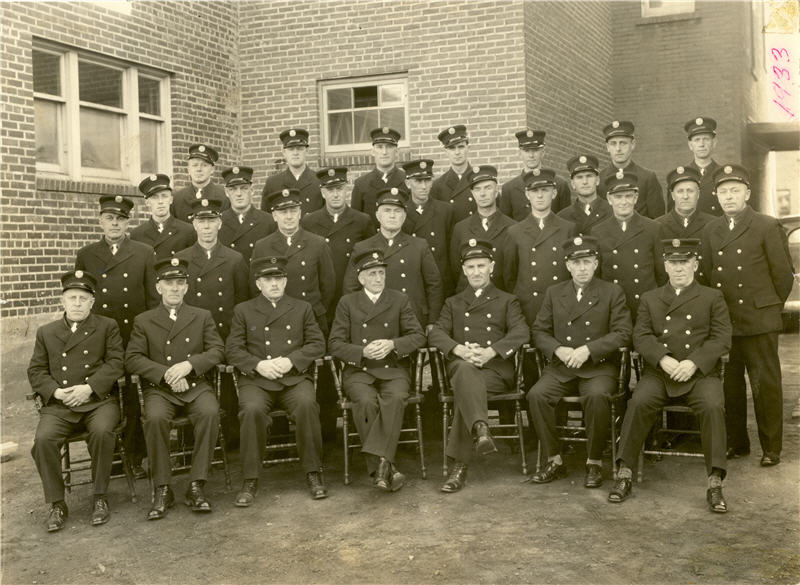
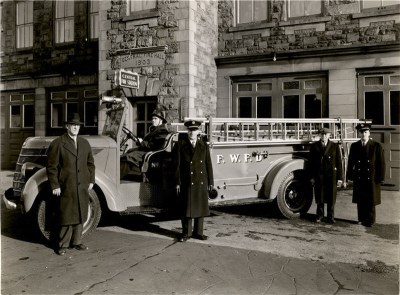 Before the Central Station in Fort William was built, the Fire Hall had been located in the Town Hall. This building burnt down in 1903. For more information on this fire hall, see the
 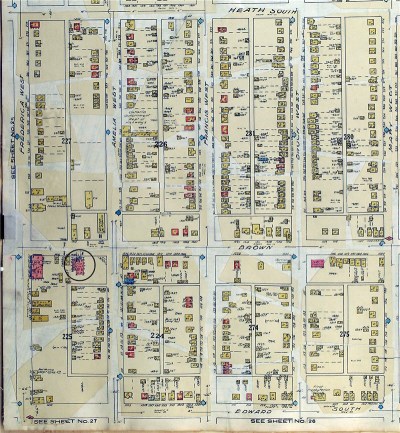 Brown Street Station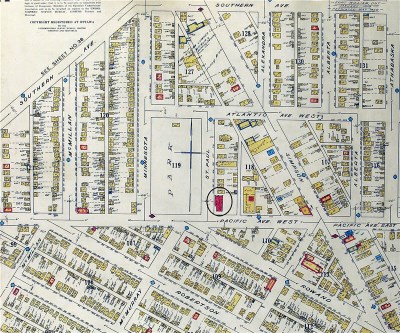
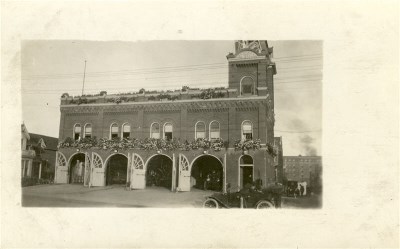
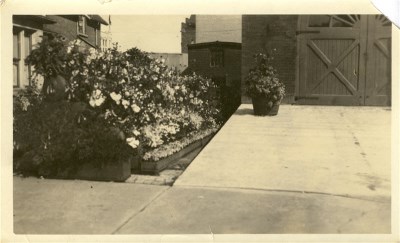
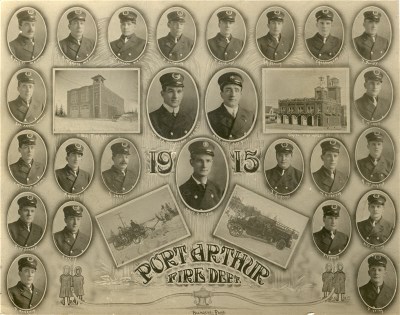 The next station to be built in Port Arthur was located at 87 Hill St. North, and was recognized as Station No. 2. It was built in 1913, and closed in the early 1930s.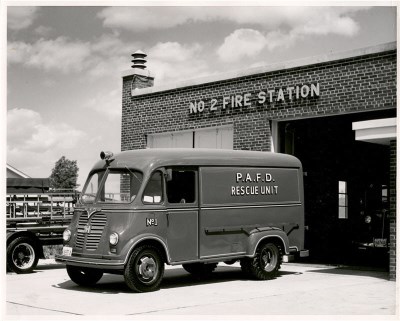
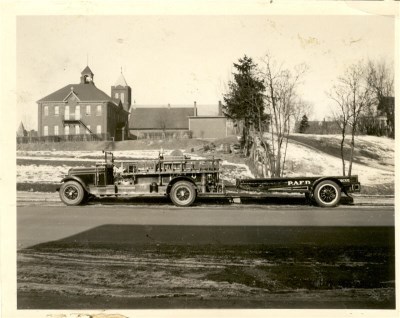
 needs of the station. For instance, in 1945, an outdated 1911 Trailer Ladder Truck from the Brown Street Station was moved to Central Station for use there, as a new truck had been purchased for the Brown Street Station. Of course, the older vehicle needed replacing the following year, as there were safety and wear-and-tear issues due to the age of the vehicle. Fire chiefs urged that vehicles and equipment should be replaced regularly, as the use of outdated equipment reflected poorly on a booming city like Fort William. There was a particular need for new equipment and vehicle replacements in the mid-to late 60s. Typically, the Department tried to disperse major purchases of equipment over the years in order to balance the need for modern equipment with realistic budget requests.
 be a Mercury Truck Model M-700 from Port Arthur’s Consolidated Motors, at a cost of nearly $5,000 (it would be “reconditioned”, not brand new).
 through the Emergency Measures Organization (EMO) in 1967, a programme through which the provincial and federal governments would subsidize firefighting equipment. According to the arrangement, the federal government would pay 30% of costs and the Province 15%, and the City would make up the remaining 55%. In 1967, however, available government contributions only totalled $1,500 (about 8%) of the $18,500 purchase, as about 40 municipalities had requested funding at the same time, and there was only $40,000 total available in the program. EMO subsidies were split across many different Fire Departments across the province, and the federal government's contribution was also threatened as they withdrew from the EMO program. The Fire Department, however, knew that the vehicle was desperately needed, and so proceeded with the purchase anyway.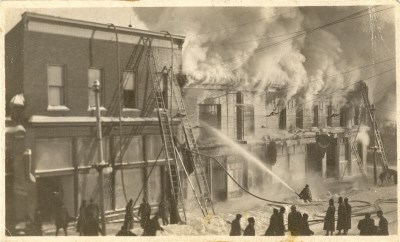
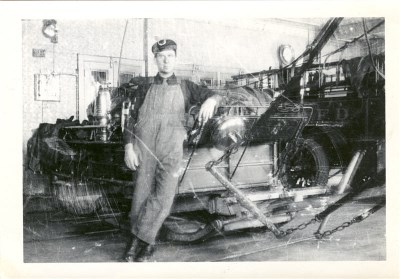 move the truck from the station to the fire. Not only was the needed truck delayed, but other firefighters and equipment were wasted on moving it rather than simply working to put out the fire.
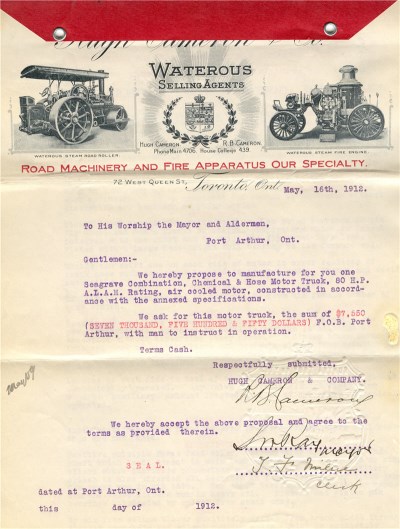 these standards: they had only been maintaining three pumper trucks with three or four men, and one active aerial ladder truck with two men.
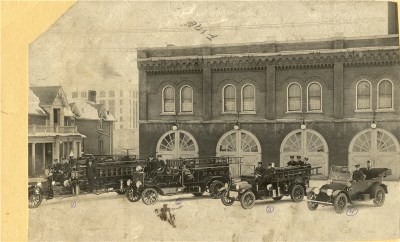 Although fire equipment and vehicles were vital, new purchases could sometimes not be made because of extenuating circumstances. For instance, during the Second World War, a decision was made not to purchase any expensive new equipment. Any extra costs would deprive the war effort of resources. This concern was echoed by a Fire Prevention Week advertisement in the newspaper that warned “Fire Losses Aid the Enemy!” (October 7, 1944).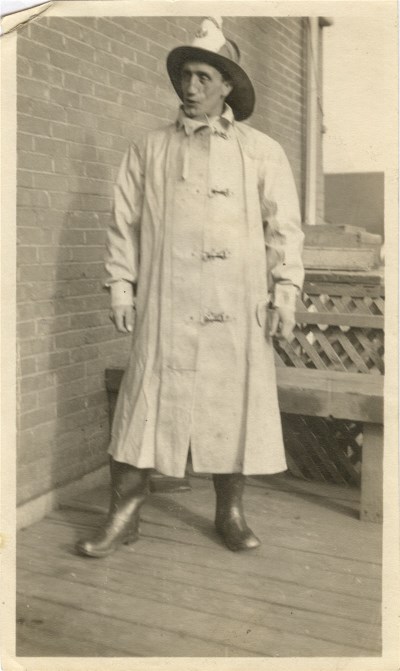
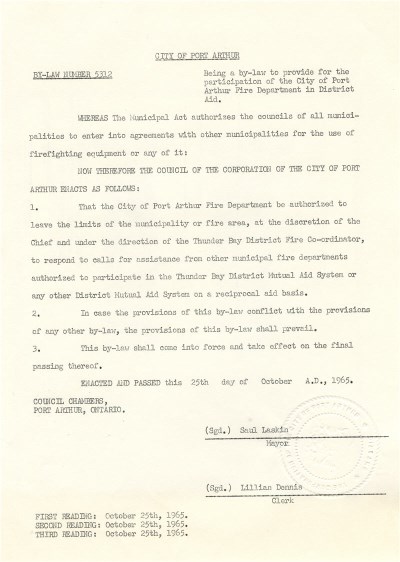 Participation in the agreement required that the municipality have its own Fire Department, as the agreement was meant to cover assistance rather than service provision. Also, a municipality had to be capable of assisting others in order to be assisted itself.
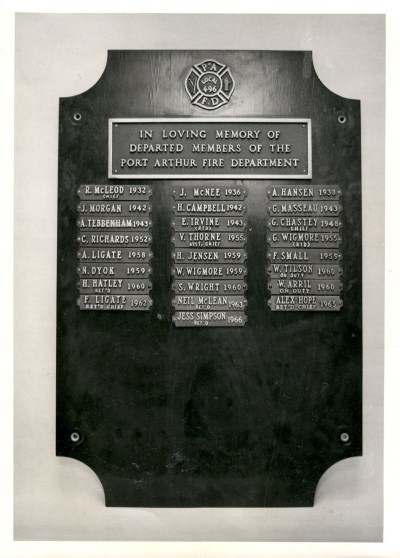 Given the demands and risks involved on the job, it is a tragic reality that some firemen become injured or lose their lives while performing a life-saving service. Though Fort William and Port Arthur were lucky enough not to mourn the loss of many of their firefighters, there still remain a brave and honoured few who were willing to risk their lives in the service of others.
About this exhibit
This exhibit was created using information and graphic material available to the public from the City of Thunder Bay Archives. The exhibit covers the time period from the inception of the two towns' fire brigades in the late nineteenth century to amalgamation in 1970.
Archival series referred to in this exhibit include the following:
- Port Arthur City Clerk's Files (Series 29)
- Port Arthur City Clerk's Agreement Files (Series 34)
- Fort William City Clerk's Files (Series 4)
- Fort William Agreements (Series 86)
- Fort William Annual Reports (Series 16)
- Thunder Bay City Clerk's Photograph Collection (Series 128)
- Thunder Bay Fire Department Photograph Collection (Series 129)
- Fire Insurance Maps
- Port Arthur Scrapbooks
Some personal information has been removed to protect the privacy of individuals.
For more information on this subject, or any other subject of interest, please visit or contact the City of Thunder Bay Archives.
Contact Us
 Connect