 The City of Thunder Bay manages a sewer system that includes both separated and combined sewers:
- Separated sewers: Wastewater from homes and businesses is carried in sanitary sewers, while stormwater from rain and snowmelt flows through separate storm sewers.
- Combined sewers: A single pipe carries both wastewater and stormwater. During heavy rain or snowmelt, the pipe can become overwhelmed, leading to overflow events.
To prevent flooding and infrastructure damage, wastewater may need to be diverted or bypassed during extreme weather or system maintenance. The City has been working since the 1990s to separate storm and sanitary sewers to reduce these events. Data collection began in 2025 and will be updated quarterly.
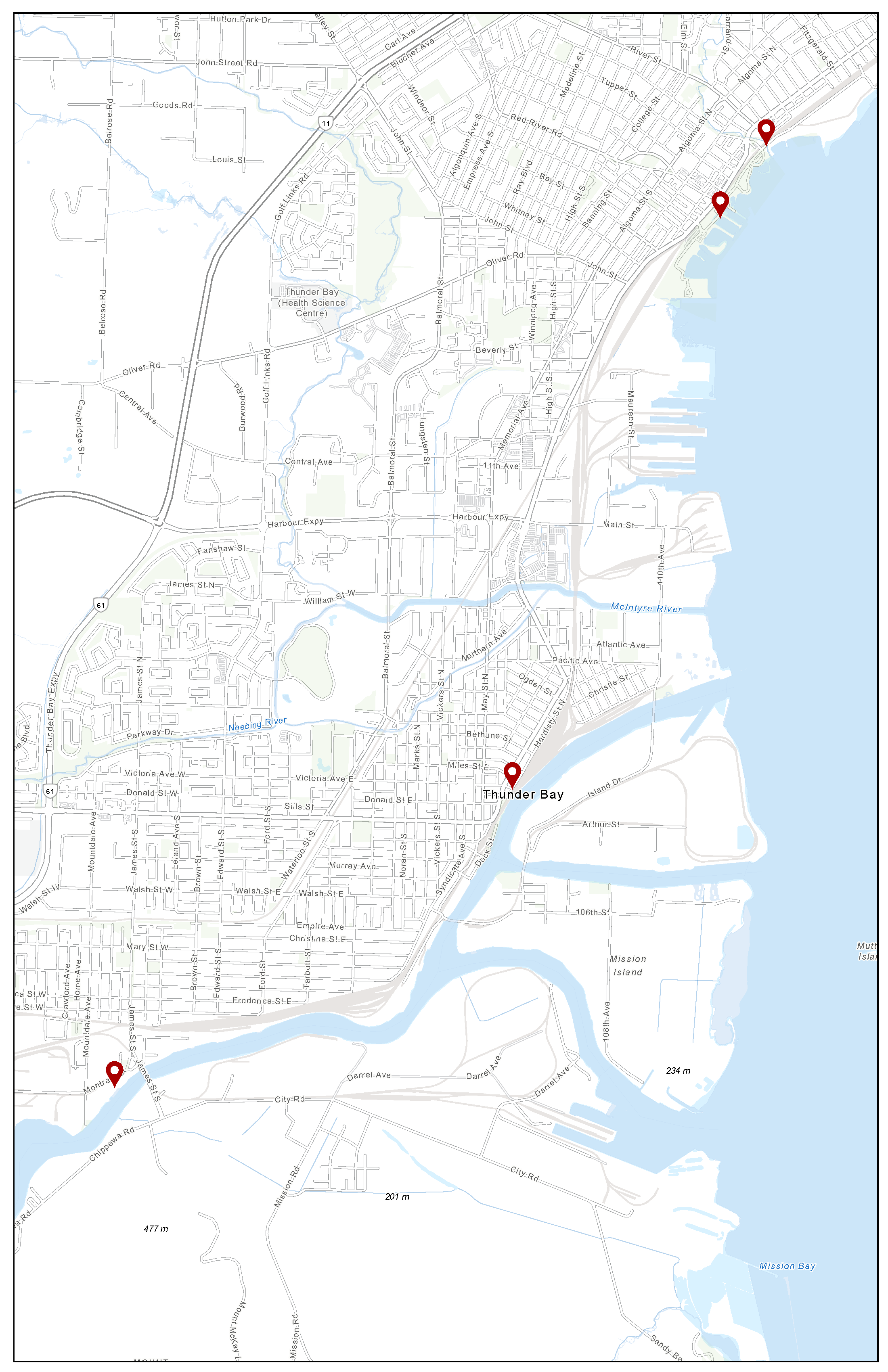
See the Map of the Separated Sewer Overflows and Combined Sewer Overflows.
| Types of Overflows and Bypasses |
- Bypass: When wastewater is diverted around part of the treatment process but still receives some level of treatment before being released.
- Combined Sewer Overflow (CSO): When a combined sewer system overflows due to excess water, releasing diluted wastewater into the environment.
- The City has only one remaining CSO outfall that operates only during extreme flow conditions to prevent flooding.
- Sanitary Sewer Overflow (SSO): When a sanitary sewer system exceeds capacity, leading to an overflow into storm sewers or waterways.
- There are three SSO locations, where overflow connections between sanitary and storm systems prevent local flooding when sewer capacity is exceeded.
|
| Water Pollution Control Plant (WPCP) Bypasses |
|
During extreme conditions or maintenance, wastewater may bypass some treatment stages but still undergo some form of processing before being released. Types of bypasses include:
- Headworks Bypass: Skips preliminary filtering (e.g., bar screens, grit removal).
- Primary Bypass: Wastewater skips primary and secondary treatment but still has large solids removed.
- Secondary Bypass: Some or all secondary treatment is bypassed, but primary treatment and some filtration still occur.
- UV Bypass: Wastewater is treated but skips UV disinfection, which is only required from April 15 to October 15.
|
| Reporting |
|
Bypass Reporting:
- The City reports all bypass events to the MECP’s Spills Action Centre (SAC) and the Thunder Bay District Health Unit (TBDHU).
- Additional details (e.g., duration, volume) must be submitted within 10 days.
- An annual summary is included in the Wastewater Annual Report, which is provided to the MECP by March 31 each year, and is available on the City’s Sewers and Wastewater webpage.
| Water Pollution Control Plant Bypasses - 12-Month Previous Period |
|
| Date | Duration (hours) | Volume (m³) | Bypass Type |
|---|
| August 17, 2025 |
0.5 |
1,585
|
Secondary bypass due to power outage |
| August 23, 2025 |
0.1 |
524
|
Secondary bypass due to power outage |
| October 23, 2025 |
0.1 |
85
|
Secondary bypass due to process upset |
| March 11, 2026 |
0.1 |
81
|
Primary bypass due to maintenance by contractor |
| April 16-21, 2026 |
49.4 hours UV (intermittent)
+ 2 minutes Secondary
|
53,679 UV
61 Secondary
|
UV (intermittent) and secondary bypass due to high flows / wet weather and snow melt |
| April 24-May 1, 2026 |
96 (intermittent) |
95,626 |
UV bypass (intermittent) due to high flows / wet weather and snow melt |
| April 27-28, 2026 |
19 (intermittent) |
24,017 |
Secondary bypass (intermittent) due to high flows / wet weather and snow melt |
| April 30, 2026 |
0.2 (intermittent) |
481 |
Secondary bypass (intermittent) due to equipment issue |
| May 4, 2026 |
8 (intermittent) |
5,220 |
Secondary bypass (intermittent) due to equipment issue |
| May 13, 2026 |
0.1 |
56 |
Secondary bypass due to equipment issue |
| May 19, 2026 |
1.1 (intermittent) |
32 |
UV bypass (intermittent) due to high flows / wet weather |
| June 14, 2026 |
3.2 |
9,845 |
Secondary bypass due to loss of utility power |
Last updated: (07/27/2026)
**This table is updated quarterly. The data is not an official record. For official data records, contact the City of Thunder Bay's Environment Division at 807-625-2195.
|
| City of Thunder Bay CSO and SSO Record - 12-Month Previous Period |
|
| Date | Location | Volume (m³) | Type (CSO, SSO) |
|---|
| |
|
|
|
No bypasses have occurred during the reporting period.
Last updated: (26/02/2026)
**This table is updated quarterly. The data is not an official record. For official data records, contact the City of Thunder Bay's Environment Division at 807-625-2195.
|
|
|
Regulations
|
|
The Ministry of the Environment, Conservation and Parks (MECP) and Environment and Climate Change Canada (ECCC) oversee wastewater treatment, including permits, compliance, and reporting.
|
For more details, contact Infrastructure & Operations Dispatch at 807-625-2195 to connect you to a representative from the Water Pollution Control Plant.








 Connect