





 The idea of amalgamating the separate cities of Fort William and Port Arthur has been brought up again and again over the years, long before the cities officially combined to become Thunder Bay in 1970. Amalgamation was formally discussed as early as 1910, although it would be another sixty years before Fort William and Port Arthur became one city.
Over the years, many names were suggested for the amalgamated city, by officials and members of the public alike. Some of the suggested names included:
- Port Edward
- Williamsport
- Westport
- WestgatePort
- Thurwilliam
- Fort Artwill
- Port Fort
The first public vote on the issue of amalgamation was held on January 5, 1920. Citizens of Port Arthur were asked the question: "Are you in favour of the union of the Cities of Port Arthur and Fort William, upon terms to be mutually agreed upon?" Out of a total of 1923 votes cast, 1183 were in favour of union, and 740 were against. Although the majority were in favour of amalgamation, no further action was taken.
The same question was asked again in both Port Arthur and in Fort William in 1958: "Are you in favour of the amalgamation of the City of Port Arthur and the City of Fort William as one city?" This vote would not be legally binding, and many questioned whether it was worth the trouble to ask the question. The results of the plebiscite were as follows:
- Fort William, 1 December 1958
Votes for: 4209
Votes against: 6827 - Port Arthur, 8 December 1958
Votes for: 5468
Votes against: 5331
In 1969, the City of the Lakehead Act was issued by Ontario Minister of Municipal Affairs Darcy McKeough. This act decreed that Fort William and Port Arthur would amalgamate as of January 1, 1970, creating a new, larger city. Citizens were asked to select the city's new name by vote, with three candidates to choose from: "Lakehead," "The Lakehead," and "Thunder Bay."
The new name of Thunder Bay won by a narrow margin, and in 1970, after more than 50 years of discussion and controversy, the two cities became one.
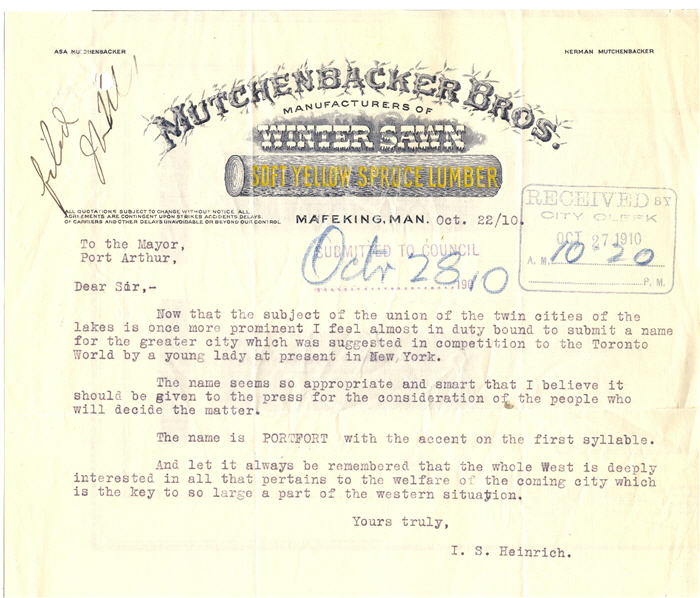
| Name Suggestion, 1910 |
|
A letter dated October 22nd, 1910, that was submitted to Port Arthur Council on October 28th, 1910. This letter suggests a possible new name for an amalgamated city of Port Arthur and Fort William.
The text reads: MUTCHENBACKER Bros. To the Mayor, Dear Sir, Now that the subject of the union of the twin cities of the lakes is once more prominent I feel almost in duty bound to submit a name for the greater city which was suggested in competition to the Toronto World by a young lady at present in New York. The name seems so appropriate and smart that I believe it should be given to the press for the consideration of the people who will decide the matter. The name is PORTFORT with the accent on the first syllable. And let it always be remembered that the whole west is deeply interested in all that pertains to the welfare of the coming city which is the key to so large a part of the Western situation. Yours truly, I. S. HEINRICH. TBA 2401 |
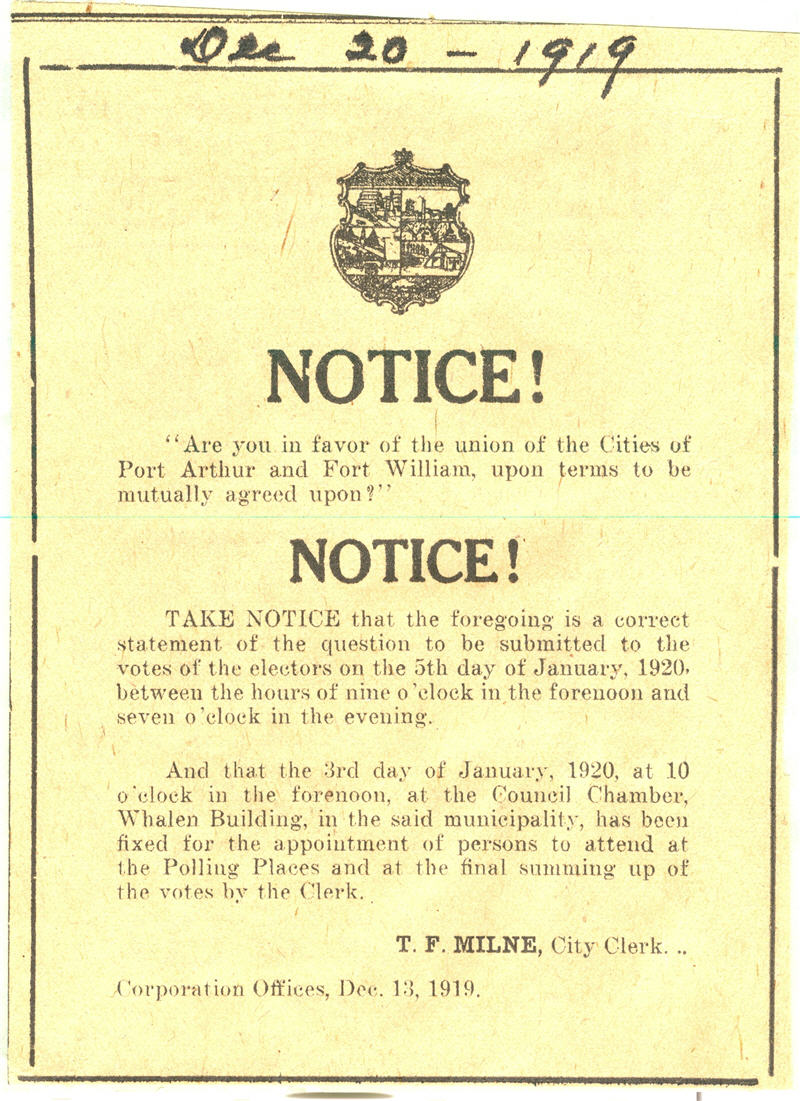
| Plebistice Notice, 1920 |
|
A notice from the Port Arthur City Clerk’s office announcing a vote on the idea of amalgamating the two Cities of Fort William and Port Arthur. The notice was published on the 13th of December, 1919.
The text reads; NOTICE! “Are you in favour of the Union of the Cities of Port Arthur and Fort William upon terms to be mutually agreed upon.” NOTICE! Take notice that the foregoing is a correct statement of the question that is to be submitted to the votes of the electors on the 5th day of January, 1920, between the hours of nine o’clock in the forenoon and seven o’clock in the evening. And that the 3rd day of January, 1920, at 10 o’clock in the forenoon, at the Council Chamber, Whalen Building, in the said municipality, has been fixed for the appointment of persons to attend at the Polling Places and at the final summing up of the votes by the clerk. T.F. MILNE, City Clerk TBA 2401 |
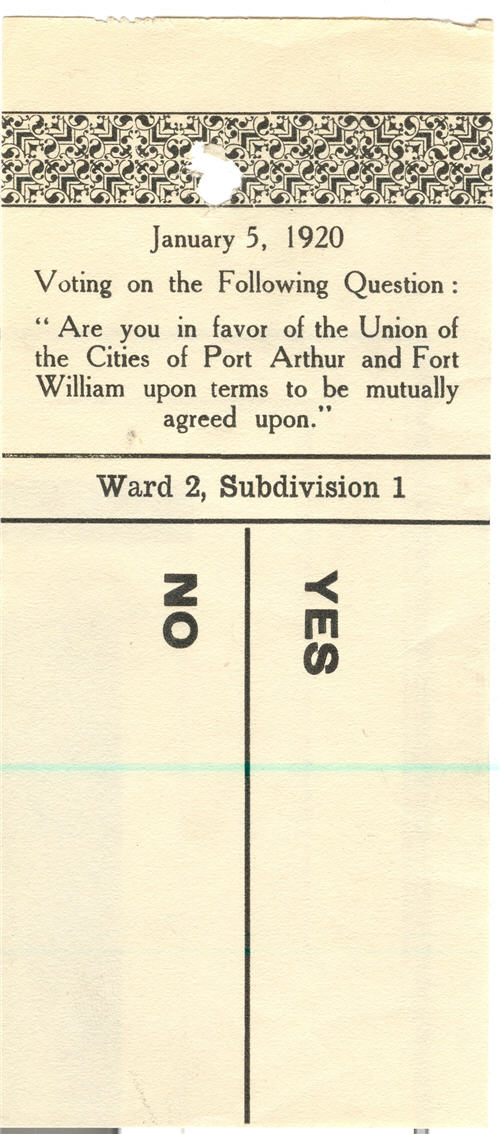
| Ballot for Amalgamation Vote, 1920 |
|
A ballot from a vote on the notion of amalgamation, held on January 5th, 1920.
The text reads: January 5th, 1920 Voting on the Following Question: “Are you in favour of the Union of the Cities of Port Arthur and Fort William upon terms to be mutually agreed upon.” Ward 2, Subdivision 1 TBA 2401 |
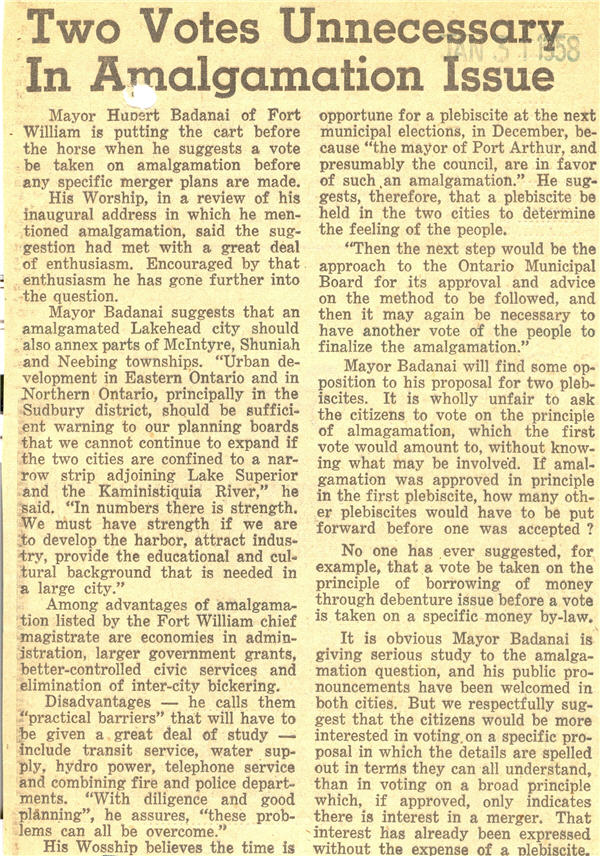
| Newspaper Editorial, January 1958 |
|
A newspaper article from a paper published on 31 January, 1958.
The text reads: Two Votes Unnecessary In Amalgamation Issue Mayor Hubert Badanai of Fort William is putting the cart before the horse when he suggests a vote be taken on amalgamation before any specific merger plans are made. His Worship, in a review of his inaugural address in which he mentioned amalgamation, said the suggestion had met with a great deal of enthusiasm. Encouraged by that enthusiasm he has gone further into the question. Mayor Badanai suggests that an amalgamated Lakehead City should also annex parts of McIntyre, Shuniah and Neebing Townships. “Urban development in Eastern Ontario and in Northern Ontario, principally in the Sudbury district, should be sufficient warning to our planning boards that we cannot continue to expand if the two cities are confined to a narrow strip adjoining Lake Superior and the Kaministiquia River,” he said. “In numbers there is strength. We must have strength if we are to develop the harbour, attract industry, provide the educational and cultural background that is needed in a large city.” Among advantages of amalgamation listed by the Fort William chief magistrate are economies in administration, larger government grants, better-controlled civic services and elimination of inter-city bickering. Disadvantages – he calls them “practical barriers” that will have to be given a great deal of study – include transit service, water supply, hydro power, telephone service and combining fire and police departments. "With diligence and good planning”, he assures, “these problems can all be overcome.” His Worship believes the time is opportune for a plebiscite at the next municipal elections, in December, because “the mayor of Port Arthur, and presumably the council, are in favour of such an amalgamation.” He suggests, therefore, that a plebiscite be held in the two cities to determine the feeling of the people. “Then the next step would be the approach to the Ontario Municipal Board for its approval and advice on the method to be followed, and then it may again be necessary to have another vote of the people to finalize the amalgamation.” Mayor Badanai will find some opposition to his proposal for two plebiscites. It is wholly unfair to ask the citizens to vote on the principle of amalgamation, which the first vote would amount to, without knowing what may be involved. If amalgamation was approved in principle in the first plebiscite, how many other plebiscites would have to be put forward before one was accepted? No one has ever suggested, for example, that a vote be taken on the principle of borrowing of money through debenture issue before a vote is taken on a specific money by-law. It is obvious Mayor Badanai is giving serious study to the amalgamation question, and his public pronouncements have been welcomed in both cities. But we respectfully suggest that the citizens would be more interested in voting on a specific proposal in which the details are spelled out in terms they can all understand, than in voting on a broad principle which, if approved, only indicates there is interest in a merger. That interest has already been expressed without the expense of a plebiscite. TBA 2401 |
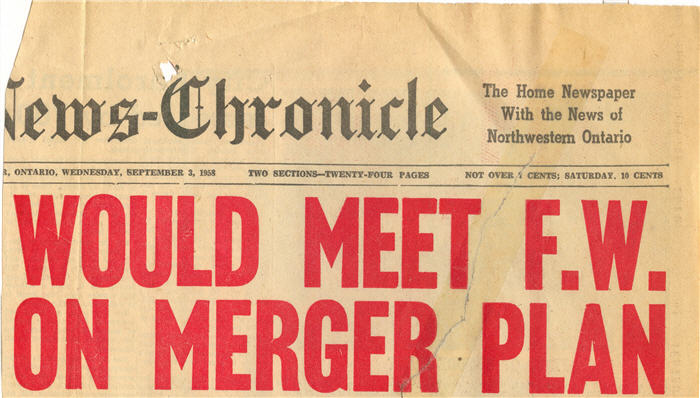
| Article on Amalgamation Plans, 1958 |
|
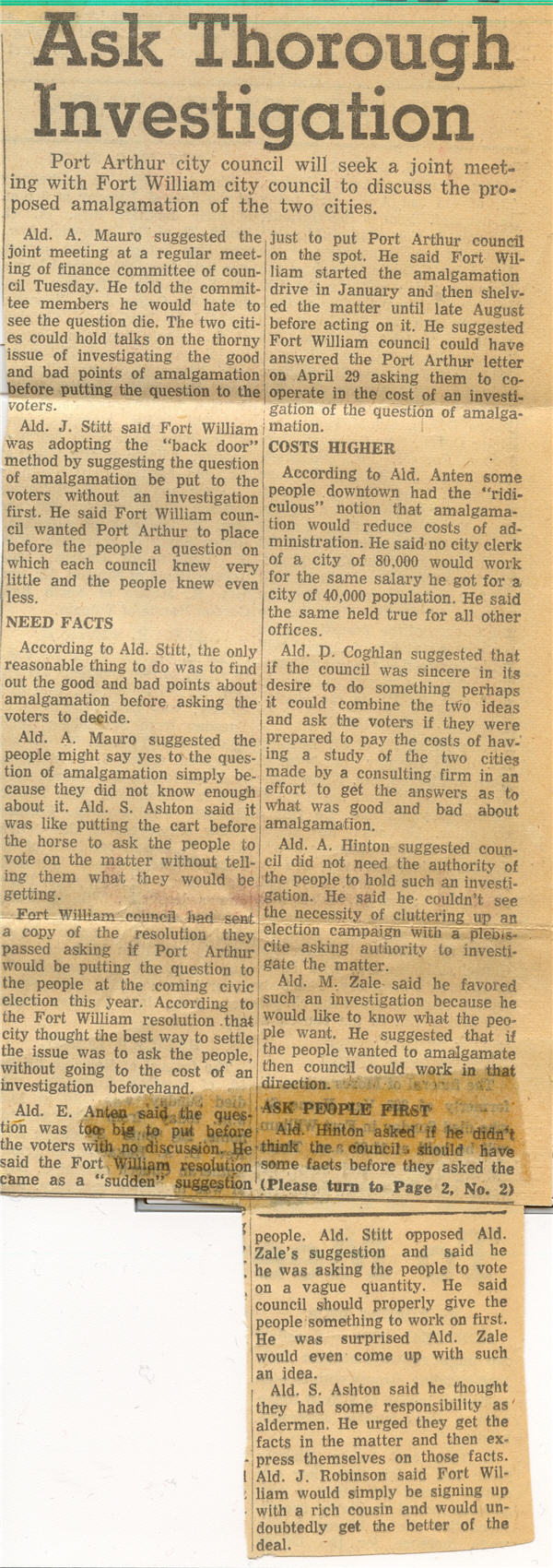
A front page newspaper article from the Port Arthur News-Chronicle published on Wednesday, September 3rd, 1958. The article is in regard to the proposed amalgamation of the two cities.
The text reads; Would Meet F.W. On Merger Plan Port Arthur city council will seek a joint meeting with Fort William to discuss the proposed amalgamation of the two cities. Ald. A. Mauro suggested the joint meeting at a regular meeting of finance committee of council Tuesday. He told the committee members he would hate to see the question die. The two cities could hold talks on the thorny issue of investigating the good and bad points of amalgamation before putting the question to the voters. Ald. J. Stitt said Fort William was adopting the “back door” method by suggesting the question of amalgamation be put to the voters without an investigation first. He said Fort William council wanted Port Arthur to place before the people a question on which each council knew very little and the people knew even less. NEED FACTS According to Ald. Stitt, the only reasonable thing to do was to find out the good and bad points about amalgamation before asking the voters to decide. Ald. A. Mauro suggested the people might say yes to the question of amalgamation simply because they did not know enough about it. Ald. S. Ashton said it was like putting the cart before the horse to ask the people to vote on the matter without telling what they would be getting. Fort William council had sent a copy of the resolution they passed asking if Port Arthur would be putting the question to the people at the coming civic election this year. According to the Fort William resolution that city thought the best way to settle the issue was to ask the people, without going to the cost of an investigation beforehand. Ald. E. Anten said the question was too big to put before the voters with no discussion. He said the Fort William resolution came as a “sudden” suggestion just to put Port Arthur council on the spot. He said Fort William started the amalgamation drive in January and then shelved the matter until late August before acting on it. He suggested Fort William council could have answered the Port Arthur letter on April 29 asking them to co-operate in the cost of an investigation of the question of amalgamation. COSTS HIGHER According to Ald. Anten some people downtown had the “ridiculous” notion that amalgamation would reduce costs of administration. He said no city clerk of a city of 80,000 would work for the same salary he got for a city of 40,000 population. He said the same held true for all other offices. Ald. D. Coghlan suggested that if the council was sincere in its desire to do something perhaps it could combine the two ideas and ask the voters if they were prepared to pay the costs of having a study of the two cities made by a consulting firm in an effort to get the answers as to what was good and bad about amalgamation. Ald. A. Hinton suggested council did not need the authority of the people to hold such an investigation. He said he couldn’t see the necessity of cluttering up an election campaign with a plebiscite asking authority to investigate the matter. Ald. M. Zale said he favoured such an investigation because he would like to know what the people want. He suggested that if the people wanted to amalgamate then council could work in that direction. ASK PEOPLE FIRST Ald. Hinton asked if he didn’t think the council should have some facts before they asked the people. Ald. Stitt opposed Ald. Zale’s suggestion and said he was asking the people to vote on a vague quantity. He said council should properly give the people something to work on first. He was surprised Ald. Zale would even come up with such an idea. Ald. S. Ashton said he thought they had some responsibility as aldermen. He urged they get the facts in the matter and then express themselves on those facts. Ald. J. Robinson said Fort William would simply be signing up with a rich cousin and would undoubtedly get the better of the deal. TBA 2401 |
| Article on Plebiscite, 1958 |
|
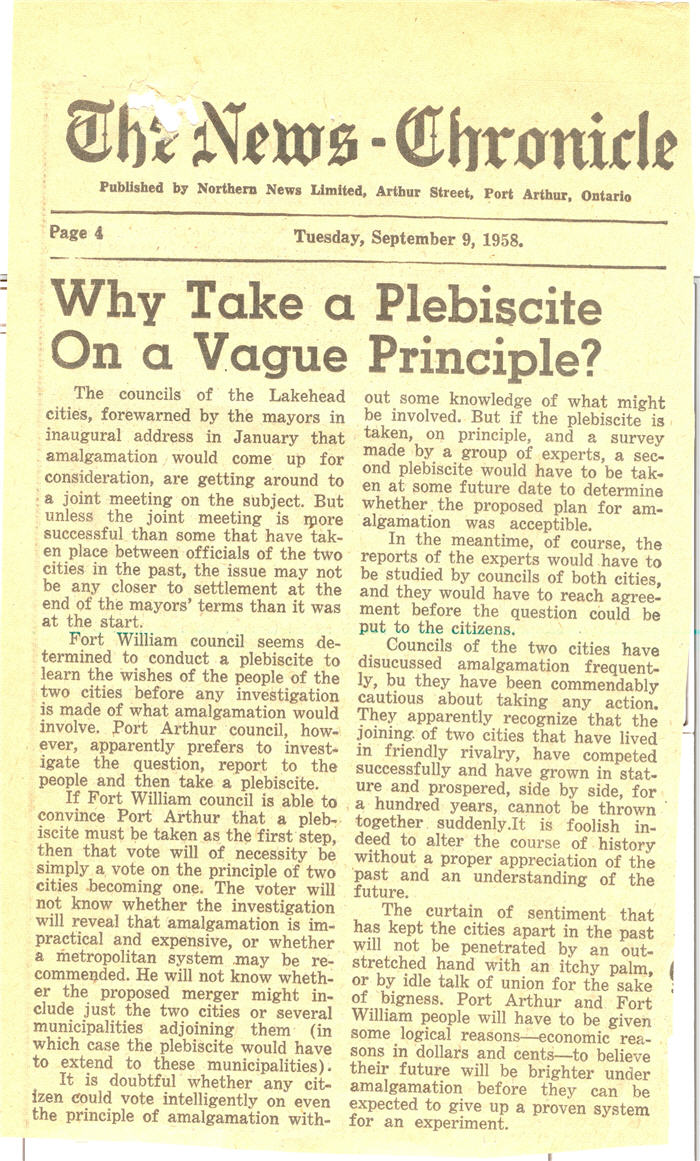
A page four newspaper article from the Port Arthur News-Chronicle, published on Tuesday, September 9th, 1958. The article is titled: “Why Take a Plebiscite On a Vague Principle?”
The text reads: The councils of the Lakehead cities, forewarned by the mayors in inaugural address in January that amalgamation would come up for consideration, are getting around to a joint meeting on the subject. But unless the joint meeting is more successful than some that have taken place between officials of the two cities in the past, the issue may not be any closer to settlement at the end of the mayors' terms than it was at the start. Fort William council seems determined to conduct a plebiscite to learn the wishes of the people of the two cities before any investigation is made of what amalgamation would involve. Port Arthur council, however, apparently prefers to investigate the question, report to the people and then take a plebiscite. If Fort William council is able to convince Port Arthur that a plebiscite must be taken as the first step, then that vote will of necessity be simply a vote of on the principle of two cities becoming one. The voter will not know whether the investigation will reveal that amalgamation is impractical and expensive, or whether a metropolitan system may be recommended. He will not know whether the proposed merger might include just the two cities or several municipalities adjoining them (in which case the plebiscite would have to extend to these municipalities). It is doubtful whether any citizen could vote intelligently on even the principle of amalgamation without some knowledge of what might be involved. But if the plebiscite is taken, on principle, and a survey made by a group of experts, a second plebiscite would have to be taken at some future date to determine whether the proposed plan for amalgamation was acceptable. In the meantime, of course, the reports of the experts would have to be studied by councils of both cities, and they would have to reach agreement before the question could be put to the citizens. Councils of the two cities have discussed amalgamation frequently, but they have been commendably cautious about taking any action. They apparently recognize that the joining of two cities that have lived in friendly rivalry, have competed successfully and have grown in stature and prospered, side by side, for a hundred years, cannot be thrown together suddenly. It is foolish indeed to alter the course of history without a proper appreciation of the past and an understanding of the future. The curtain of sentiment that has kept the cities apart in the past will not be penetrated by an out-stretched hand with an itchy palm, or by idle talk of union for the sake of bigness. Port Arthur and Fort William people will have to be given some logical reasons – economic reasons in dollars and cents – to believe their future will be brighter under amalgamation before they can be expected to give up a proven system for an experiment. TBA 2401 |
| City of The Lakehead Act, 1969 |
|
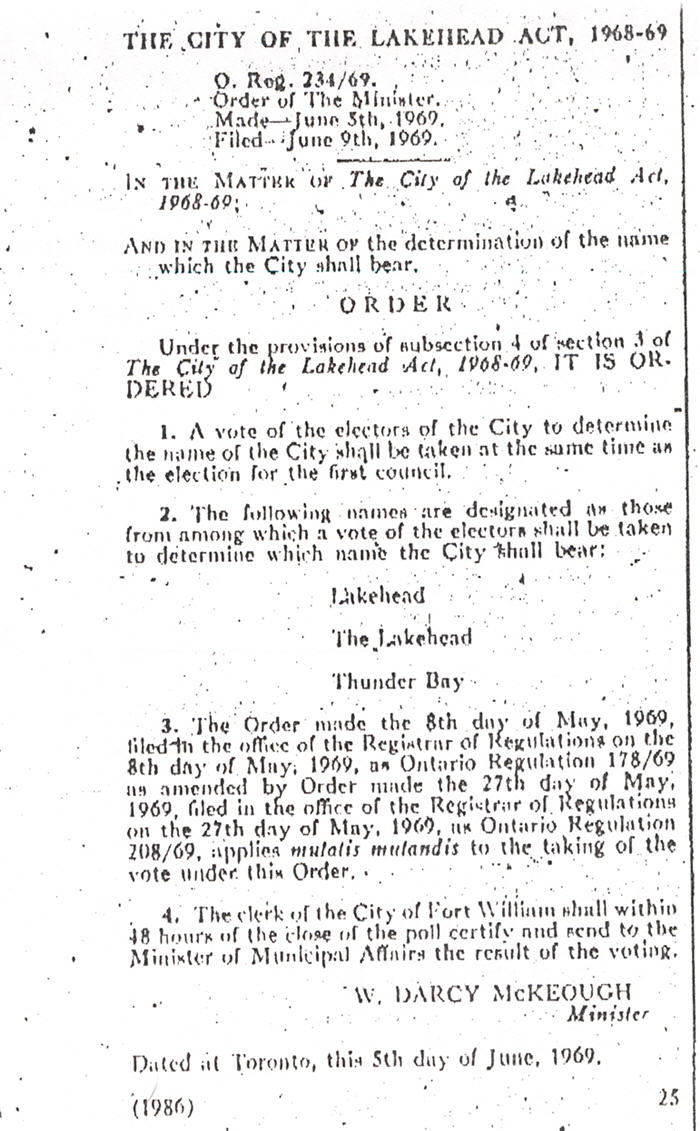
A copy of The City of the Lakehead Act, issued 5 June, 1969, by Minister of Municipal Affairs Darcy McKeough. This act effectively created the City of Thunder Bay by amalgamating the former cities of Fort William and Port Arthur.
THE CITY OF THE LAKEHEAD ACT, 1968-69 IN THE MATTER OF The City of the Lakehead Act, 1968-69. AND IN THE MATTER OF the determination of the name which the city shall bear. ORDER Under the provisions of subsection 4 of section 3 of the City of the Lakehead Act, 1968-69, IT IS ORDERED 1. A vote of the electors of the city to determine the name of the city shall be taken at the same time as the election for the final council. 2. The following names are designated as those from among which a vote of the electors shall be taken to determine which name the city shall bear.
3. The Order made the 8th day of May, 1969, filed in the office of the Registrar of Regulations on the 8th day of May, 1969, as Ontario Regulation 178/69 as amended by Order made the 27th day of May, 1969, filed in the Office of the Registrar of Regulations on the 27th day of May, 1969, as Ontario Regulation 208/69, applies mulalis munlandis to the taking of this vote under this Order. 4. The clerk of the City of Fort William shall within 48 hours of the poll certify and send to the Minister of Municipal Affairs the result of the voting. W. DARCY McKEOUGH Minister Dated at Toronto, this 5th day of June, 1969. |
| "Songs to Amalgamate By" |
|
A lyric sheet for songs written for the amalgamation of Fort William and Port Arthur.
The text reads: Songs To Amalgamate By New Year’s Eve, December 31, 1969. Auld Acquaintances Should old Fort William be forgot, We can all claim the giant now, Happy birthday to you, Thunder Bay Old Fort William has changed its name-- With Wawa here, and a Green Bay there, Port Arthur too shall now become, With a Wawa here, and a Green Bay there, The Sleeping Giant still looks up With a Wawa here, and a Green Bay there, Both Air Canada and the C.P.R. With a Wawa here, and a Green Bay there, Document provided by the Thunder Bay Historical Museum. |

Contact Us
 Connect