




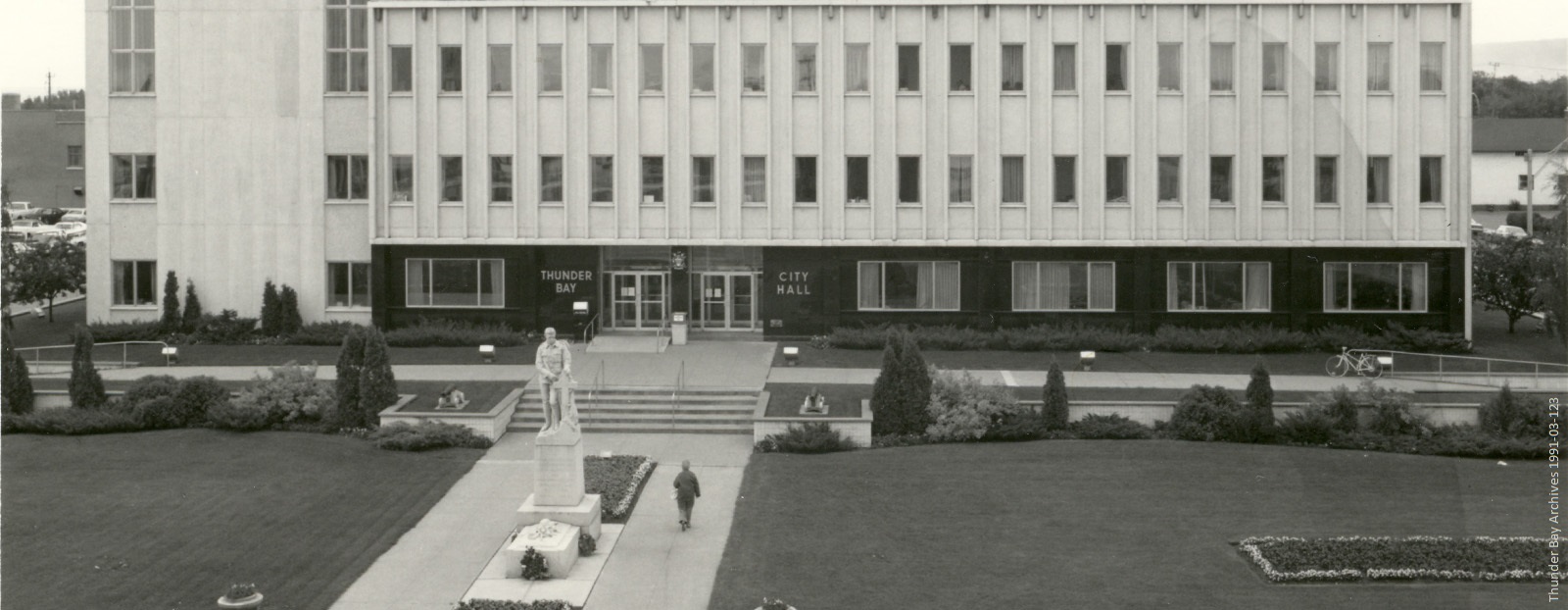


The City of Thunder Bay has not one history, but three. Having been created by the amalgamation of the twin cities of Fort William and Port Arthur in 1969, Thunder Bay's past is inextricably linked with the parallel but separate pasts of its constituents. Central to these histories is a cornerstone of municipal government and community: the City Hall.
While exploring the City Halls Web exhibit, you'll discover a lot about Thunder Bay's history through three stories that link together to characterize what Thunder Bay represents: harmony, ingenuity, rich culture, and the value of community.
Port Arthur City Hall |
|
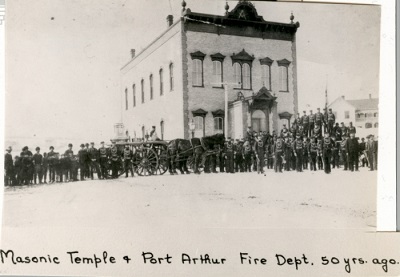
Town Hall: 1880-1883The building known as Port Arthur Town Hall was built in 1880, and among other functions served as a meeting place for the Shuniah Council, which was the precursor to Port Arthur Town Council. (Port Arthur would not be incorporated as a town until 1884.) Other functions of the building included:
The multipurpose nature of the building required that its space was used efficiently, and that its patrons exercised a great deal of patience. The Freemasons housed their facilities on the top floor. The Anglican church was also located on the upper floor, and the Presbyterian church on the lower floor. Meeting rooms led onto the performer's stage at the end of the hall, and in front of the stage there were chairs that could be set up on the floor for a seating area. The groups that used this building were largely able to cooperate; however, on occasion, the Freemasons' rituals were reportedly a little disruptive. Fire Hall: 1883-1907
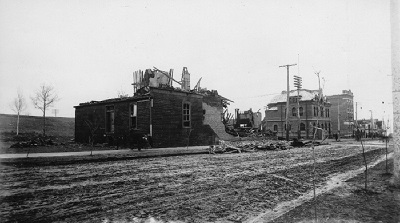
Also in 1907, the Town Hall building burnt down, on the night of November 23rd, to the dismay of all those who made use of it. Fortunately, no one was harmed (the cinema in the building had just finished showing a film) but among the losses were historical records, artefacts, furnishings, and film and projection equipment. The cause of the fire is unknown, and though the fire fighters collected on the scene within minutes of the alarm, the building was already well on its way to being destroyed. Due to this fire, many of the records and documents that the town owned were lost, which leaves us with scarce information on Port Arthur's government in its first twenty-seven years. Port Arthur Telephone Exchange / Municipal Building: 1907-1914Port Arthur Town Council voted to fund construction of a new municipal building and telephone exchange in 1905. Construction on this building and on a new Fire Hall began in 1906, and continued despite controversies surrounding the rising costs of the construction. In March of 1907, the telephone switchboard was installed, and the Clerk and Council moved in to the new building. Work was declared completed in June. As early as 1910, it became apparent that this facility was too small to meet the needs of the growing City of Port Arthur. There were discussions held in council over the possibility of enlarging the building, but these came to nothing. It seemed more economically sound to move the municipal administration and City Council to the recently-constructed Whalen Building, a commercial property; this move took place in 1914. The Municipal Building continued to house the telephone exchange and the Board of Health, as well as various other businesses over the years. Over time, the brick façade began to crumble, and the building itself was deemed unsafe. The City of Port Arthur decided to sell the building and property in 1944. Whalen Building / Public Utilities Commission Building: 1914-1969
The Public Utilities Commission Building, keeping with the Port Arthur "Town Hall" tradition, has always contained more than just municipal offices. Some of the other tenants of the building have included the Municipality of Shuniah, the Great Lakes Dredging & Contracting Co. Ltd., the Detroit Sulphite Pulp and Paper Co., the Red Cross, the Imperial Life Insurance Company, the Board of Education, the District of Thunder Bay Social Services Department, St. Joseph’s Care Group Behavioural Sciences Centre, the Canadian Diabetes Association, and Thunder Bay Hydro.
Timeline of Port Arthur City Council Meeting Locations
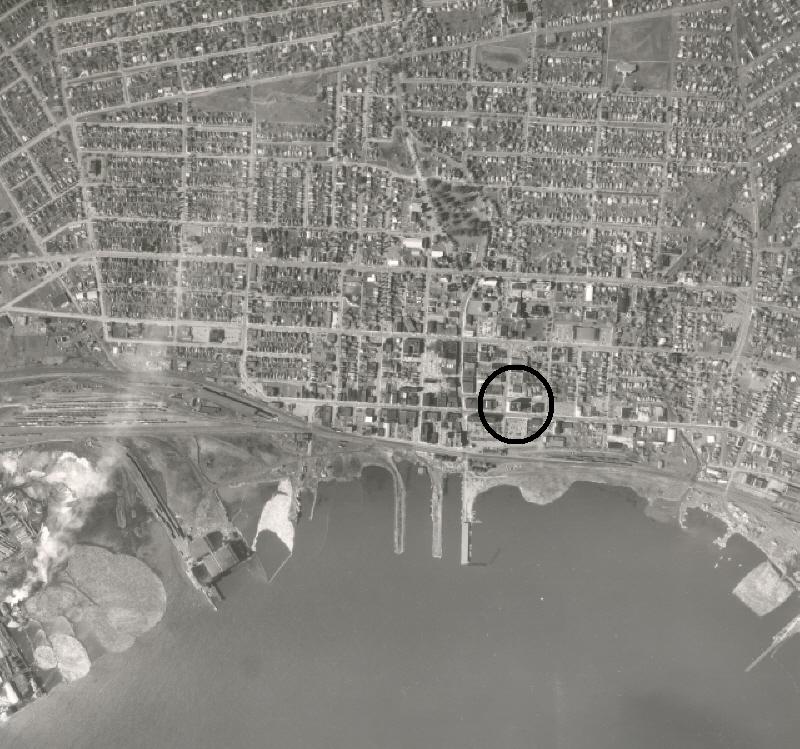
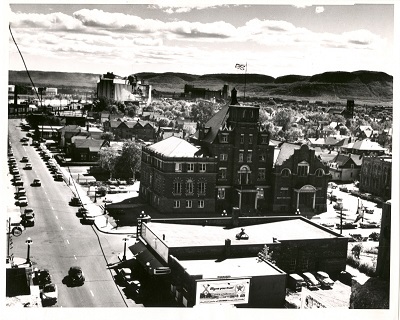
This aerial photograph, taken in 1969, shows the location of the Public Utilities Commission building (at centre of circle) relative to the rest of downtown Port Arthur.
City of Thunder Bay Archives Series 92
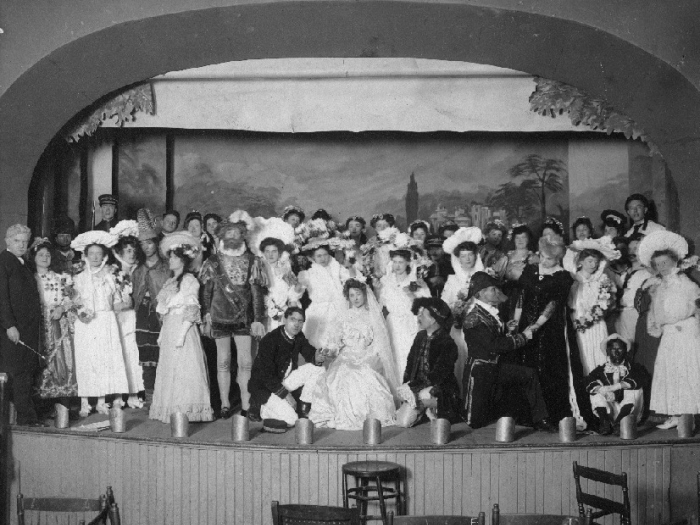
This photograph, courtesy of the Thunder Bay Historical Museum, shows a number of actors onstage at the Port Arthur Town Hall in 1903. Entertainment in the Town Hall was common in the early 1900s, as it was one of the only venues large enough to host gatherings of many people.
Thunder Bay Historical Museum Society: 986.29.101
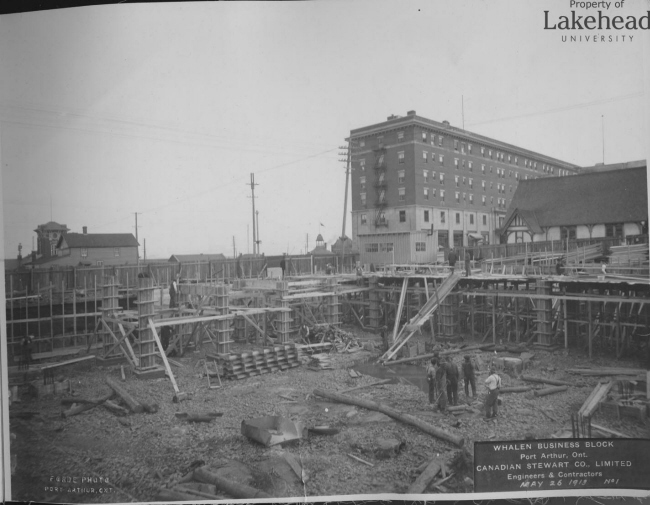
This photograph, courtesy of the Lakehead University Library Archives, shows the construction site of the future Whalen Building. Construction was in its early stages when the photograph was taken on May 26, 1913.
Lakehead University Library Archives Collection Number: A0039
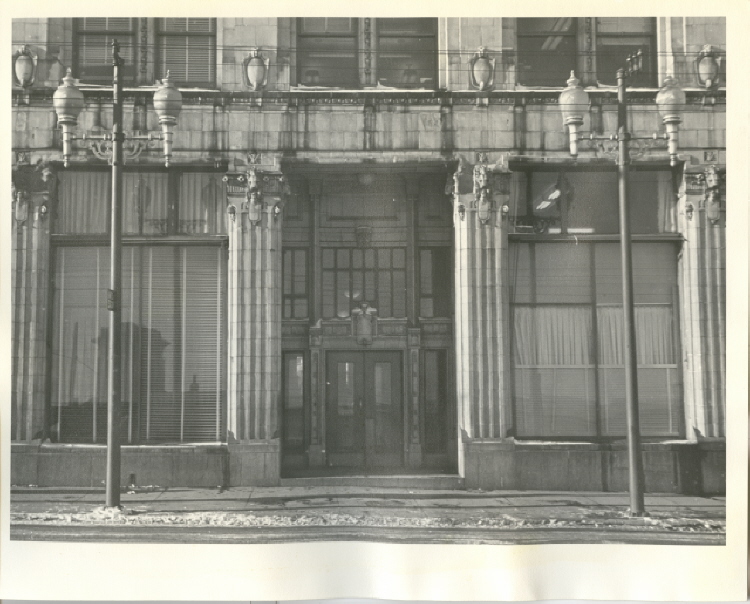
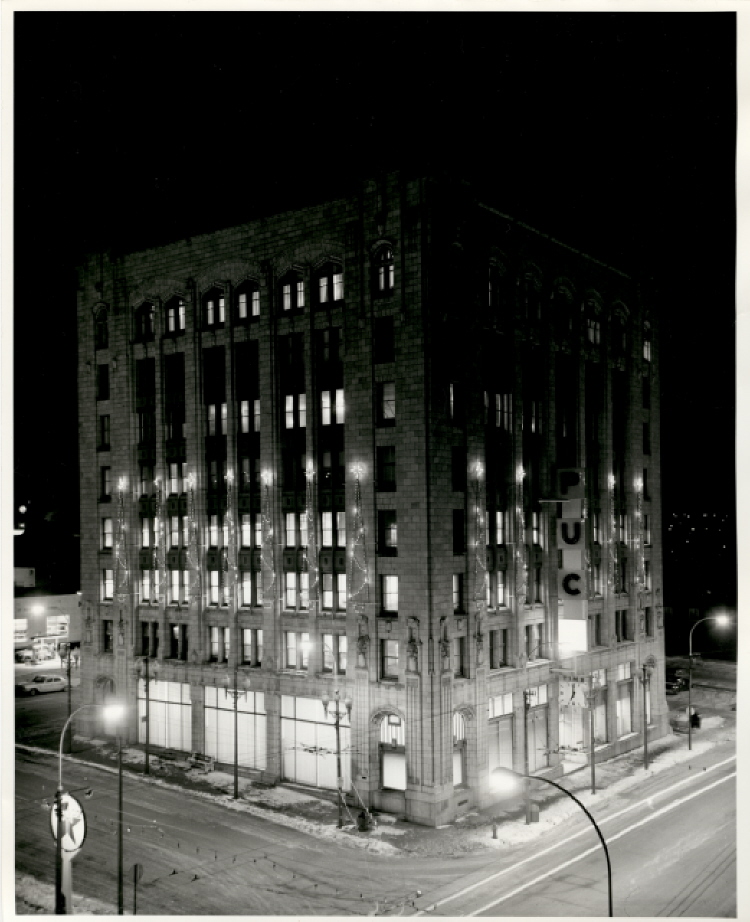
The entrance to the Public Utilities Commission building, Port Arthur.
City of Thunder Bay Archives Series Number: 88
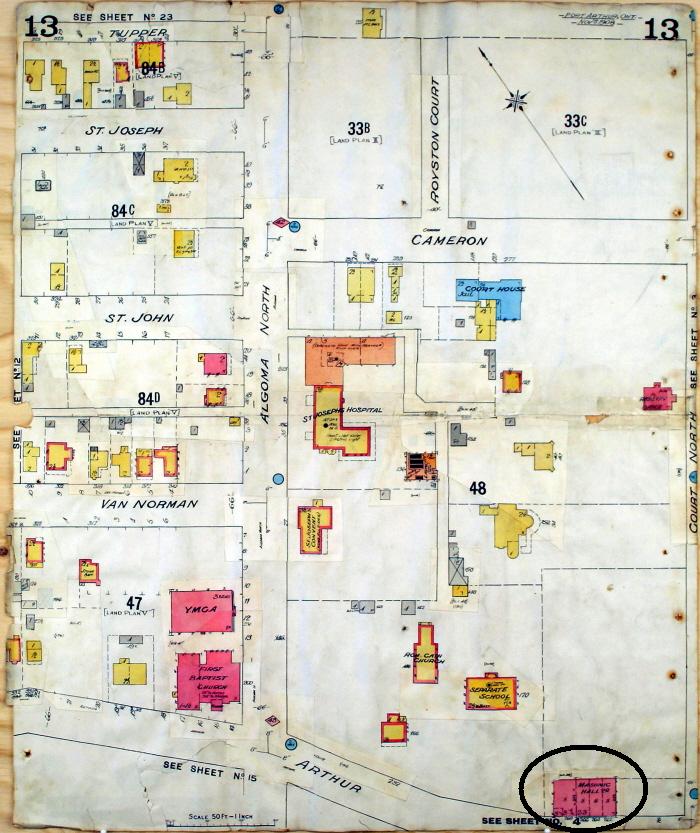
The first Town Hall can be seen in this fire insurance map from 1908, located in the bottom right corner, listed as the Masonic Hall. Fire Insurance Plans were maps of all of the buildings in a location that an insurance company used to assess the risk of fire.
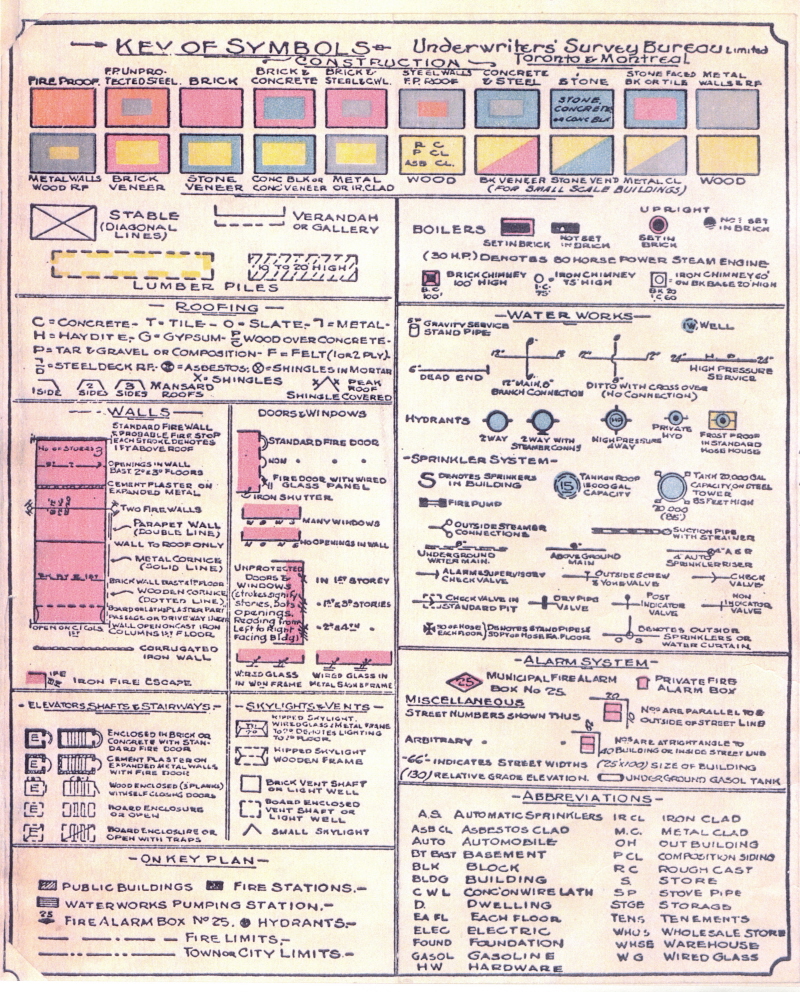
The key for the symbols on the map is provided below.
1908, Fire Insurance Map #13, Port Arthur
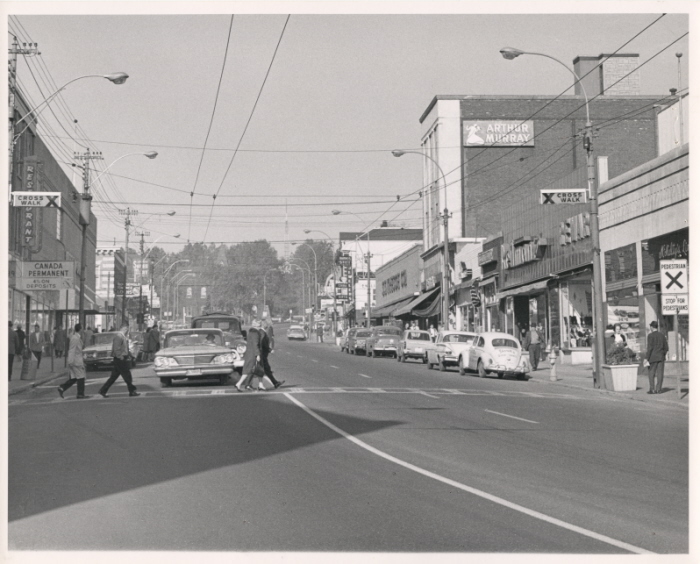
This photograph was taken of downtown Port Arthur in 1964, on the street where the first Town Hall stood. The second image (below) indicates the precise location where the first Town Hall was located: at the time of the photograph, occupied by the Birks Stitt Jewellery Store. The site is currently home to the Bank of Montreal, on the corner of Red River Road and Court Street.
City of Thunder Bay Archives Series Number: 29 |
Fort William City Hall 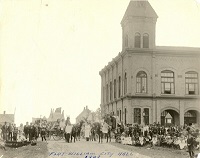 |
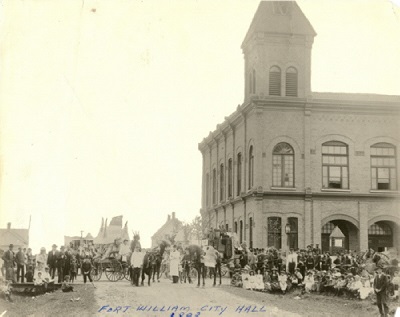
The First Town Hall: 1892-1903Fort William's first Town Hall was built for a total cost of $15,000 in 1892, the same year that Fort William reached a population of 2,000 people and achieved town status. The first Town Hall was located on Donald Street, on the land which now forms the front lawn of our modern City Hall.
Fort William's first Town Hall building served a number of different purposes. It functioned not only as the municipal government building, but also as a home for the local telephone company, the prison and the fire department. Many local groups also used the building for their needs, as the Town Hall was the largest multipurpose building available in the town. Businesses, including the Board of Trade and the Hudson's Bay Company, held their meetings there, as would area representatives on the federal and provincial political scene (Beaulieu 5). Of course, the town residents and Fort William Town Council also made use of the hall for their own meetings. Apart from official affairs such as Council meetings, the Town Hall was also a place to hear speeches and lectures to inform the public on social issues and concerns. Several churches held events at the Town Hall as well, including St. Luke's Anglican Church. Dances held in the hall were anticipated and highly popular. It seemed that nearly anyone could use the Town Hall for purposes public or private (Beaulieu 9). The Town Hall's use as a public space helped foster a strong sense of community in Fort William. Improvements and renovations were soon made to the Town Hall, to meet its growing needs as a public entertainment facility. More seating was added, as well as new heating and plumbing systems.
This Town Hall building burnt down on the night of March 9-10, 1903. The fire devastated everything in the building, including gifts of clothing for an upcoming bazaar, and the official records of the town. Included in these records were important documents such as contracts between Fort William and the Canadian Pacific Railroad, a key business for the town. The fire was a terrible blow to the community, as the Town Hall played a central role in the everyday life of the townspeople. Despite the tragedy, it was evident that Fort William was quick to recover, as plans were immediately made to build a new Town Hall and a separate building for the phone company. But for the time being, Fort William had the privilege of receiving the generosity of neighbouring Port Arthur, who assisted in the effort to return to normalcy. The Port Arthur electrical light and telephone companies were able to extend these services to Fort William as they dealt with the loss of their Town Hall. The Second City Hall: 1905-1966
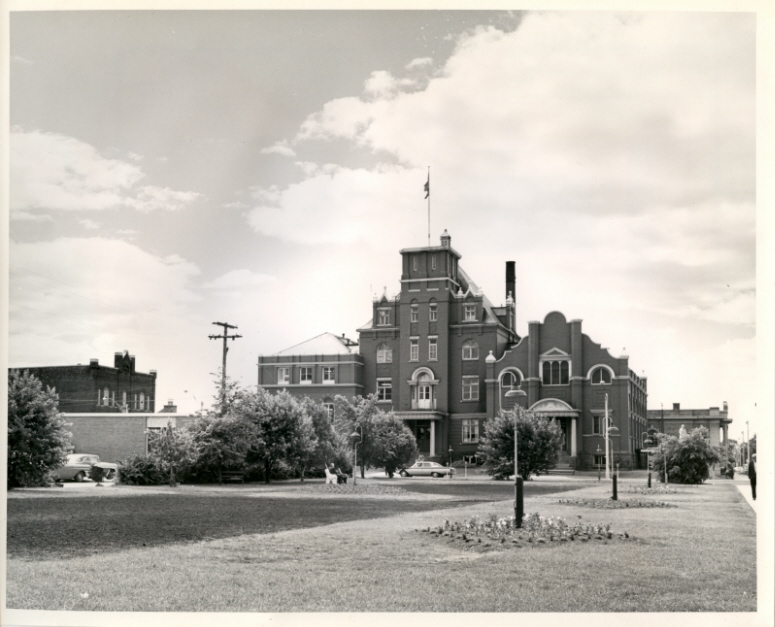
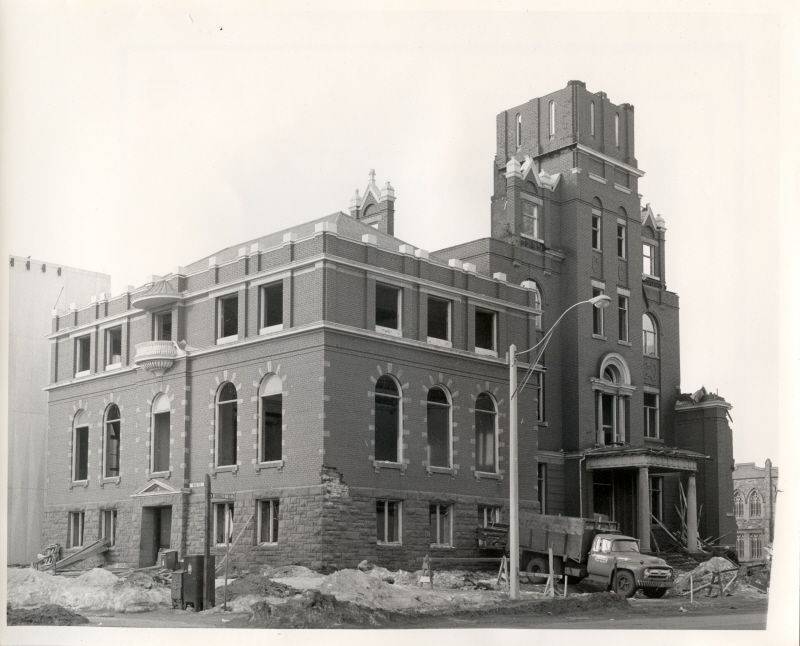
Despite the speed of the new Town Hall's construction, there were delays that slowed the building of the auditorium and the police station. Another barrier to the completion of the Town Hall was a problem with heating in the auditorium, particularly in the dressing rooms and the vestibule. There were no radiators in these parts of the building, and three other radiators in the building did not work properly. Even at the beginning of 1905, the Town Hall was incomplete as it lacked sidewalks, police cells, a court, council and vault fittings, and a finished basement. Delays continued for months, even close to a year, on some parts of the building. Despite these setbacks, Council held its first meeting in the new facility on October 10th, 1905, where the previous mayors made speeches, citing future hopes for the Town of Fort William. These "future hopes" did not take long to become reality, The second City Hall was more decorative and ornate than the first. A variety of decorations, artifacts and paintings were produced for the aesthetic improvement of the building. Gifts such as paintings, portraits and photographs were gratefully accepted from members of the community, and from artists as far away as Montreal. The City Hall was also a devoted patron of the Western Taxidermists' Company, located in Winnipeg. This company provided the service of stuffing and preservation of animals for the decoration of the City Hall. Letters back and forth from this company indicate that the City Hall could either order from a list of items, or send an animal of its own to Winnipeg to be stuffed. Other decoration included pictures of City Councils, royalty, the Governor General, police, Prime Ministers and views of the city. R As time progressed, the City Hall began to require significant repairs and renovations due to safety risks and the needs of a growing community. The tower on the City Hall had been removed in the 1940s, as it had become unsafe over time. Even fifteen years before the new City Hall of 1966 was built, it was found that great changes to the building were necessary for it to be safe and to meet public needs. $85,000 worth of alterations and additions were made both to the Hall in general and to the Auditorium in 1955. Ultimately, the renovation and improvement costs proved to be too high, which prompted the decision to demolish the building and construct a new City Hall.
The Fort William Fire Brigade in 1894, outside of the Town Hall/Fire Hall building. The handwriting at the bottom of the photograph reads: "Fort William Fire Brigade - 1894-." The cut-off bottom left corner reads "Allan Fraser."
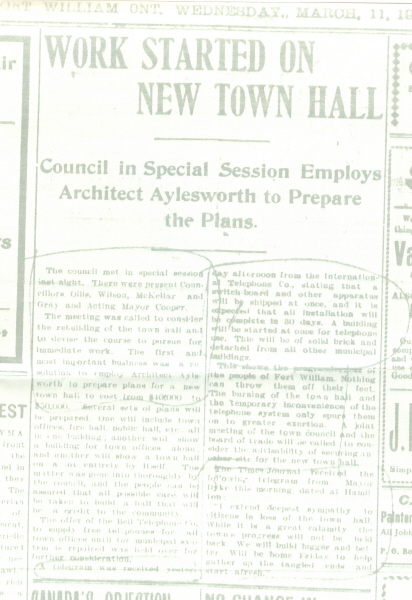
City of Thunder Bay Archives Series Number: 128 An article in the "Daily Times-Journal", the day after the fire in 1903, explaining that plans for a new Town Hall were already in the works.
The text reads: "WORK STARTED ON NEW TOWN HALL, Council in Special Session Employs Architect Aylesworth to Prepare the Plans. The council met in special session last night. There were present Councillors Ollis, Wilson, McKellar and Gray and Acting Mayor Cooper. The meeting was called to consider the rebuilding of the town hall and to devise the course to pursue for immediate work. The first and most important business was a resolution to employ Architect Aylesworth to prepare plans for a new town hall to cost from $10,000 to $50,000. Several sets of plans will be prepared. One will include town offices, fire hall, public hall, etc., all in one building; another will show a town hall on a lot entirely by itself. The matter was gone into thoroughly by the council, and the people can be assured that all possible care will be taken to build a hall that will be a credit to the community. The offer of the Bell Telephone Company to supply free telephones for all town offices until the municipal system is repaired was held over for further consideration. A telegram was received yesterday afternoon from the International Telephone Co., stating that a switch board and other apparatus will be shipped at once, and it is expected that all installation will be complete in 30 days. A building will be started at once for telephone use. This will be of solid brick and detached from all other municipal buildings. This shows the progressiveness of the people of Fort William. Nothing can throw them off their feet. The burning of the town hall and the temporary inconvenience of the telephone system only spurs them on to greater exertion. A joint meeting of the town council and the board of trade will be called to consider the advisability of securing another site for the new town hall. The Times-Journal received the following telegram from Mayor Dyke this morning, dated at Hamilton: 'I extend deepest sympathy to citizens in loss of the town hall. While it is a great calamity, the town's progress will not be held back. We will build bigger and better. Will be home Friday to help gather up the tangled ends and start afresh." City of Thunder Bay Archives Series Number: 198 The McKellar brothers wrote this letter in 1913 to authorize their donation to the City.
A transcript of the letter reads: "Fort William, June 30th, 1913. To His Worship, Mayor Graham and Councillors of the City of Fort William, Dear Sirs: We, the McKellar Brothers, have been instructed by Miss Annie McIntyre to present to the City of Fort William the two cannon that stood like 'Watch Dogs' in front of the Hudson's Bay Post on the Kaministikwia River since the days of the Fur Traders troubles and before the advent of Railroads or Steamboats into Canada, with the understanding that they will be properly preserved for the benefit of the City. These valuable relics passed to Miss McIntyre from her father, Mr. John McIntyre commonly known as 'Governor McIntyre', who was last in charge of the old Hudson's Bay Post of the Kaministikwia River, and to whom the cannon were presented by the Company. Mr. McIntyre had them removed and placed in front of his new home as sentinels until he died. When the Home was broken up in 1906 Miss McIntyre placed them in our charge until she would want them. She has decided that this City shall retain them in perpetuity as a valuable memento of the great Fur Traders in Fort William. Yours Faithfully, Peter McKellar Donald McKellar" City of Thunder Bay Archives Series Number: 198 TBA 5751-15
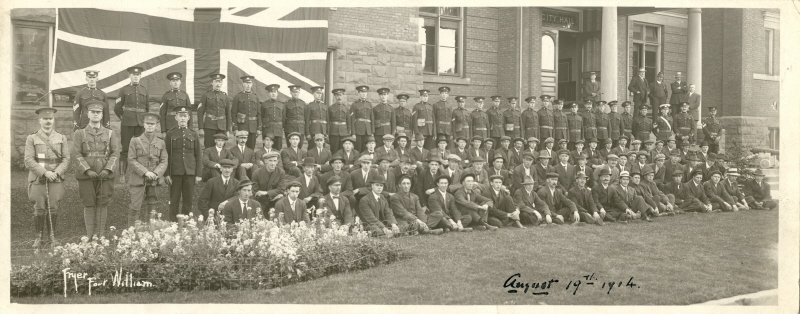
The Lake Superior Regiment, August 19, 1914. At this time, members of the regiment were in active service, local duty. Many of these soldiers would later fight overseas.
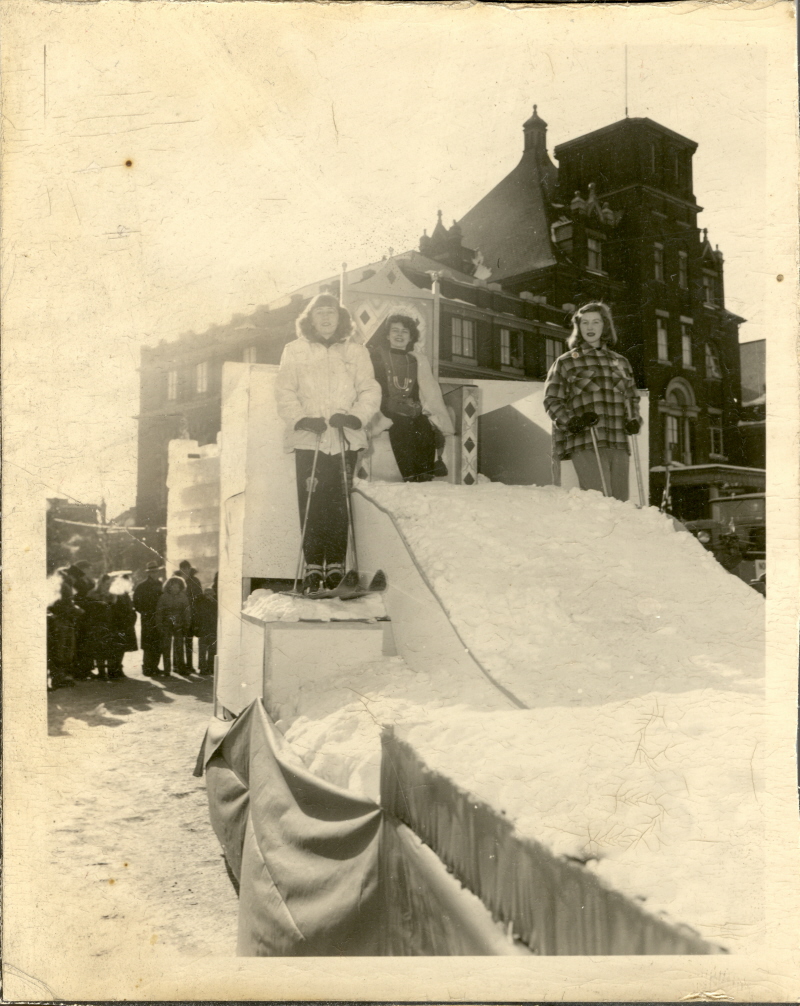
The picture is taken in front of Fort William City Hall. City Clerk Alexander McNaughton and Mayor S.C. Young are also standing on the front steps. The text in the left hand corner reads "Fryer, Fort William" and to the bottom right of the picture is the date: "August 19th, 1914" City of Thunder Bay Archives Series Number: 128 A photograph taken in 1949 at a winter carnival outside City Hall. The role of the City Hall building as a centre for community shows clearly.
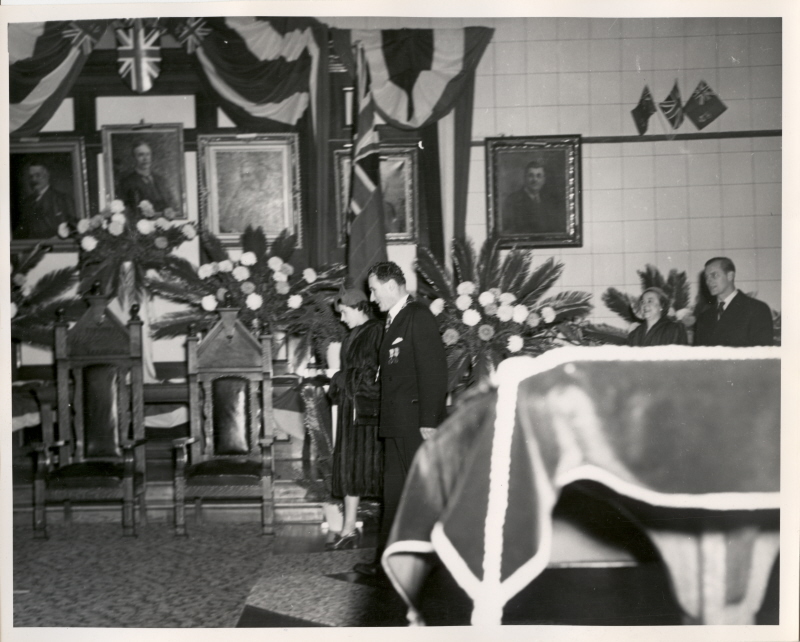
City of Thunder Bay Archives Series Number: 128 This photograph was taken in 1951 in the Fort William City Hall during the Royal Visit of Princess Elizabeth. Note the portraits, which display the decor of the City Hall, as well as the Council Chairs to the left, which are currently on display at the City Archives.
City of Thunder Bay Archives Series Number: 4
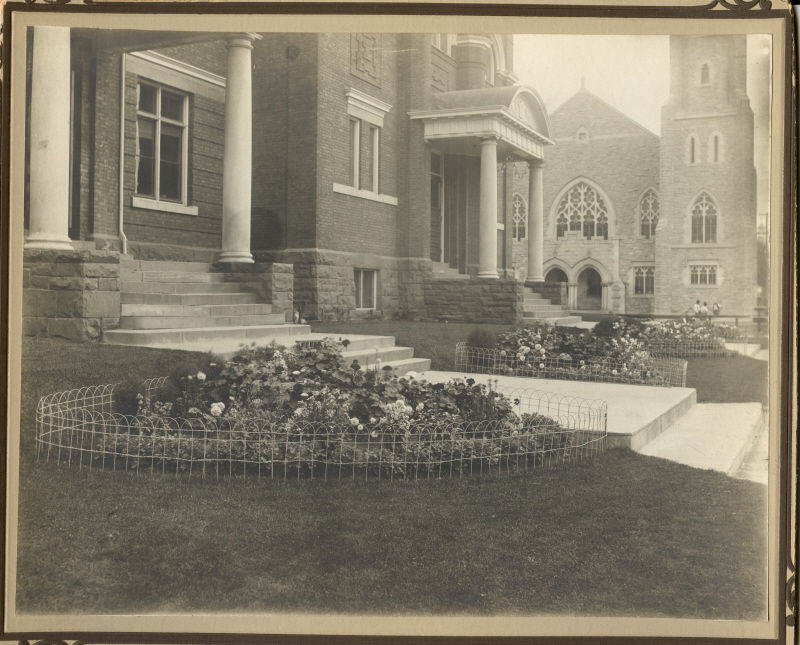
A garden in front of the Fort William City Hall. Note how the City Hall building is more closely aligned with St. Andrew's Church, as the front lawn is more extensive now than it was when this building was in existence.
City of Thunder Bay Archives Series Number: 128
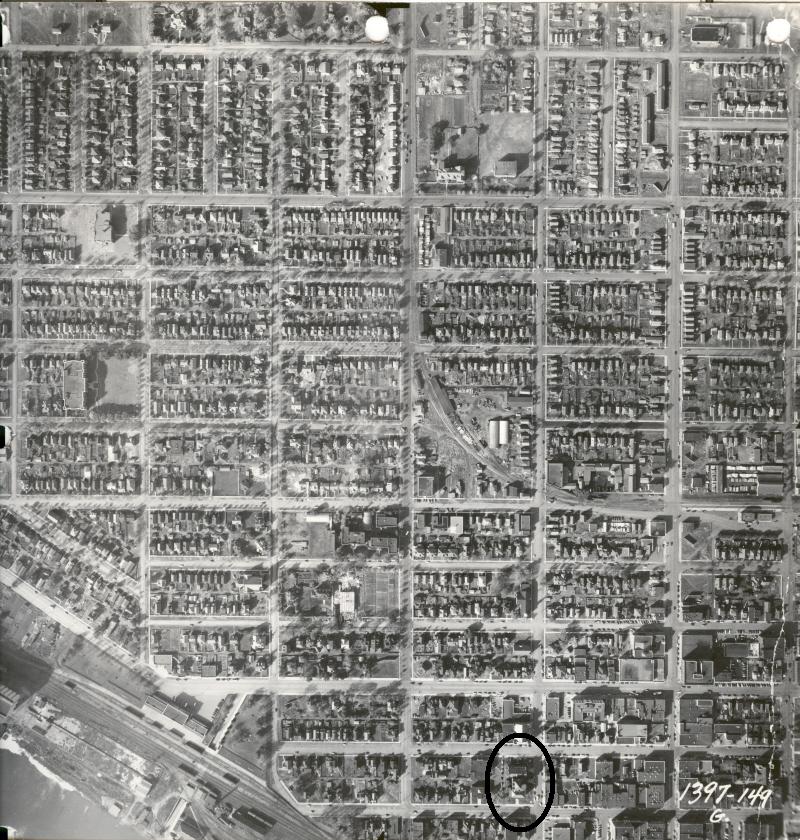
This aerial photograph was taken in 1949. The City Hall can be seen circled at the bottom of the page.
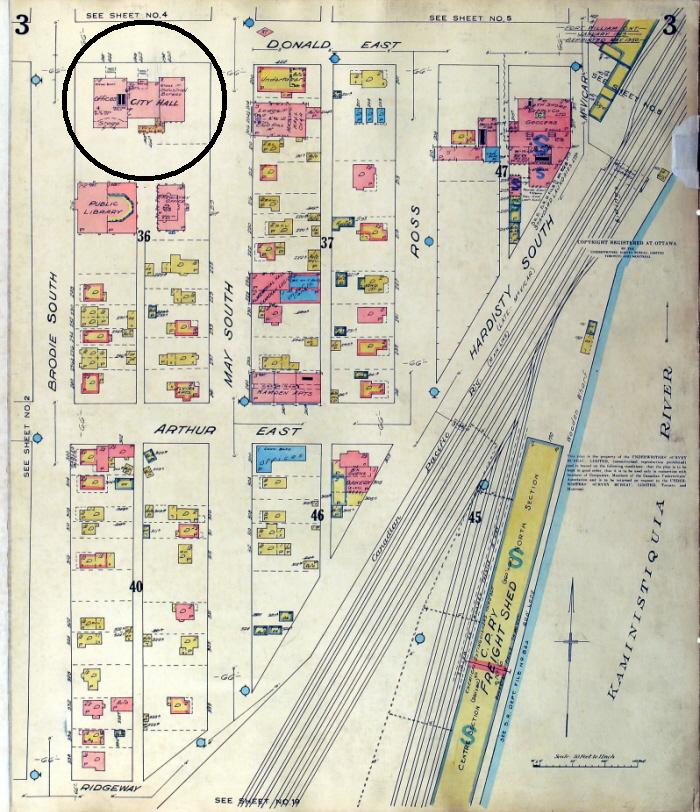
City of Thunder Bay Archives Series: 92 The 1919 Fire Insurance Maps for Fort William show the location of the City Hall, indicated with a circle at the top left corner here.
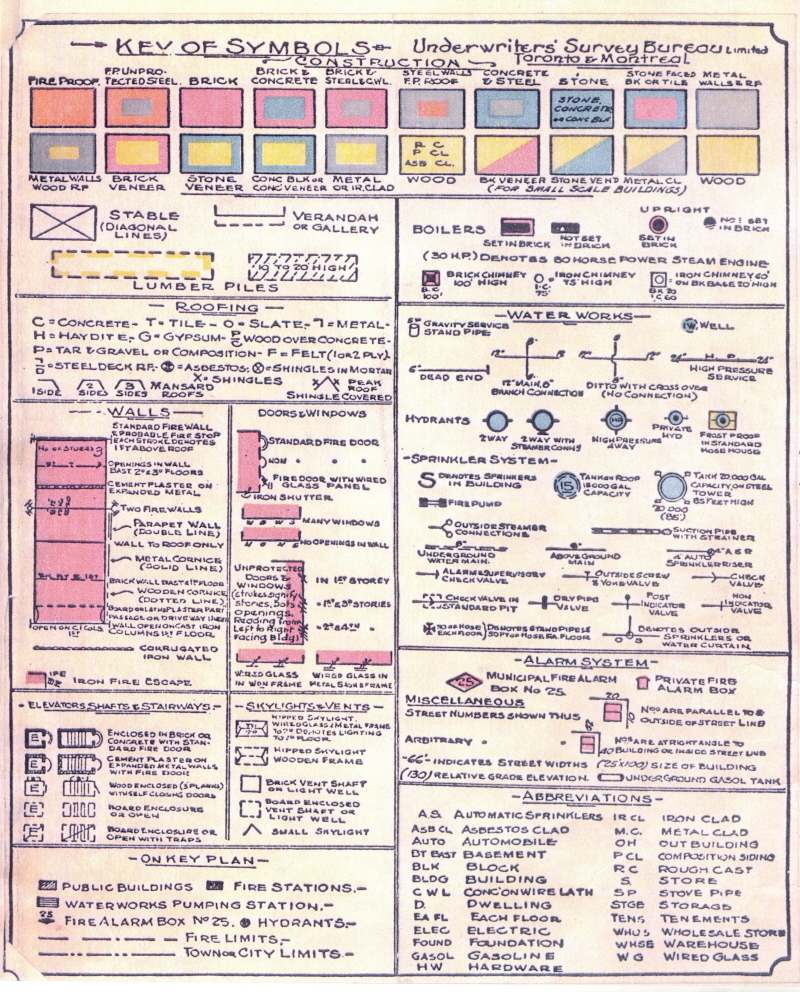
Following is the Symbols Key to reading the map.
1919, Fire Insurance Map #3, Fort William
This photograph was taken across the street from the second City Hall, when there was a park located opposite the building. Behind the tree on the far right side, the Cenotaph can be seen in its original location: on the right-hand corner of the lawn.
|
Thunder Bay City Hall 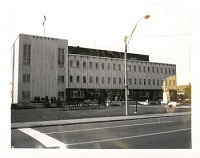 |
|
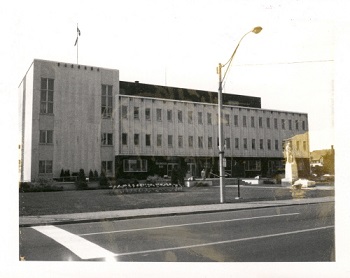
The current Thunder Bay City Hall was first constructed to serve as the third City Hall for Fort William. Built in 1966 at a cost of $1 million, it became the Thunder Bay City Hall in 1970, when Fort William and Port Arthur amalgamated.
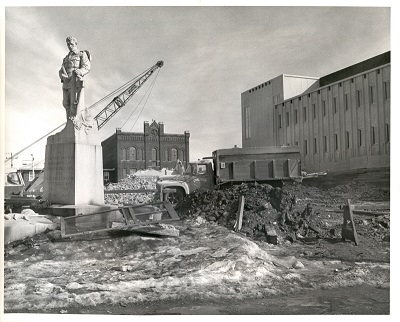
Plans were completed years in advance for this building, as there was a debate as to whether the previous Fort William City Hall should be renovated or completely rebuilt. In 1964, after two years of debate, it was decided that an entirely new City Hall should be built. Locations for the new City Hall were also argued over for some time, until it was finally decided to situate it directly behind the existing City Hall, on land which was then in use as a parking lot. This location was ideal, as it would allow City Hall to remain at the same site, would allow room for the construction to take place, and the existing City Hall would be able to run its business undisturbed throughout construction. The new City Hall was completed in January 1966, and at the end of the month permission was given for the previous City Hall to be demolished. As little as two months before the official opening ceremonies of the new City Hall building, there was still debate about how to make use of the land in front. The three options considered were:
The public voiced their opinion and called for the space in front to be completely landscaped without a parking lot. This area would in 1969 be given the name "McGillivray Square." William McGillivray had been a key figure in the fur trade, who after twenty years of experience managed to work his way up to become director of the North West Company in 1804. This Company was responsible for establishing the location of the fur trading post, Fort William, the namesake of the city. The Fort William fur trading post was a place of significant importance in the fur trade, especially under the command of McGillivray. McGillivray played an important role in this company, and presided over its later union with the Hudson's Bay Company (Cleveland 9).
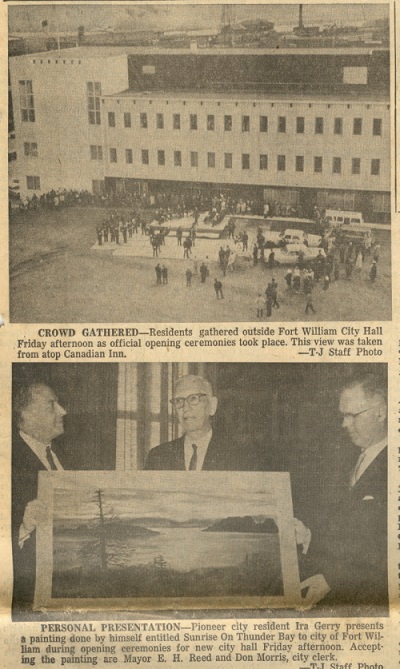
The official opening ceremony for the new City Hall took place on Friday, May 27th, 1966, on the grounds of the new Hall. Because of the festivities, Donald, May and Brodie Streets were blocked off for five hours during the ceremony. Months of preparation went into the ceremony, even consulting the City of Toronto for guidance, as it had also opened a new City Hall the year before. Though the City Hall had been in use since January 1966, and the opening ceremonies took place months later, the area in front of the City Hall (McGillivray Square), had not been completed. Landscaping was delayed due to the demolition of the previous City Hall, and indecision regarding what to do with the new space. For the ceremony, the area was cleaned up and smoothed to make the space usable, but no other work was done. Voluminous correspondence in the preceding months shows that important figures were invited to the opening ceremonies to participate in the presentations, including local religious officials, MPs, MPPs and Ministers of the provincial government. Despite the rivalry between Port Arthur and Fort William, the Mayor of City Hall underwent a major restoration beginning in July 2008 and ending in November 2009. The reasons for these renovations are similar to those given for the construction in 1966: safety concerns and a need for increased space. What began as a project to replace crumbling caulking, expanded significantly once it was realized that the building required major structural improvement, as parts of the concrete siding were crumbling off due to rusting hardware. This project soon came to encompass the need for fully accessible facilities (including wheelchair-accessible doors and bathrooms) and a larger, more practical public meeting space. The building now features local art, and archival displays which celebrate the history of the region and the diversity of people’s within it. Carrying on the tradition of the importance of community, an outward extension along the front of the City Hall, and the inclusion of a landscaped Civic Square created more room for public gatherings as well. When City Hall officially reopened on November 3, 2009 (after being pushed from its original February opening due to construction delays) it was touted for its efficiency and adherence to the Clean, Green and Beautiful initiative. As well as being more energy efficient with the inclusion of tinted windows, an updated heating system and air barrier, the most impressive feature according to then Mayor Lynn Peterson, to the amusement of her colleagues, was “It has insulation!” Eliminating over 22 tons of greenhouse gases per year and greatly reducing utility costs, the new building was celebrated by staff and citizens as taking a step forward for the City. Much like during the previous renovation in 1966, several items were added to the Time Capsule originally buried in 1903. The items included coins, an aerial photograph of the city, the Hoito pancake recipe, drawings provided by elementary students on what they believed the city would look like in 2058 (the next year the Capsule will be opened and added to) as well as a list of tuition and residence fees from Lakehead University. Originally projected at a cost of $2.5 million - with an additional $750,000 added during the 2008 budget proposal, when the extent of renovations became apparent - the project ended up costing just over $5 million. The 2008-2009 restorations have allowed City Hall to continue its growth into a bustling hub of the South side’s downtown core. Alongside an additional renovation in 2015 that increased accessibility for all those working in and using the building, City Hall has also become the South Core transit hub.
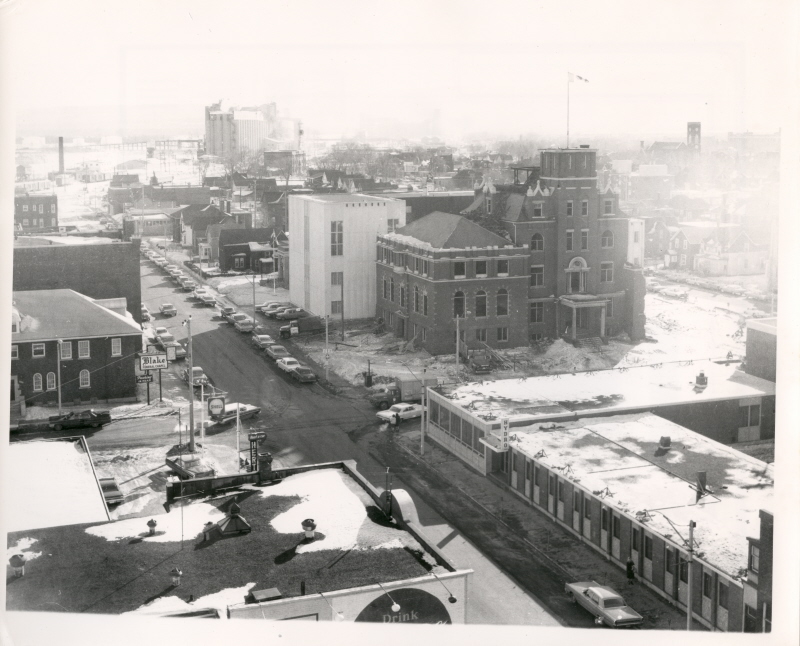
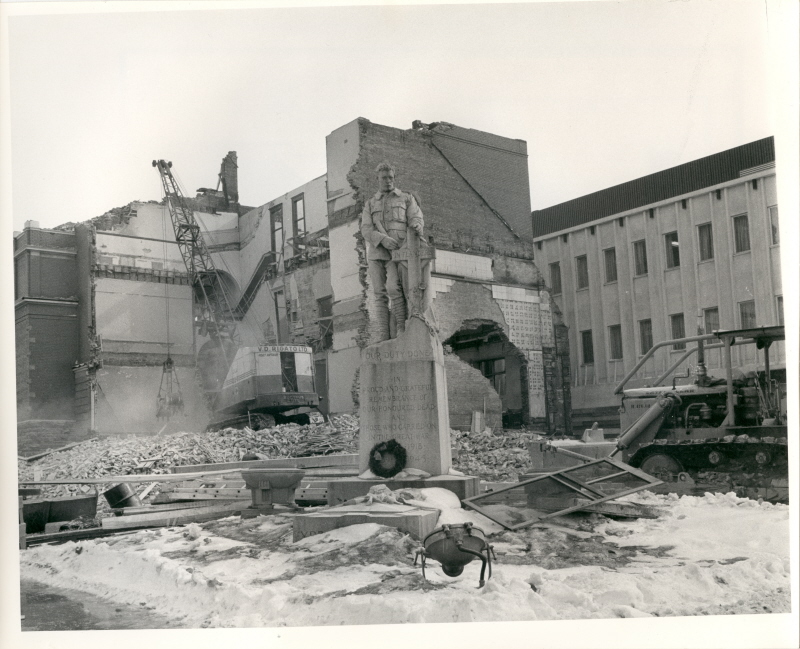
This succession of photos shows the process of the demolition of the old Fort William City Hall.
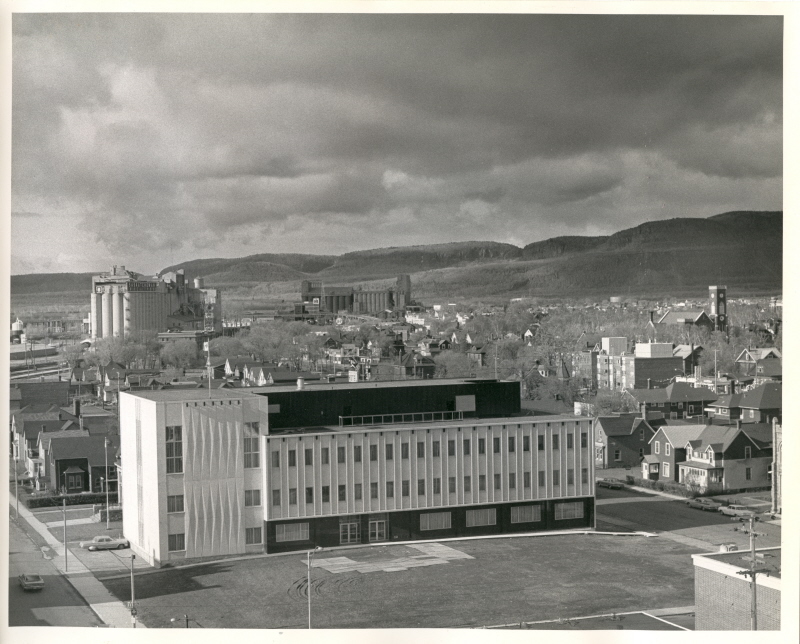
The new City Hall was built behind the old one in 1966, so that the city could continue "business as usual" for as long as possible.
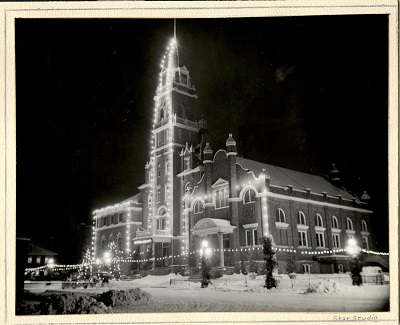
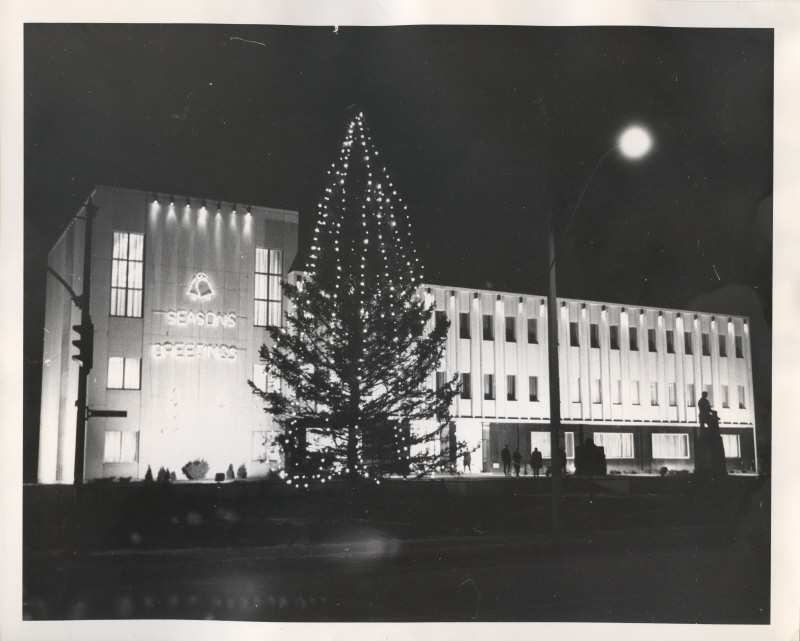
Thunder Bay City Hall, 500 Donald St E, decorated for Christmas.
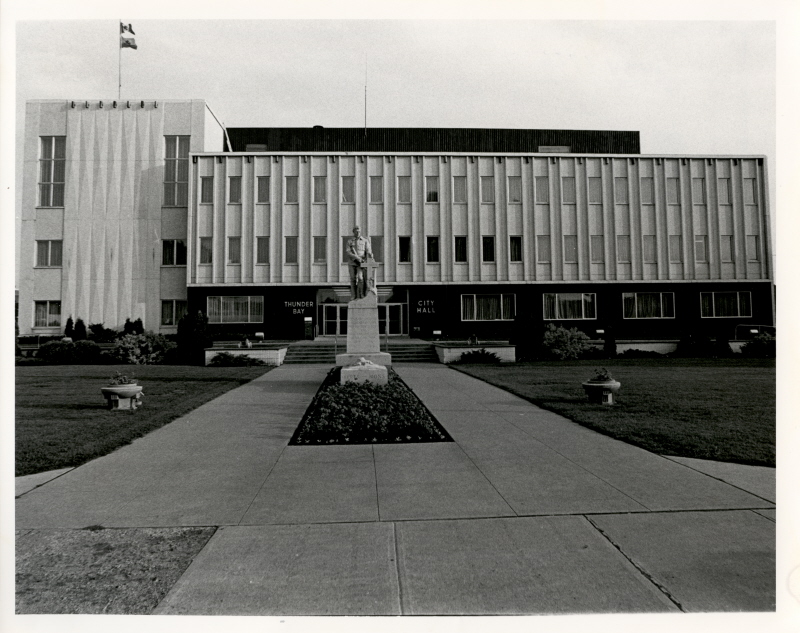
City of Thunder Bay Archives Series Number: 121 A front view of Thunder Bay City Hall, taken in 1976.
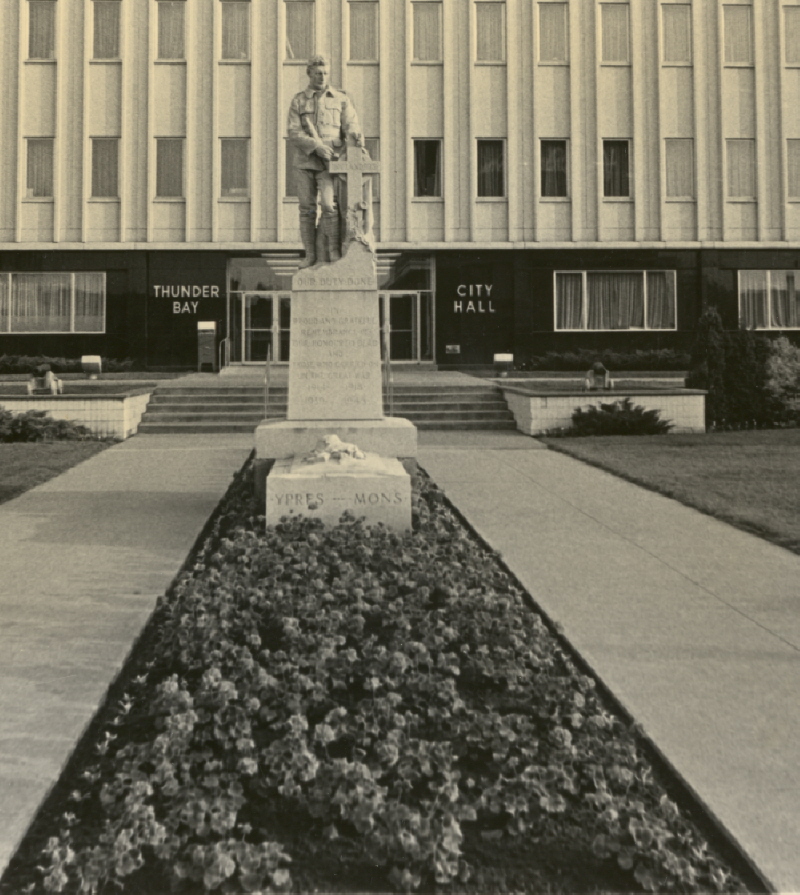
City of Thunder Bay Archives Series Number: 131 A close up of the War Memorial in front of the Thunder Bay City Hall, possibly taken in the 1970s.
It reads: "OUR DUTY DONE City of Thunder Bay Archives Series Number: 131
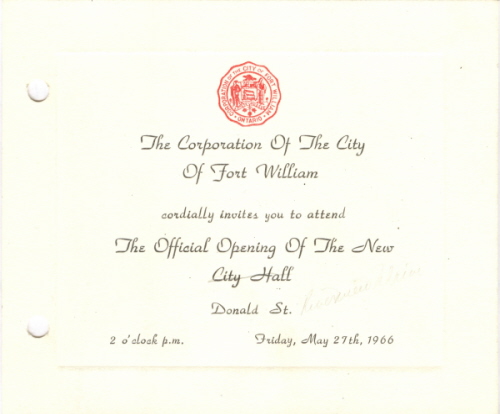
This invitation was sent to dignitaries for the opening ceremonies of the Fort William City Hall in 1966.
The invitation reads: "The Corporation Of The City Of Fort William cordially invites you to attend The Official Opening Of the New City Hall City of Thunder Bay Archives Series Number: 4 This photograph of the new Fort William City Hall in 1966 shows that the grounds without landscaping; it remained this way for months after the demolition of the previous City Hall.
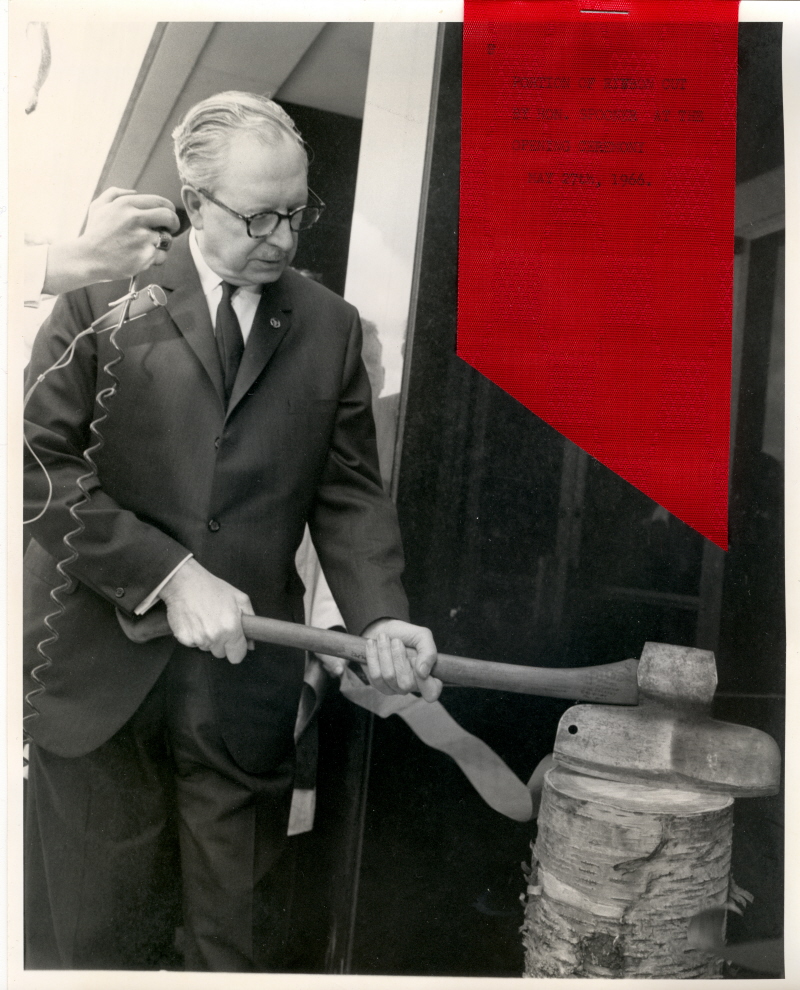
Minister of Municipal Affairs, J.W. Spooner, cuts the ribbon for the opening ceremonies at the new City Hall. A portion of the original ribbon is attached to the photograph.
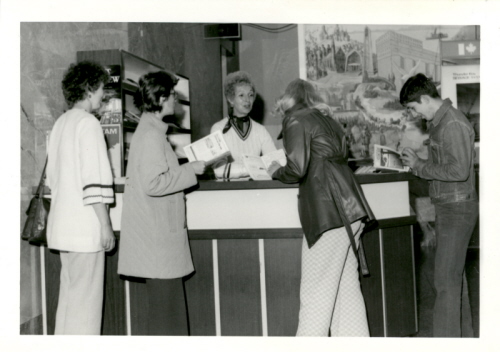
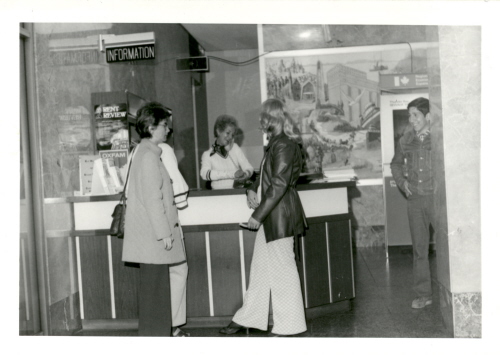
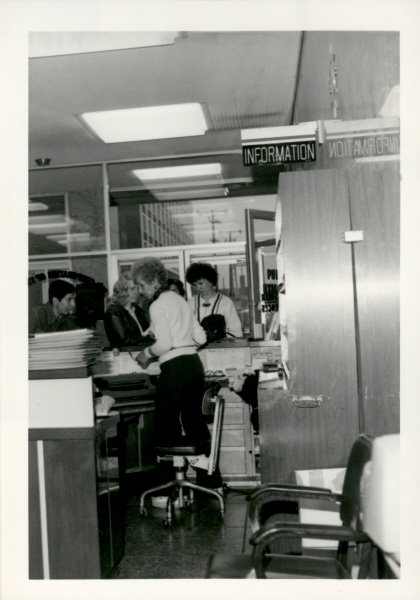
The text on the ribbon reads: "PORTION OF RIBBON CUT BY HON. SPOONER AT THE OPENING CEREMONY MAY 27th, 1966" These photographs were taken in 1976 at the Information Desk in City Hall. Note that in the several of the photographs, the mural can be seen in the background.
City of Thunder Bay Archives Series: 131
City of Thunder Bay Archives Series: 131
City of Thunder Bay Archives Series: 131 |
 Although incorporated as a town in 1884, Port Arthur never constructed a dedicated City Hall building. Offices of municipal government were located in a variety of publicly and privately owned buildings. There have been, however, several locations which can be recognized as serving as the Port Arthur City Hall.
 1907 was a significant year for Port Arthur. In the month of March, Port Arthur achieved "City" status, reaching a population of 15,000. In the same month, the Clerk and Council moved the centre of governance of the new City to the Municipal Building and Telephone Exchange on Arthur Street. A new Fire Hall was constructed on Court Street.
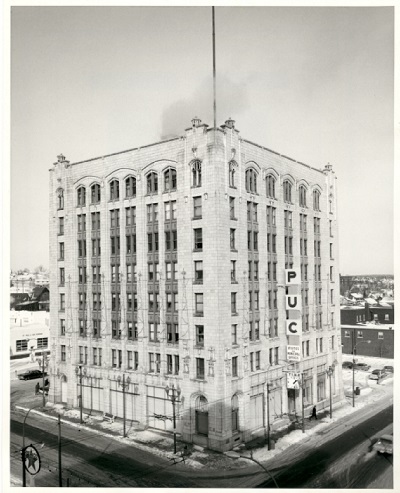 The fourth structure to be used as Port Arthur's City Hall was the Whalen Building, which eventually housed the municipal offices, the Mayor's office, the City Council Chamber and City Clerk's office. From 1914 to 1931, the Port Arthur government rented offices from the private owners of the building; in 1931 it was purchased by, and renamed after, the Port Arthur Public Utilities Commission. This building, on the corner of Cumberland and Van Norman Streets, is still in use as an office building and the home of Thunder Bay Hydro. The timeline below shows the increasing significance of the Whalen building as a municipal facility: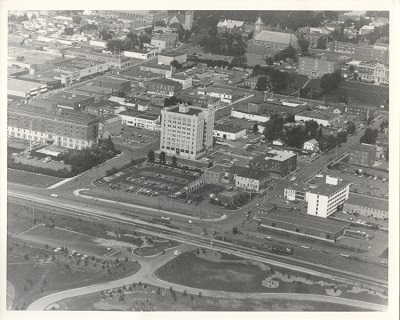
 Performing tours would come to the town to put on plays in the theatre. This served as a great source of entertainment for the public--the town did not enjoy a designated motion picture theatre until 1912. These entertainers included travelling tour groups featuring musicians, hypnotists, and even minstrel shows (which today would be highly controversial due to their negative racial content) (Beaulieu 10-13).
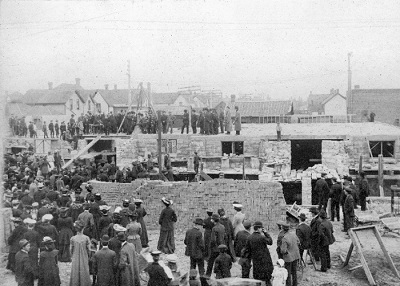 The rebuilding of the Town Hall began in 1903 on the same site as the previous building, and was completed in 1905 at a cost of under $80,000. The new Town Hall was built according to the designs of Mr. Aylesworth, the architect. Again, it was a multi-purpose building which contained a public hall, a stage with dressing rooms, a police station, athletic rooms, a library, a courtroom and a chamber for council meetings. There were plans to house another fire hall in the new Hall, but the idea was rejected, and it was decided to have the two in separate locations.
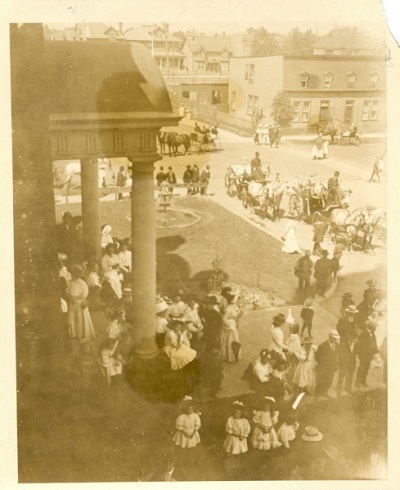
 as an exciting milestone for Fort William occurred in 1907: the Town Hall became the new "City Hall" as the required population of 15,000 for City status was reached.
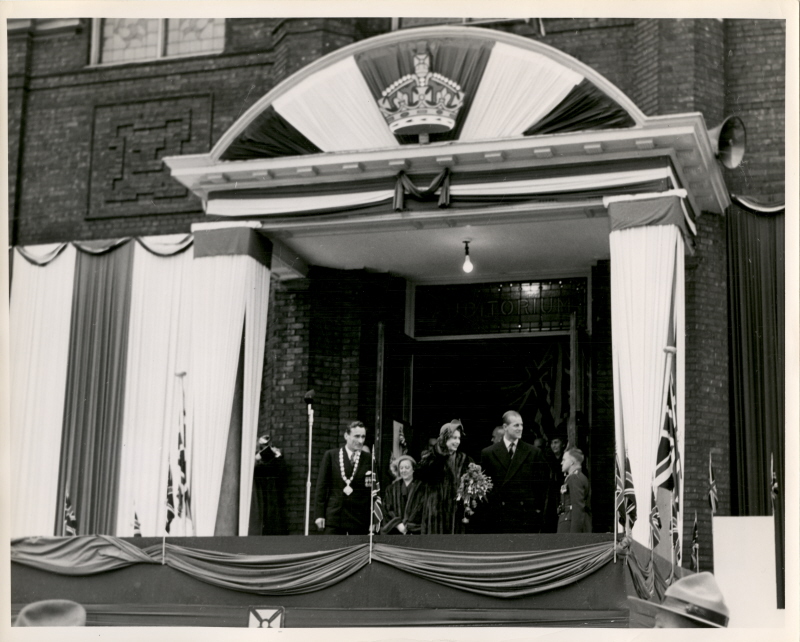
 oyal visits were an exciting event for the citizens of Fort William. One visit in 1951 included a stop at the Fort William City Hall, where the Mayor made a speech and then-Princess Elizabeth received flowers and viewed the crowd of people who came to the City Hall to see her.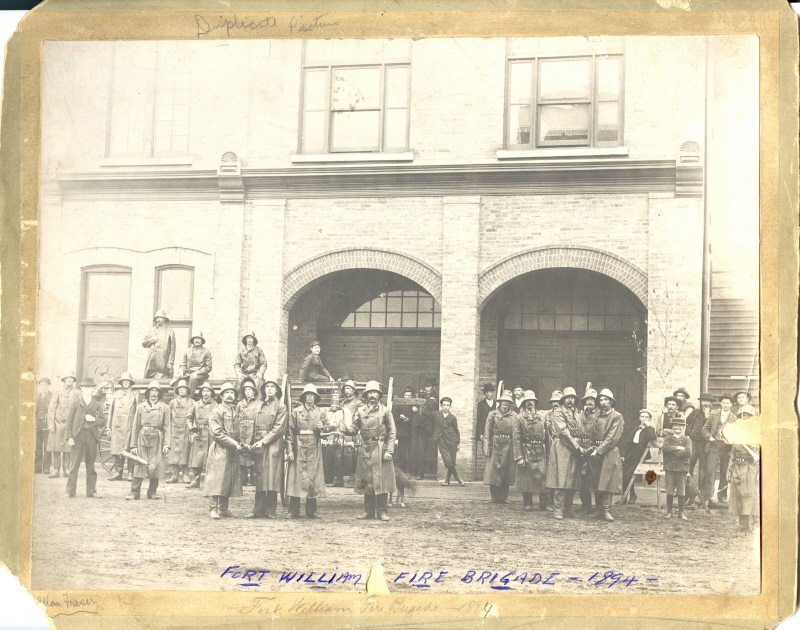
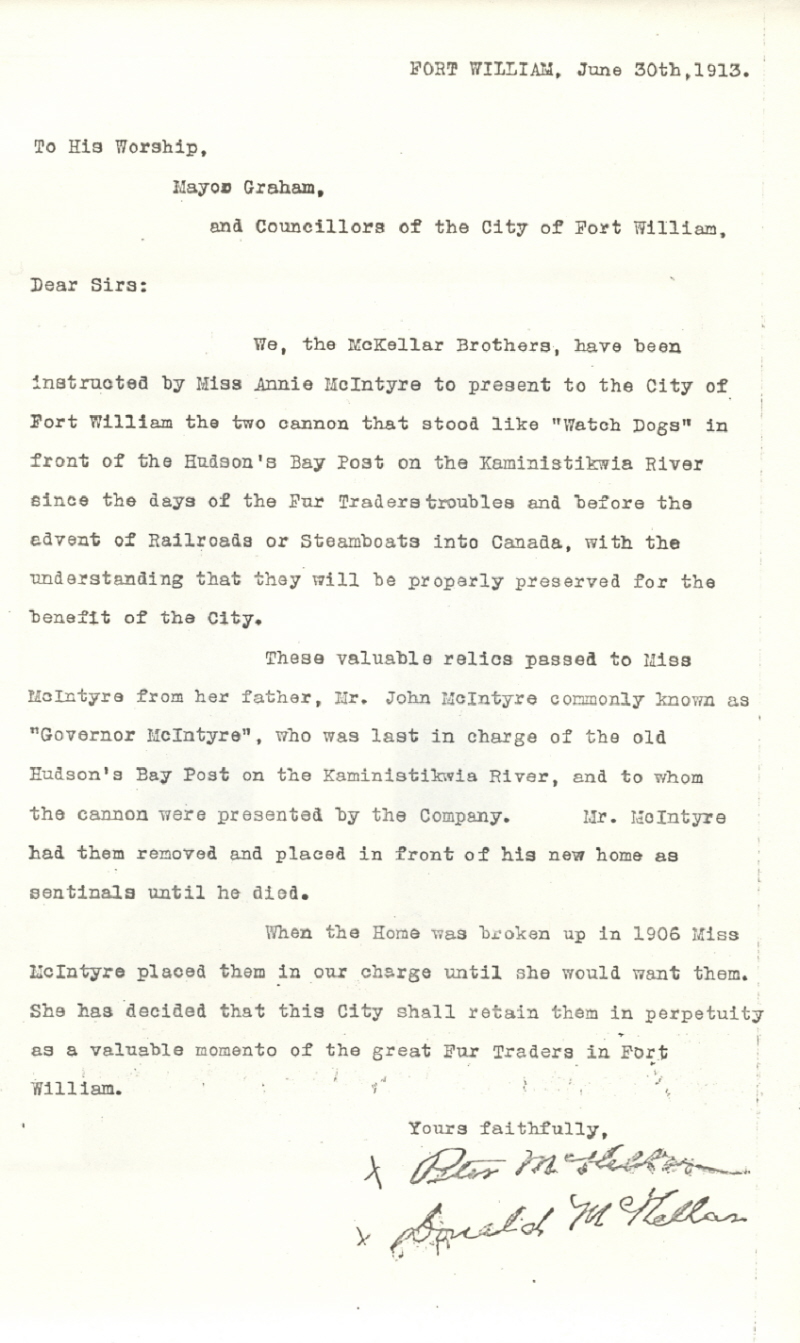
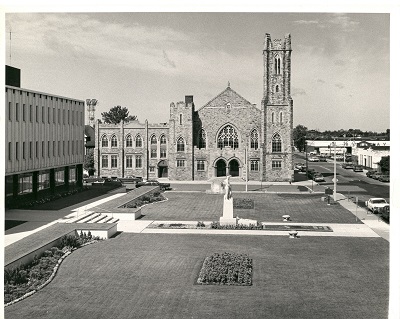
 There are several decorative items in the square, including two cannons, which were donated to the city in 1913 by Peter and Donald McKellar. These cannons represent the conflicts that the fur traders faced in the early days of Fort William. Also in the square is the First World War memorial, which was established in the 1920's by the Women's Patriotic Auxiliary. After the construction of the new City Hall, the war memorial, which was originally set off to the side of the previous building, was moved to the front centre of the lawn to become a focal point. In 1981, the lawn was further decorated with two spruce trees. The new trees had an added financial and environmental benefit, as the City no longer needed to purchase a 60 foot Christmas tree for the space each year.
 Port Arthur (Saul Laskin) and the local MP (R.K Andras) both attended the opening, presaging further cooperation between the two cities. The two were correct in their predictions, as Fort William and Port Arthur amalgamated less than four years later, and adopted the newly built City Hall as the municipal offices for the City of Thunder Bay.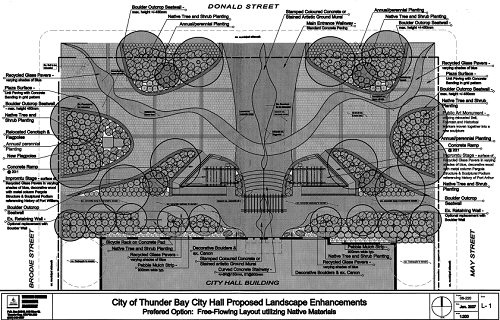
About this exhibit
The Port Arthur, Fort William and Thunder Bay City Hall exhibits and the Time Capsule display were made possible by the City of Thunder Bay Summer Student Employment Program.
Special thanks must be given to:
- Thunder Bay Historical Museum Society for the generous contribution of images, as well as resources for information, Lakehead University Northern Studies Resource Centre, for providing sources for research,
- Lakehead University Library Archives, for the use of images,
- Thunder Bay Public Library, for the use of newspapers on microfilm,
- SAFE Coin & Stamp Supplies, for advice and specialty supplies
City of Thunder Bay Archives series used for research include Port Arthur City Clerk's Files, Fort William City Clerk's Files, Thunder Bay City Clerk's Files, Aerial Photographs, Thunder Bay City Clerk's Photographs, and Thunder Bay Planning Department Photographs.
Other reference sources used in this exhibit are:
- Beaulieu, M. "In Public's demand: Entertainment in Fort William's First Town Hall, 1892-1903." Papers and Records XXXI(2003): 3-20.
- Cleveland, Jacquie. "McGillivray Square." August 1982: 1-12.Ed.
- Epp, A. E. and T. J. Tronrud. Thunder Bay: From Rivalry to Unity. Thunder Bay: The Thunder Bay Historical Museum Society Inc., 1995.
- Mauro, J. M. The Golden Gateway of the Great Northwest: A History of Thunder Bay. Thunder Bay: Lehto Printers Limited, 1981.
- Scollie, F.B. Thunder Bay Mayors & Councillors 1873-1945. Thunder Bay: The Thunder Bay Historical Museum Society Inc., 2000.
To learn more about this subject, as well as any other historical information on Thunder Bay that interests you, please visit or contact the City of Thunder Bay Archives.
Contact Us
 Connect