




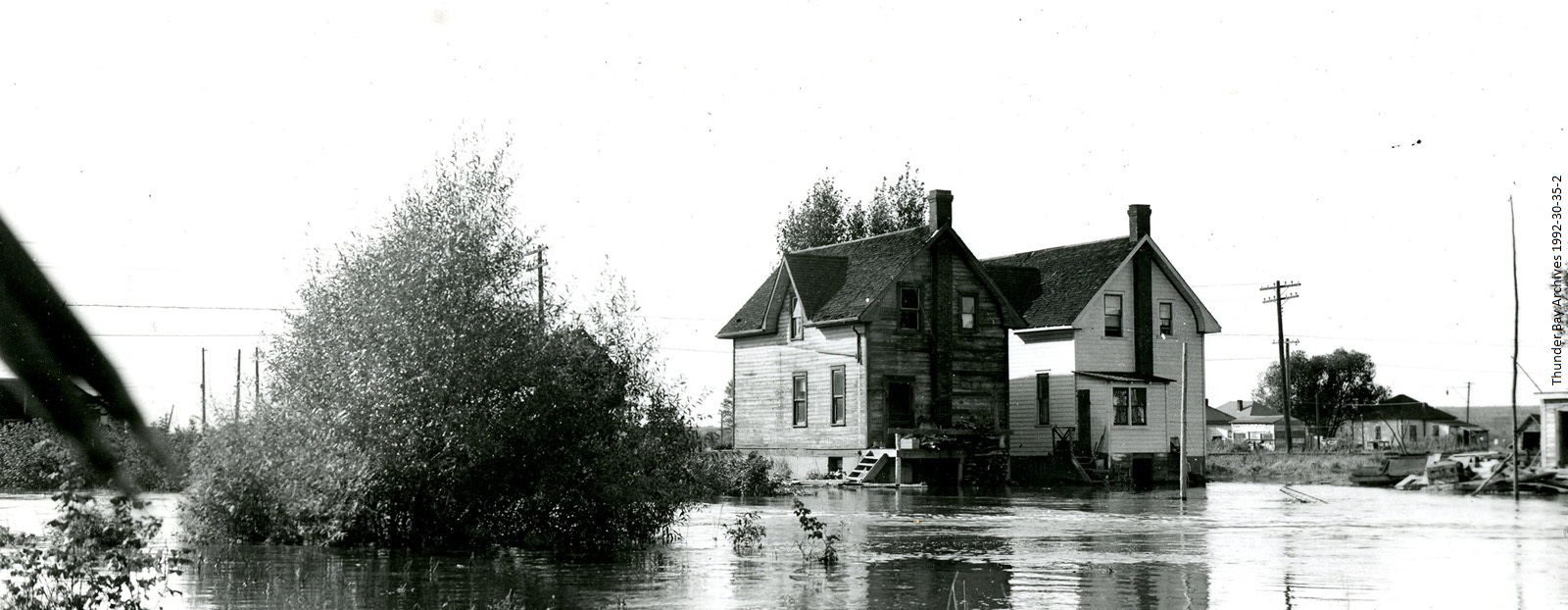


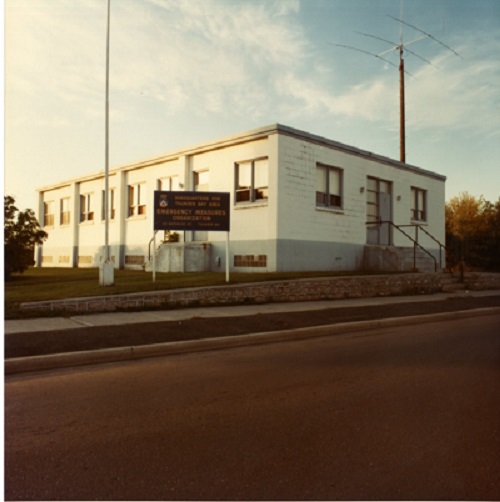
 Records of the work of the Emergency Measures Organization in the Thunder Bay City Archives begin in 1960, when a Civil Defence Committee formed in Port Arthur. The records continue to 1994, and contain information about emergency responses and simulations, new planning procedures, and technological advances. The Emergency Measures Organization has played a vital role in Port Arthur, Fort William, and eventually Thunder Bay, keeping citizens safe from both man-made and natural disasters.
The City of Thunder Bay's "Peacetime Emergency Plan" was established in May of 1979. This 300-page document lists detailed instructions of how to respond to different types of emergencies, with specific tasks laid out for each City department. Everything is covered, from nuclear explosions to floods, and every department is expected to be fully involved in the processes of response and recovery.
With the threat of the Cold War looming over North America, the ability of citizens to survive a nuclear war was a major concern. Along with the fear, though, came activity and safety preparations, as air raid sirens were constructed and organizations provided information about bomb shelters and survival kits. As the City grew and developed, the need to prevent as well as respond to disasters became more pressing. Issues such as bomb threats and the transportation of dangerous materials were seen as significant potential hazards that needed to be addressed. Simulated disasters were practiced in order to improve efficiency and pinpoint what might go wrong in a disaster recovery. The Emergency Measures Organization also responded to actual disaster situations throughout the years, including chemical spills and a passenger train derailment.
Thunder Bay Area Emergency Measures Organization eventually became part of the province-wide Emergency Management Ontario. The core principles and values that it stood for then remain the same today: that preparedness, response, and recovery are vital for the safety of any community.
| Civil Defense and the Cold War |
|
While the cold war played out between the United States and the Soviet Union, Fort William and Port Arthur sat at the centre of continental shipping and right beside North America's largest fresh water supply. Canada allied itself with other Western nations through organizations such as NATO (the North Atlantic Treaty Organization) and worked with the United States on military defences through NORAD (the North American Aerospace Defense Command). Strategies were needed to keep Thunder Bay's citizens and other Canadians safe in the event of any type of nuclear attack. Throughout the 1960's, information was distributed in the form of pamphlets and books, describing ways to survive nuclear attacks, protect oneself from nuclear fallout, and how to obtain and organize proper emergency supplies. The Aircraft Detection Corps in the Lakehead
Figure 1. Plate I AN OUTLINE DRAWING SHOWING THE PARTS OF AN AIRCRAFT 1. Navigation Light 16. Pilot Tube (shows Air Speed) 2. Upper Wing 17. Leading Edge of Wing 3. Upper Aileron 18. Lower Wing 4. Wing Center Section 19. Machine Gun 5. Pilot's Cockpit 20. Wheel Pants 6. Fuselage 21. Landing Gear Strut 7. Fin 22. Wheels 8. Rudder 23. Engine Cowling 9. Tail Light 24. Engine 10. Elevator 25. Propeller Spinner 11. Stabilizer 26. Lower Wing 12. Tail Wheel 27. Center Section Strut 13. Stabilizer Strut 28. Forward Wing Strut 14. Lower Aileron 29. Upper Wing 15. Rear Wing Strut The Parts of an Aircraft [ 29 ] World War II and Threats to the LakeheadDuring World War II, the cities of Fort William and Port Arthur were the home of the Bombardier plane manufacturing plant. This meant they were threatened by enemy aircraft. The Royal Canadian Air force partnered with Bell Telephone Company and Canadian National Telegraph, set up air raid siren towers and observation posts to keep the cities safe.1 In 1943, D.W. Ferrier, the General Traffic Manager for the R.C.A.F, contacted the Public Utilities Commission in Port Arthur to arrange an area of Port Arthur that the Aircraft Detection Corps (A.D.C.) would operate out of and the system in which they would operate. 2 The A.D.C. was a group of mainly volunteer civilians whose job was to report on any enemy aircraft or vessels seen around the Lakehead during World War II.3 Observation posts were set up in strategic areas of Port Arthur and detection handbooks were given to observers to know how and when to send over reports to Fort William, then from there reported to Winnipeg for action.4 Observation posts covered 124.3 kilometres and each separate one was identified by a specific code name, such as “Baffin 10”.5 The observers were all given handbooks that would aid them in identifying potential threats, including information like aircraft markings and shapes, to the cities but these handbooks were also given to all the assisting telephone company offices so they could also make a report when needed.6 Along with having A.D.C. observers, Fort William and Port Arthur also served as distribution centres, receiving and sending calls in a radius of 141.6 kilometres.7 The Bell Telephone Company and Canadian National Telegraph would have connection points, at Kaministiquia, Sunshine, Shabaqua, Shebandowan, along with connections to Cameron Falls by radio.8 With the help of radio circuits ran by the Hydro-Electric Power Commission in Cameron Falls, long distance calls were also sent from Beardmore, Geraldton, and Long Lac, allowing more reports to be sent from Fort William to the Winnipeg regiments for documentation and action.9 Thirty-seven years after the set up of the Air Raid Sirens and about fifteen years after their last use, the siren located at the Fort William Gardens went off unexpectedly in 1980.10 This caused the Provincial Warning Officer to look into a testing system for the old alarms since they had worn down over the years and they were never to be heard unless there was an attack or radioactive fallout within the city. It was then decided that Canadian Forces Base Winnipeg and the 73rd Communication Group would test the sirens annually by using a growl test.11 Growl tests were done by starting up the engine of the siren, but not putting it to full power, resulting in the siren making a low humming noise to not worry the public.12 The sirens did accidentally go off every now and again, but only six to nine of the five hundred sirens in Ontario were estimated to go off every year.13 In result systems were put in the place to quickly shut off the engines if the sirens did start to wail.14
ConclusionNo major attack did ever hit the two cities, but the procedures that were put in place were ready to keep the Lakehead safe if there ever was a threat, and sometimes even if there wasn’t. Footnotes:1. City of Thunder Bay Archives (TBA), Series 88, TBA 4231-02, “Air Raid Detection,”, 1943.
2. Ibid. (See Figure 4).
3. Ibid. (See Figure 4).
4. Ibid. (See Figure 2, 3, and 5).
5. City of Thunder Bay Archives (TBA), Series 88, TBA 4231-02. “Air Raid Detection,” Official Handbook for the Aircraft Detection Corps, September 1943.
6. Ibid. (See Figure 5).
7. City of Thunder Bay Archives (TBA), Series 88, TBA 4231-02, “Air Raid Detection,”, 1943. (See Figure 6)
8. Ibid. (See Figure 6).
9. Ibid.
10. City of Thunder Bay Archives (TBA), Series 117, TBA 5170-33, “Communications Telephone Service Air Raid Sirens,” 1980-1981. (See Figure 7).
11. Ibid. (See Figure 8).
12. Ibid.
13. Ibid. (See Figure 9).
14. Ibid. (See Figure 9).
Additional Images
Figure 2. PLATE XI
 National Markings German Aircraft [ 39 ]
Figure 3. PLATE X
National Markings Russian Aircraft [ 38 ]
Figure 4. ROYAL CANADIAN AIR FORCE AIRCRAFT DETECTION CORPS SPECIAL INFORMATION TO TELEPHONE OPERATORS 1. The Aircraft Detection corps of the Royal Canadian Air Force has been formed to provide prompt and reliable reports to our Defence Forces of the approach of hostile aircraft. Its personnel consists of volunteer civilian observers, who forward these reports through the normal communication facilities of the country. 2. Your company has patriotically granted the use of their facilities on a priority basis, to transmit these reports. However, the success of the plan depends on the speed and accuracy with which the reports are handled between the observer and the Defence Forces, and this link in the chain in the telephone operator.
Figure 5. It was decided at that time that all "Aircraft Detection Corps" or "Army Flash" calls received at Port Arthur would be passed to Fort William for handling. Fort William, in turn, will route these calls to the Reporting Centre at Winnipeg, with the exception of calls received from Cameron Falls which will be routed to Sault Ste. Marie. In order that the Fort William operator will be able to recognize the calls from Cameron Falls, it was agreed that the Port Arthur operators would identify these calls in passing them to the Toll Centre. The decisions reached at Port Arthur have been incorporated in an Operating Practice, two copies of which are attached hereto. We are also sending a copy of this Practice to Mr. Mcdougall at Fort William, so that he can advise his operators what to expect on calls received from Port Arthur. In addition to handling "Army Flash" calls from official observers, the R.C.A.F. have requested that telephone operators originate "Army Flash" calls themselves to report any matters which, in their judgement, should be reported and which, to their knowledge, have not already been reported by official observers. To assist them in rendering this help to the Aircraft Detection Corps, the R.C.A.F. are supplying each telephone office in the activated area a copy of the "Official Handbook for Aircraft Detection Corps", which was prepared for the use of their official observers. For your information, I am attaching a copy of this handbook, together with a letter from the Chief of Air Staff addressed to telephone operators.
Figure 7. We confirm the suggested arrangement whereby Port Arthur and Fort William will be listed as distributing centres. In connection with warning centres contingent to Port Arthur, we beg to advise that we have long distance telephone points on the Canadian National Railways, a distance of approximately 88 miles west of Port Arthur, as follows: Sunshine, Kaministiquia, Shabaqua, Shebandowan, Kashabowie, and we expect later to have have long distance connection as far as Atikokan where the Steep Rock Mines will be located. These points are also accessible by Canadian National Telegraphs. We also have long distance connection to Cameron Falls, 88 miles east of Port Arthur on the Canadian National Railways. Cameron Falls is the location of the Hydro-Electric Power Commission's generating plants totalling 129,000 horsepower, with an invested capital of around ten million dollars and are the source of power supply for the entire Lakehead district including Port Arthur, Fort William and the mining centres around Beardmore, Geraldton, etc.
Figure 8. All of the sirens in Ontario are tested annually by teams from the nearest Military Base. The maintenance of the sirens in Thunder Bay are the responsibility of Canadian Forces Base Winnipeg and 73rd Communication Group. When a team is scheduled to go out in the field the Provincial Warning Officer (continues in Figure 9). Stamp in lower left reads: RECEIVED / Jan 29, 1981 / City of / Thunder Bay / City Clerks Dept.
Accidental soundings do unfortunately happen on occasion, caused by the environment, vandalism or line repair/maintenance, but then are the exception rather than the norm. Ontario which has in excess of 500 sirens average about 6-9 accidental soundings a year. We have effective procedures in place that can silence the offending siren in a relatively short period of time and get it back on line. I trust that this will satisfy your request, however if you require further information do not hesitate to contact me. Yours Truly / R. Lang / Major / Provincial Warning Officer |
| Transportation of Hazardous Materials |
| Transportation of Hazardous Materials |
| Bomb Threats and Civilian Safety |
| Around the world, many countries were facing bomb threats by both civilian and terrorist organizations, particularly beginning in the 1970s. Thunder Bay Emergency Organization decided to spearhead the issue and place Thunder Bay on the defensive.
An introduction to the E.M.O. bomb threat plan reads: “Because changes in our society have brought about incidents of bomb threats, [a] pamphlet has been prepared to assist in the formulation of a plan in the event of a bomb threat.” This plan was to assist and maintain the security of all Thunder Bay civilians under the threat of a timed explosive device. To combat the dangers presented by bomb threats, Thunder Bay E.M.O. published procedures (tailored to different organizations) for evacuation, the search for the device, and more. These standard procedures have changed remarkably little in intervening years. (For example, guidelines for collecting information from the caller when a bomb threat is made remain the same today.)
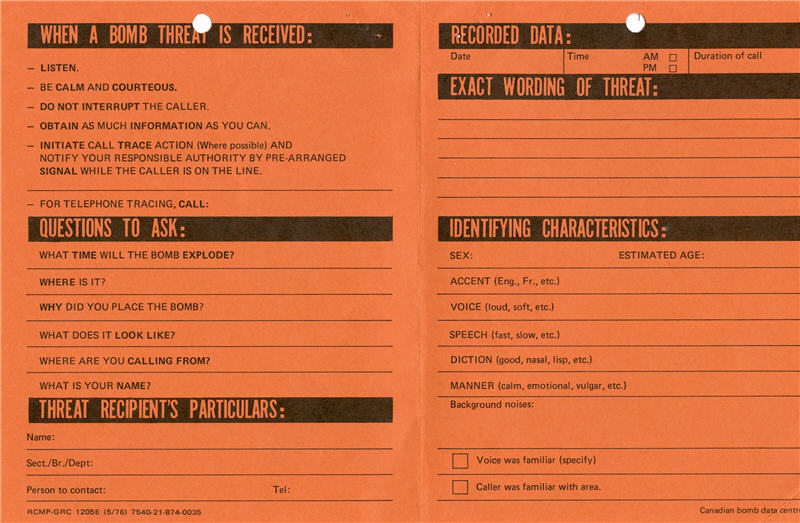
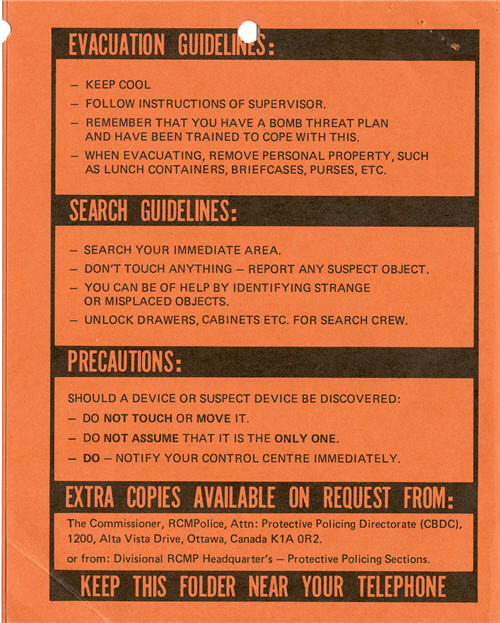
This brochure was issued by Canadian Bomb Data Centre in the late 1970s. The procedures here would have been used by City staff.
When a bomb threat is received:
Questions to ask:
Threat recipient's particulars:
Recorded data:
Exact wording of threat: Identifying characteristics:
Evacuation Guidelines:
Search Guidelines:
Precautions: Should a device or suspect device be discovered:
|
| Emergency Responses |
The Thunder Bay Emergency Measures Organization planned how to react during a disaster situation, and from time to time were required to put that planning into effect. Real-life events included a major snowstorm and a train derailment.
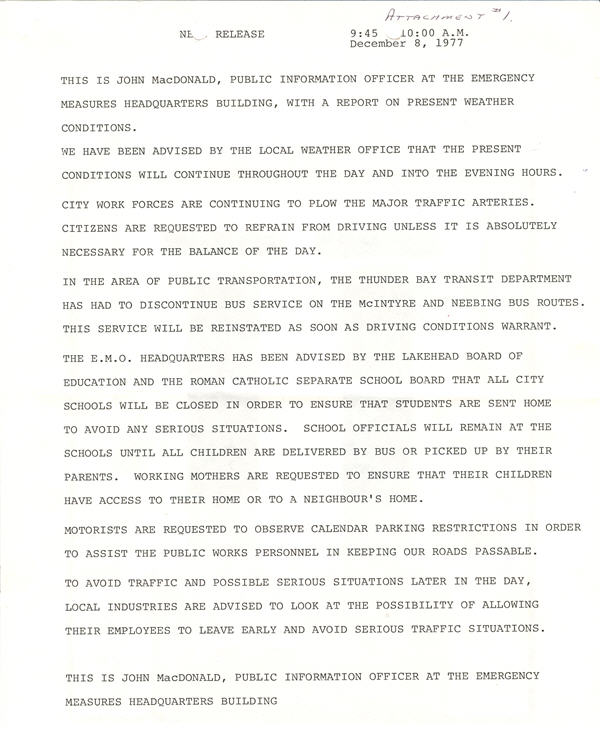
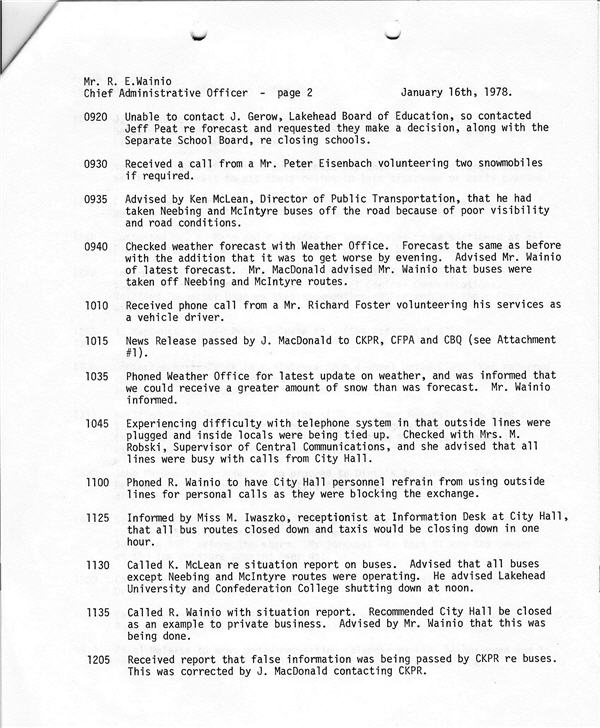
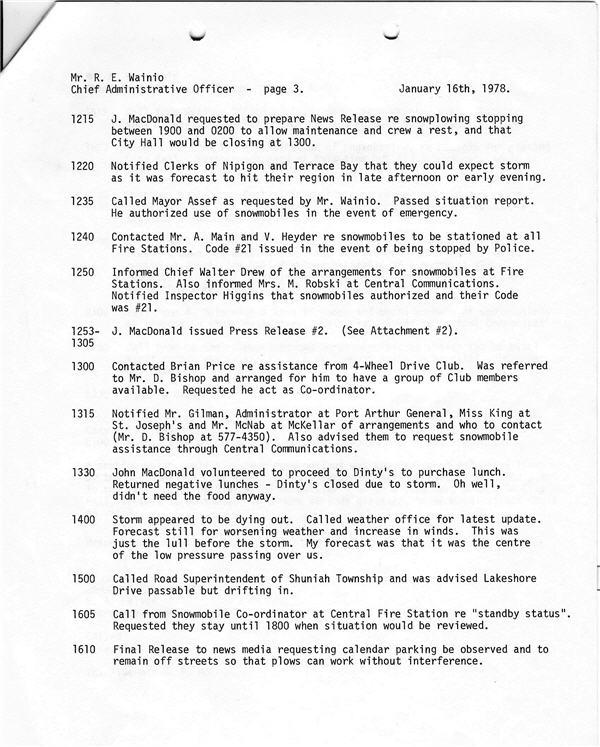
Snowstorm, 1977On December 8th, 1977 at approximately 6:00 a.m., snow warnings began to sound on the radio. The Atmospheric Environment Service Weather Office warned of heavy snowfall coupled with high winds and drifting. Transportation all over the city was reduced, and rural buses were cancelled immediately. About three hours later, a press release went out by radio predicting the effects of the storm, and stating that the situation was being handled by the Thunder Bay Area Emergency Measures Organization. School boards were contacted and local schools were closed. This was followed by the decision of the Director of Transportation to halt all public transit because of poor visibility. Thunder Bay was grinding to a halt as more snow fell. As officials knew that a major snowstorm was coming, this news release was issued on the morning of December 8 to warn citizens of school closures and potential traffic problems.
Transcript: News Release 9:45 – 10:00 A.M. December 8, 1977 This is John MacDonald, Public Information Officer at the Emergency Measures Headquarters building, with a report on present weather conditions. We have been advised by the local weather office that the present conditions will continue throughout the day and into the evening hours. City work forces are continuing to plow the major traffic arteries. Citizens are requested to refrain from driving unless it is absolutely necessary for the balance of the day. In the area of Public Transportation, the Thunder Bay Transit Department has had to discontinue bus service on the McIntyre and Neebing bus routes. This service will be reinstated as soon as driving conditions warrant. The E.M.O. Headquarters has been advised by the Lakehead Board of Education and the Roman Catholic Separate School Board that all city schools will be closed in order to ensure that students are sent home to avoid any serious situations. School officials will remain at the schools until all children are delivered by bus or picked up by their parents. Working mothers are requested to ensure that their children have access to their home or to a neighbour’s home. Motorists are requested to observe calendar parking restrictions in order to assist the Public Works personnel in keeping out roads passable. To avoid traffic and possible serious situations later in the day, local industries are advised to look at the possibility of allowing their employees to leave early and avoid serious traffic situations. This is John MacDonald, Public Information Officer at the Emergency Measures Headquarters building. Another hour brought worse news. An update from the Weather Office suggested that more snow than originally anticipated might fall. In an attempt to relay this news to City Hall, E.M.O. co-ordinators uncovered a serious communications problem: all phone lines were in use as City staff called home, and no calls could get through. In addition to the buses, taxi companies were also closing down for safety, and some businesses and industries were shutting early so their staff could make their way home. As the day went on, officials were able to make better predictions of how the storm would proceed. Plans for snow clearing were announced, and businesses and industries were encouraged to close early.
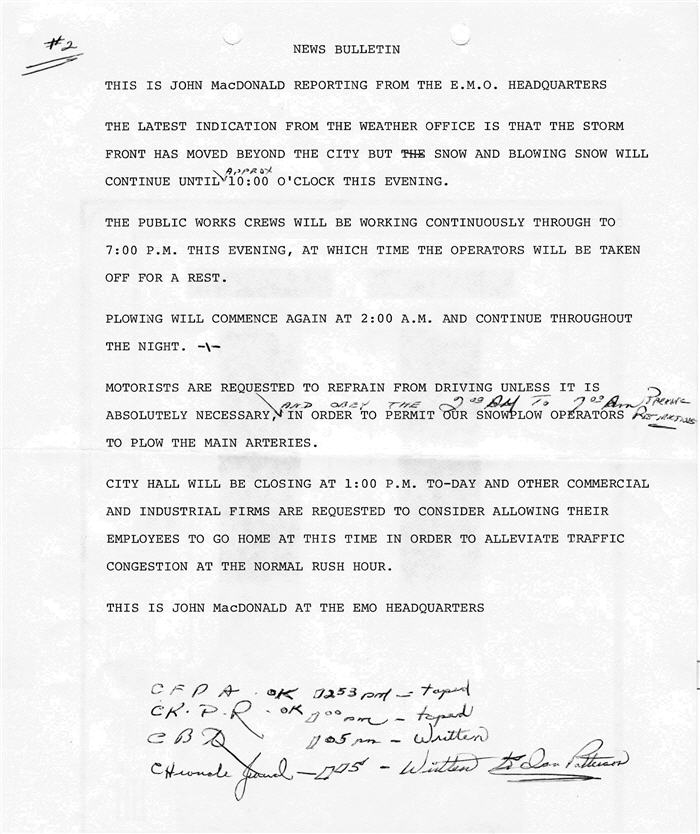
Transcript: News Bulletin This is John MacDonald reporting from the E.M.O. Headquarters. The latest indication from the Weather Office is that the storm front has moved beyond the city but [the] snow and blowing snow will continue until [approx.] 10:00 o’clock this evening. The Public Works crews will be working continuously through to 7:00 p.m. this evening, at which time the operators will be taken off for a rest. Plowing will commence again at 2:00 a.m. and continue throughout the night. Motorists are requested to refrain from driving unless it is absolutely necessary, [and obey the 2:00 a.m. to 7:00 a.m. parking restrictions] to plow the main arteries. City Hall will be closing at 1:00 p.m. to-day and other commercial and industrial firms are requested to consider allowing their employees to go home at this time in order to alleviate traffic congestion at the normal rush hour. This is John MacDonald at the EMO Headquarters. [Handwritten:] CFPA. OK 2:53p.m. – taped CKPR. OK [].00 p.m. taped CBQ. OK []5 p.m. – Written Chronicle Journal – [].[]5 – Written to Ian Pattison As more and more snow fell, E.M.O., in order to set an example to private businesses, recommended the closing of City Hall. Staff contacted other communities such as Nipigon and Terrace Bay so they too would be prepared should the storm go their way. Both the Mayor and Police Departments authorized the use of snowmobiles, should they be necessary, for emergency personnel. The storm was becoming so intense that some people were forced to leave their cars on the Expressway and walk home through the snow. The Weather Office cancelled the snow warning several hours later, but a list of snowmobilers who could assist with emergency transportation was kept on hand. The weather, now just a typical snowy day, had finally settled and Thunder Bay and its residents were safe.
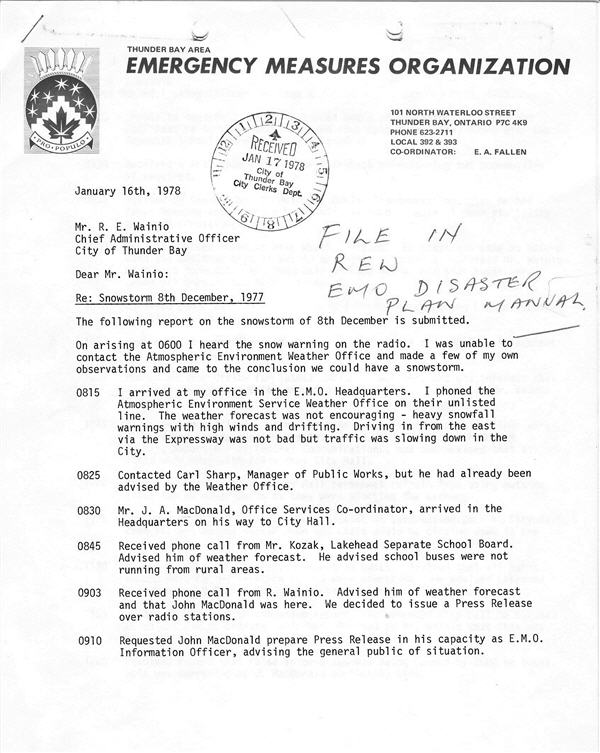
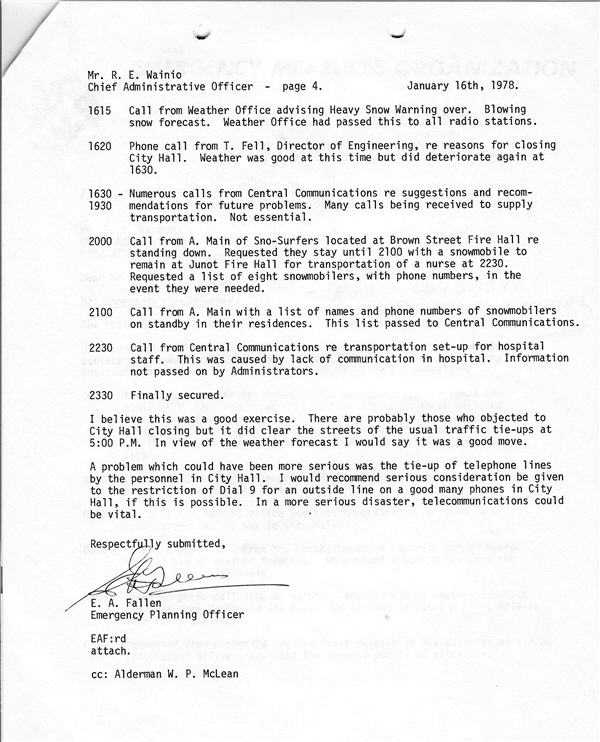
This report, written several weeks after the snowstorm took place, summarizes the actions taken by emergency personnel to minimise the effects of the weather upon the city.
Thunder Bay Area Emergency Measures Organization 101 North Waterloo Street Thunder Bay, Ontario P7C 4K9 Phone 623-2711 Local 392 & 393 Co-Ordinator: E.A. Fallen January 16th, 1978 Mr. R. E. Wainio Chief Administrative Officer City of Thunder Bay Dear Mr. Wainio: Re: Snowstorm 8th December, 1977 The following report on the snowstorm of 8th December is submitted.
Stamp: Received Jan 17 1978, City of Thunder Bay City Clerks Dept. Handwritten: File in Rew. EMO Disaster Plan Manual
I believed this was a good exercise. There ware probably those who objected to City Hall closing but it did clear the streets of the usual traffic tie-ups at 5:00 p.m. In view of the weather forecast I would say it was a good move. A problem which could have been more serious was the tie-up for telephone lines by the personnel in City Hall. I would recommend serious considerations be given to the restriction of Dial 9 for an outside line on a good many phones in City Hall, if this is possible. In a more serious disaster, telecommunications could be vital.
Respectfully submitted, (signed) E. A. Fallen Emergency Planning Officer cc: Alderman W. P. McLean
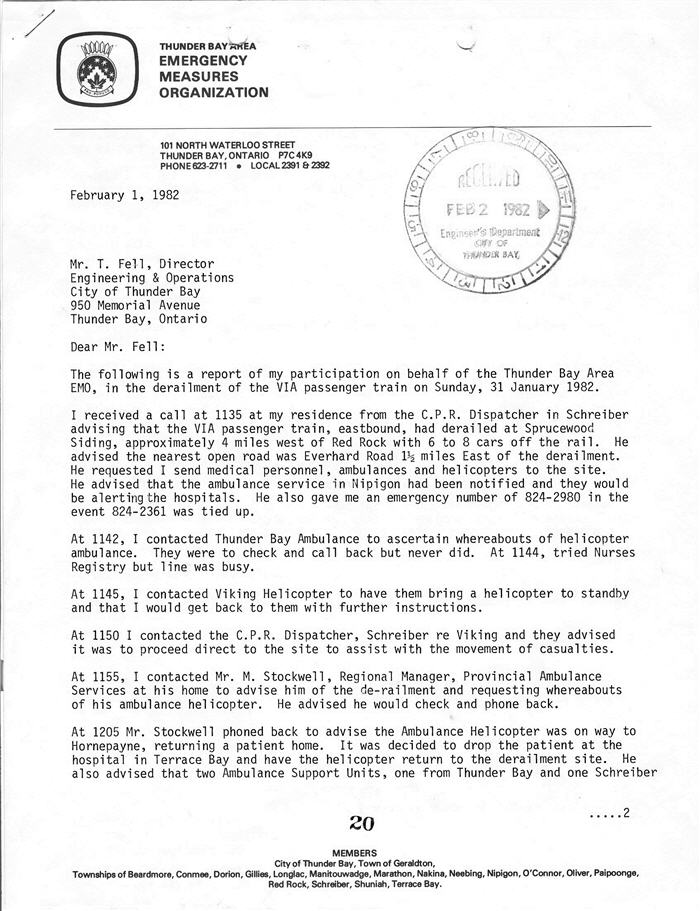
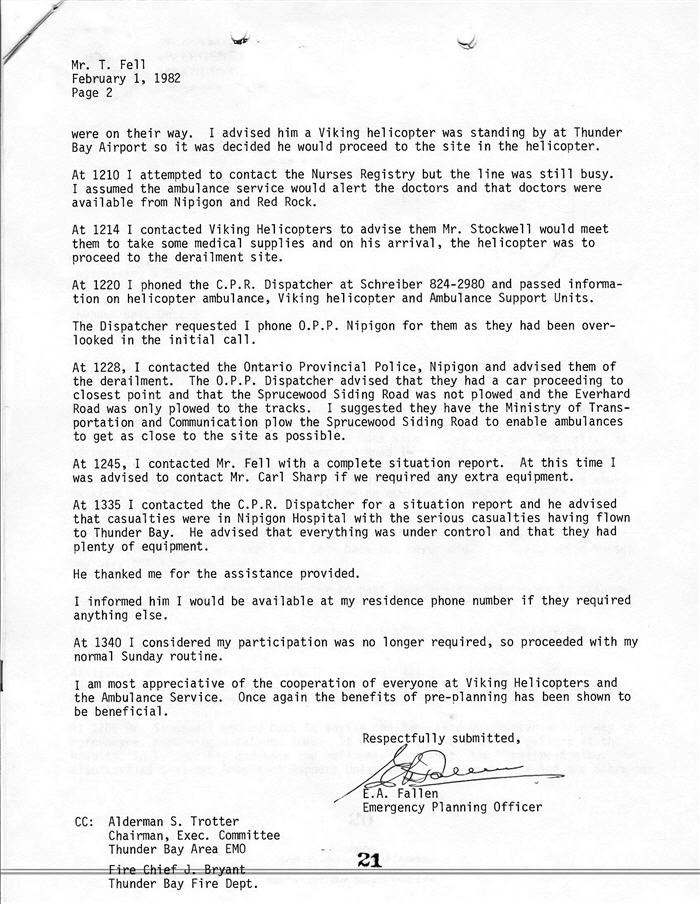
Passenger Train Derailment, 1982Just west of Red Rock, on Sunday, January 31, 1982, an eastbound VIA passenger train became derailed. The detailed report on this event states that six to eight passenger cars were completely off the rails. Emergency medical personnel were notified in both Thunder Bay and Nipigon. However, the Emergency Officer had trouble contacting Thunder Bay Ambulance, to locate the helicopter ambulance, and the Nurse's Registry. In addition to these communication problems, the natural environment presented a challenge as well. The road nearest to the crash site had not been plowed since the last snowfall. The Emergency Planning Officer suggested that the Ministry of Transportation and Communication should plow the road as soon as possible to enable ambulance access. Despite the challenges, the response was successful. Helicopters, ambulances, and emergency personnel were on the scene to assist those who needed help. Serious casualties were flown to Thunder Bay while some less seriously injured were treated in Nipigon. As was reported in following days, out of 89 passengers and 25 crew members, 31 people were admitted to hospital, and only 5 for overnight stays.
This report was submitted shortly after the Emergency Measures Organization was involved in responding to a passenger train derailment near Red Rock.
Text: "Dear Mr. Fell: The following is a report of my participation on behalf of the Thunder Bay Area EMO, in the derailment of the VIA passenger train on Sunday, 31 January 1982. I received a call at 1135 at my residence from the C.P.R. dispatcher in Schreiber advising that the VIA passenger train, eastbound, had derailed at Sprucewood Siding, approximately 4 miles west of Red Rock with 6 to 8 cars off the rail. He advised the nearest open road was Everhard Road 1 1/2 miles east of the derailment. He requested I send medical personnel, ambulances and helicopters to the site. He advised that the ambulance service in Nipigon had been notified and they would be alerting the hospitals. He also gave me an emergency number of 824-2890 in the event 824-2316 was tied up.
Text:
He thanked me for the assistance provided. I informed him I would be available at my residence phone number if they required anything else.
I am most appreciative of the cooperation of everyone at Viking Helicopters and the Ambulance Service. Once again the benefits of pre-planning has been shown to be beneficial." TBA 5198-01
Conclusion Although these emergency responses were ultimately successful, they resulted in many additional recommendations made to the E.M.O. The closure of City Hall during the snowstorm was initially controversial, but E.M.O. defended the action as helping to clear the streets of rush-hour traffic tie-ups that may have occurred later in the day. The tie-up of telephone lines led to the recommendation of new phone equipment and procedures. During a serious disaster, telecommunications would be vital.
|
| Disaster Simulations |
In a real emergency situation, first responders have absolutely no time to waste. To prepare and train for potential disasters, the Emergency Measures Organization held disaster simulations that replicated possible accidents or events. Through the simulations, emergency responders gained insight to predict the behaviours of those involved (on their own staff and working with other local safety organizations), and the effectiveness of systems and technologies. Adjustments could then be made to procedures, in order to save more lives in the event of future disasters.
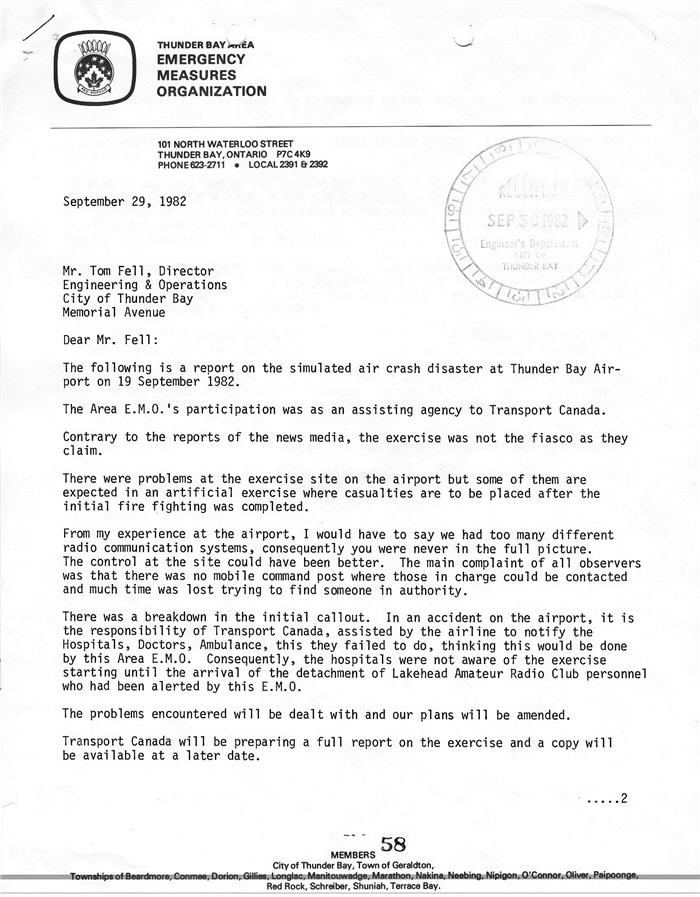
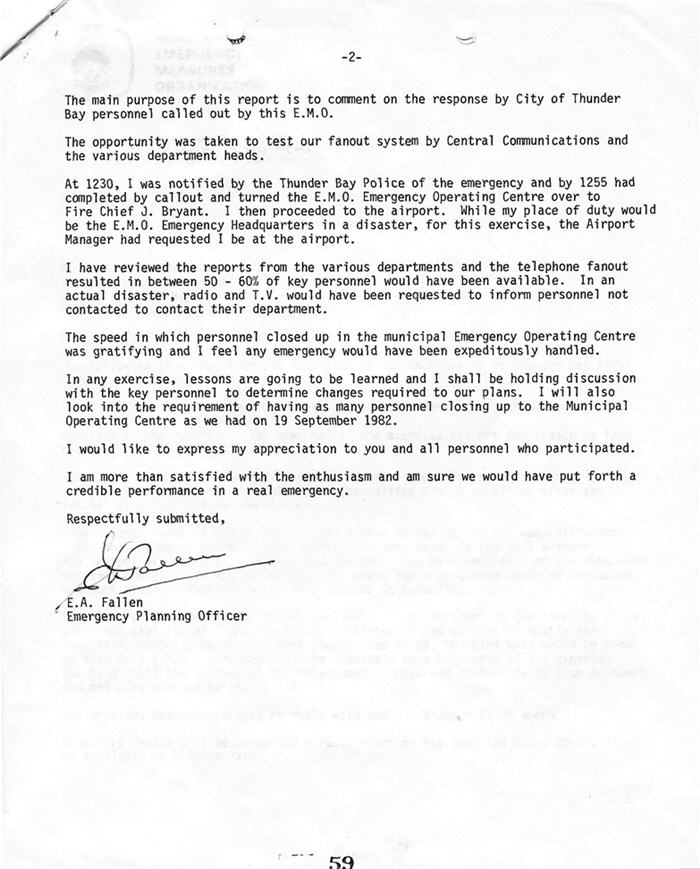
Who Ran These Simulations?The Emergency Measures Organization Planning Group, which approved and outlined disaster simulations, was comprised of City departments such as Police, Fire, Parks and Recreation, and members of neighbouring communities, such Oliver Township. During each particular simulation, roles would be assigned to City departments and specific personnel (such as the City Engineer, for example). The co-ordinators of the simulation would wrap the event up by submitting a timeline and report that would be used to study and learn from what went on. Minutes recorded at planning group meetings suggest that these reports provided a successful, useful exchange of information which overall contributed to the efficient handling of real-life emergency situations. Simulated Airplane Crash, 1982The simulated airplane crash at Thunder Bay Airport on September 19, 1982 proved to be beneficial to both the Emergency Measures Organization and its partner in the simulation, Transport Canada, as both parties discovered potential problems in their response procedures. Emergency personnel discovered problems with communicating between different types of radio systems -- getting in touch with persons in authority turned out to be a complicated and time-consuming task. There were also misunderstandings over which agencies would be responsible for which tasks. Despite these shortcomings, though, the exercise was deemed a success and a credible performance of emergency response forces.
This letter summarizes the events of a 1982 training exercise that simulated an airplane crash at Thunder Bay International Airport. While some problems with response systems were encountered, this gave the Emergency Measures personnel the opportunity to improve their plans in the event of a real emergency.
"September 29, 1982 Mr. Tom Fell, Director Engineering & Operations City of Thunder Bay Memorial Avenue Dear Mr. Fell: The following is a report on the simulated air crash disaster at Thunder Bay Airport on 19 September 1982. The Area E.M.O.’s participation was an assisting agency to Transport Canada. Contrary to the reports of the news media, the exercise was not the fiasco as they claim. There were problems at the exercise site on the airport but some of them are expected in an artificial exercise where casualties are to be placed after the initial fire fighting was completed. From my experience at the airport, I would have to say we had too many different radio communication systems, consequently you were never in the full picture. The control at the site could have been better. The main complaint of all observers was that there was no mobile command post where those in charge could be contacted and much time was lost trying to find someone in authority. There was a breakdown in the initial callout. In an accident on the airport, it is the responsibility of Transport Canada, assisted by the airline to notify the Hospitals, Doctors, Ambulance, this they failed to do, thinking this would be done by this Area E.M.O. Consequently, the hospitals were not aware of the exercise starting until the arrival of the detachment of Lakehead Amateur Radio Club personnel who had been alerted by this E.M.O. The problems encountered will be dealt with and our plans will be amended. Transport Canada will be preparing a full report on the exercise and a copy will be available at a later date."
"The main purpose of this report is to comment on the response by City of Thunder Bay personnel called out by this E.M.O. The opportunity was taken to test our fanout system by Central Communications and the various department heads. At 1230, I was notified by the Thunder Bay Police of the emergency and by 1255 had completed by callout and turned the E.M.O. Emergency Operating Centre over to Fire Chief J. Bryant. I then proceeded to the airport. While my place of duty would be the E.M.O. Emergency Headquarters in a disaster, for this exercise, the Airport Manager had requested I be at the airport. I have reviewed the reports from the various departments and the telephone fan-out resulted in between 50 – 60% of key personnel would have been available. In an actual disaster, radio and T.V. would have been requested to inform personnel not contacted to contact their department. The speed in which personnel closed up in the municipal Emergency Operating Centre was gratifying and I feel any emergency would have been expeditiously handled. In any exercise, lessons are going to be learned and I shall be holding discussion with the key personnel to determine changes required to our plans. I will also look into the requirement of having as many personnel closing up to the Municipal Operating Centre as we had on 19 September 1982. I would like to express my appreciation to you and all personnel who participated. I am more than satisfied with the enthusiasm and am sure we would have put forth a credible performance in a real emergency.
Respectfully submitted, (signed) E.A. Fallen Emergency Planning Officer TBA 5198-02 |
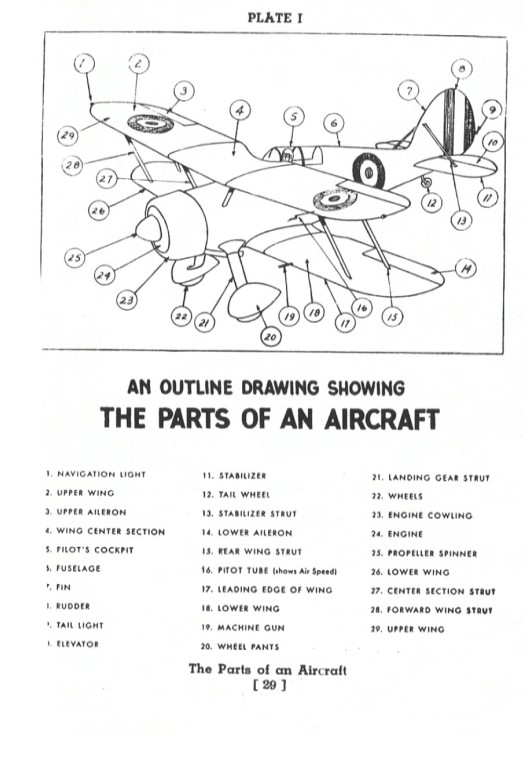
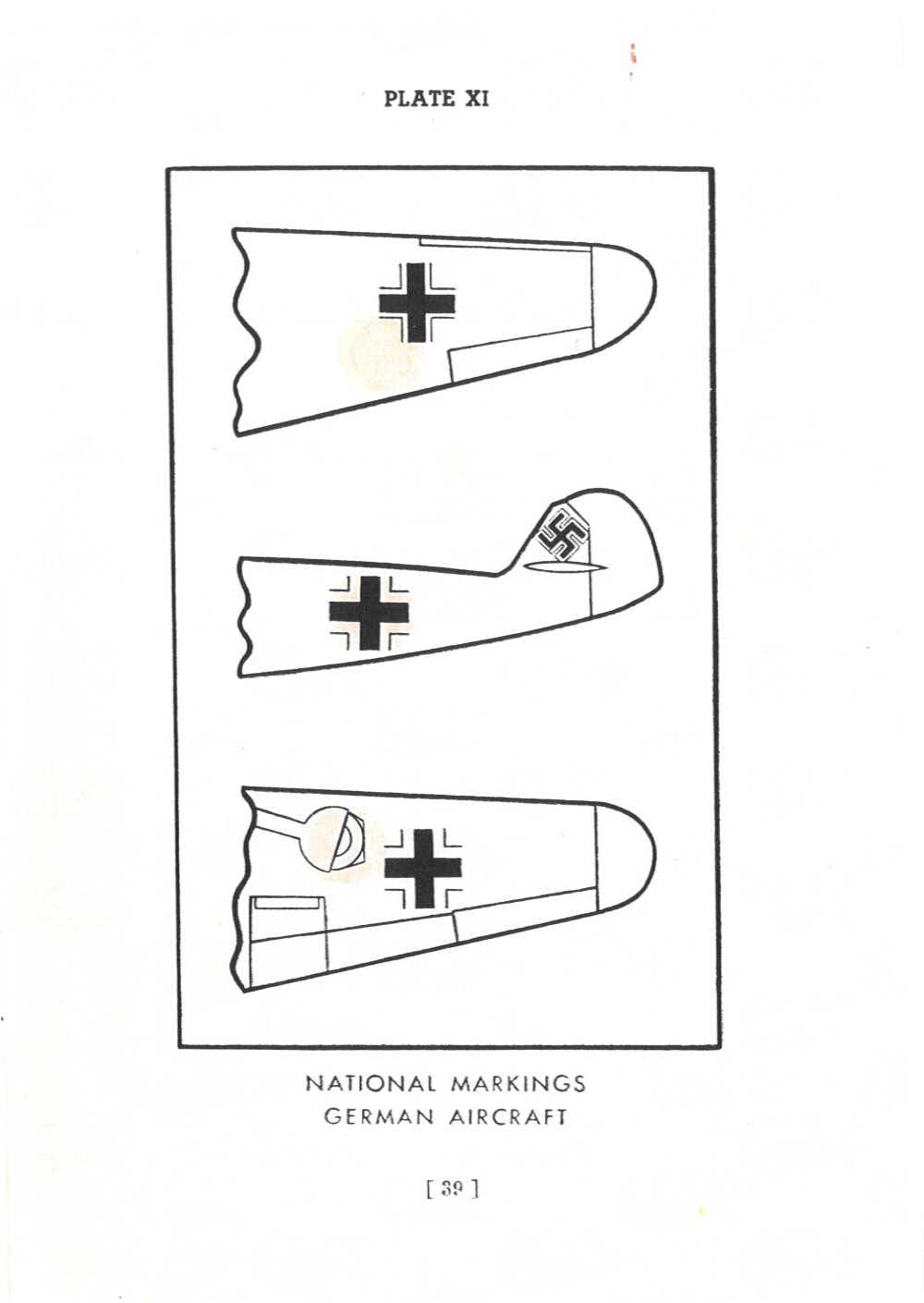
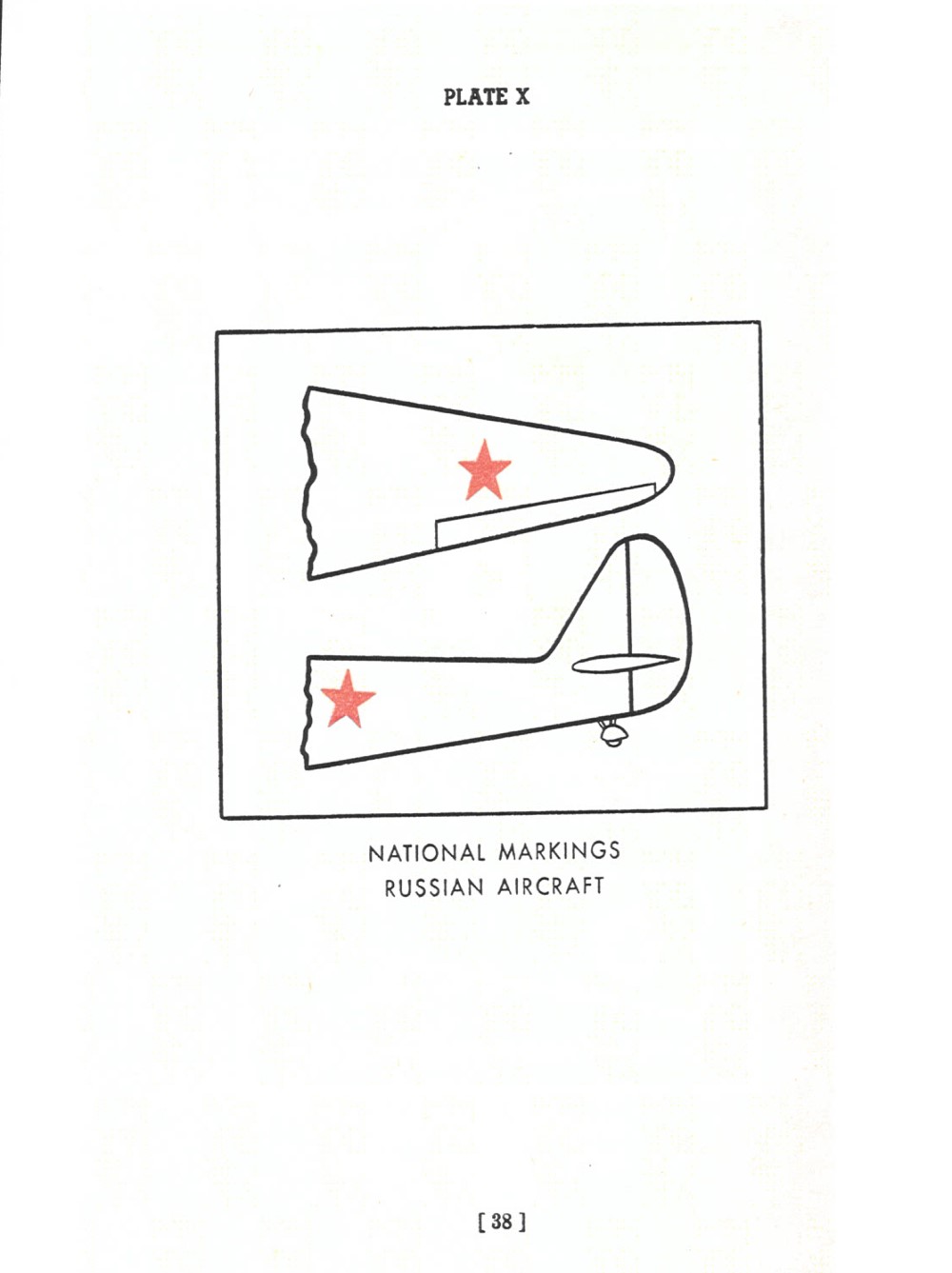
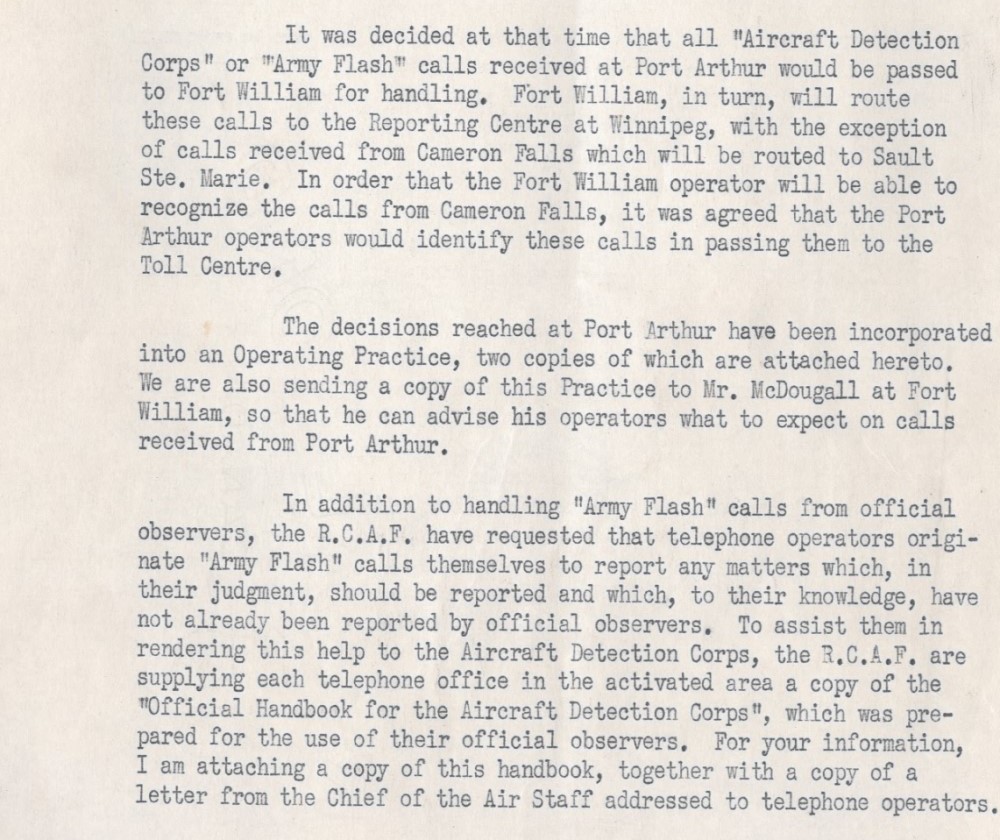
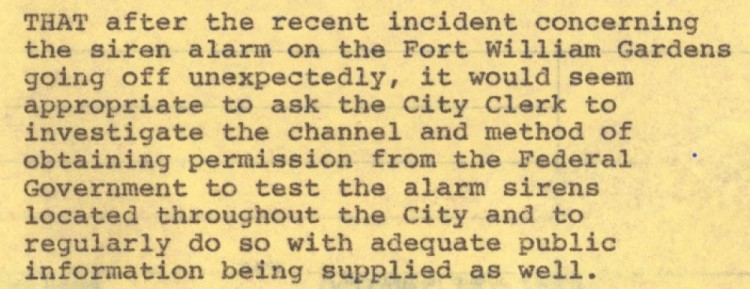 Figure 6. THAT after the recent incident concerning the siren alarm on the Fort William Gardens going off unexpectedly, it would seem appropriate to ask the City Clerk to investigate the channel and method of obtaining permission from the Federal Government to test the alarm sirens located throughout the City and to regularly do so with adequate public information being supplied as well.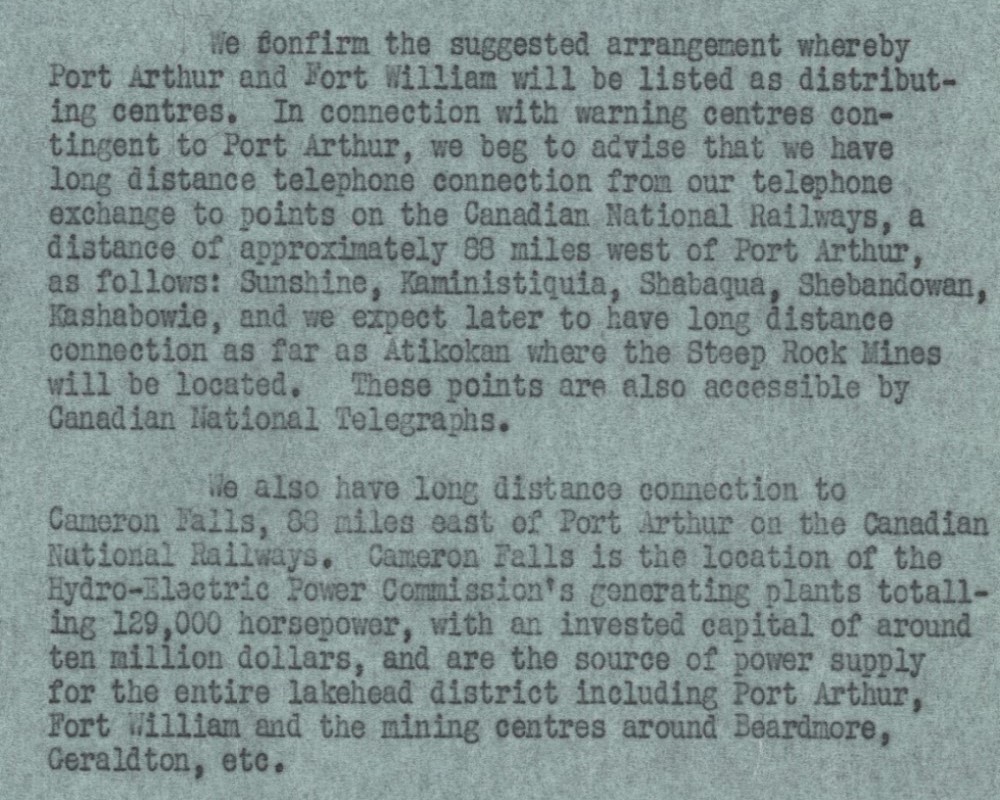
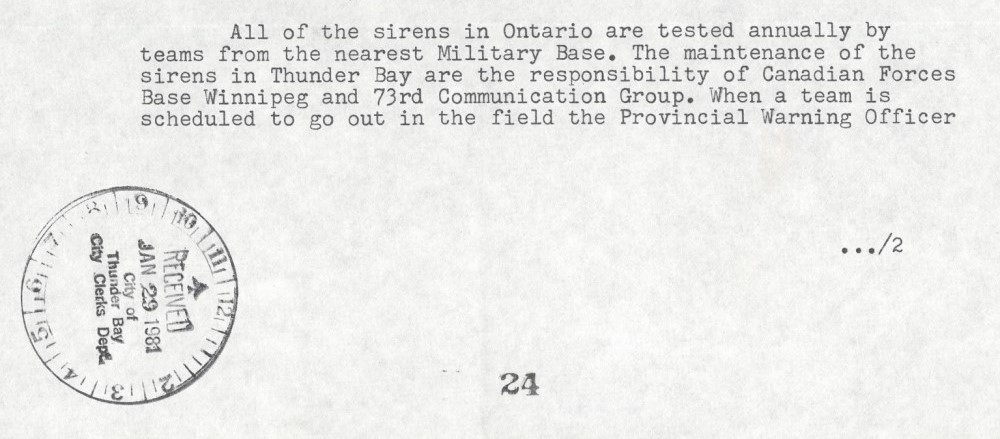
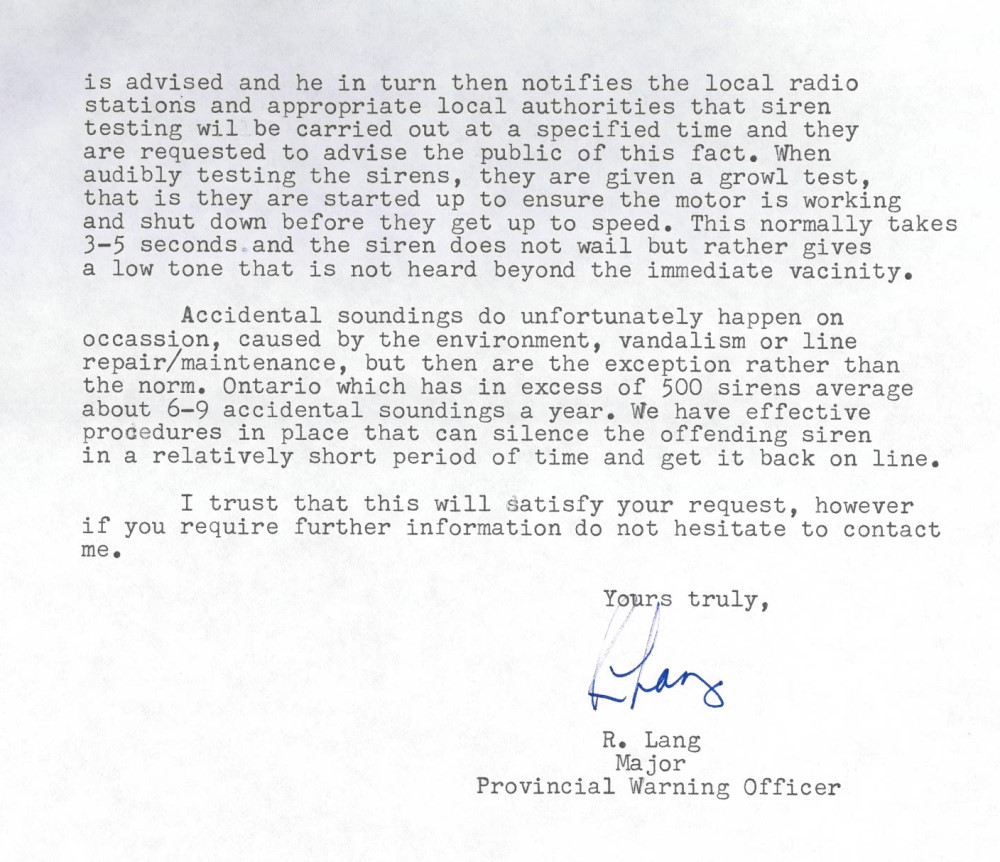 Figure 9. is advised and he in turn then notifies the local radio stations and appropriate local authorities that siren testing will be carried out at a specified time and they are requested to advise the public of this fact. When audibly testing the sirens, they are given a growl test, that is they are started up to ensure the motor is working and shut down before they get up to speed. This is normally takes 3-5 seconds and the siren does not wail but rather gives a low tone that is not heard beyond the immediate vicinity.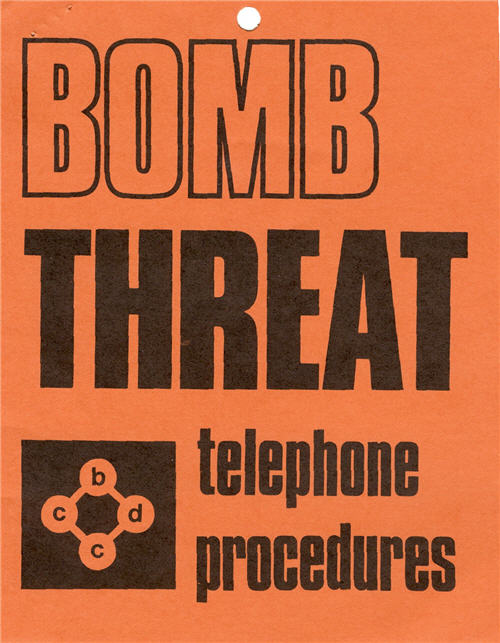
About this exhibit:
This exhibit was produced using information and graphic material available to the public from the City of Thunder Bay Archives, with support from the City of Thunder Bay Co-Op Student Placement Program
Archival series referred to in the exhibit include:
- Series 29: Port Arthur City Clerk's Files
- Series 34: Port Arthur City Clerk's Agreement Files
- Series 88: Port Arthur Public Utilities Commission Files
- Series 112: Thunder Bay City Coordinator Files
- Series 117: Thunder Bay City Clerk's Files
- Series 120: Thunder Bay Mayor's Office Files
- Series 156: Thunder Bay Central Files (Administration, Parks, Community Recreation)
- Series 316: Thunder Bay Fire Service Administrative Files
For more information on this subject, or any other subject of interest, please visit or contact the City of Thunder Bay Archives.
Contact Us
 Connect